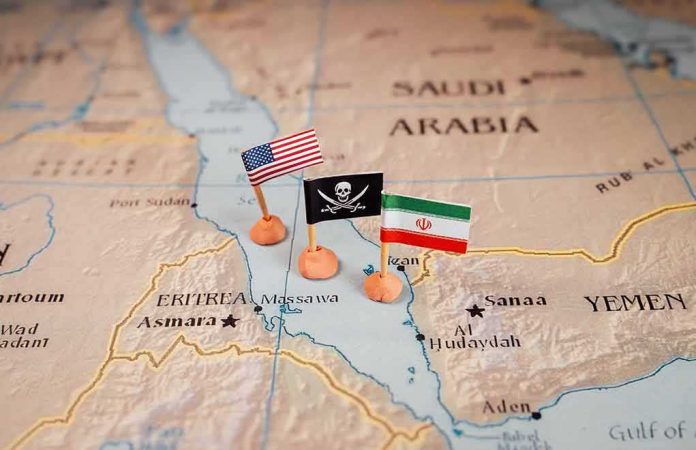
The center of gravity in the Middle East shifts not when one side fires a missile, but when Washington changes how it balances coercion and reassurance—because that balance determines whether Riyadh feels protected enough to hedge or compelled enough to harden. President Trump’s second-term reset toward renewed pressure on Iran, coupled with an overt effort to bind Saudi Arabia more tightly to a U.S.-led order, sharpened both edges of that sword: it strengthened deterrent aims while heightening the risk that a local fight spills into a systemwide confrontation that threatens Saudi security and U.S. strategy alike.
The Short Version
- Trump’s approach married maximum pressure on Iran with explicit political and security reinforcement of Saudi Arabia and Israel—an alignment designed to isolate Tehran but prone to escalation risk.
- Analysts warn that renewed pressure can jeopardize fragile Saudi–Iran de-escalation and invite reprisals against Saudi oil and infrastructure if deterrence falters.
- Riyadh’s near-term priorities—economic transformation, energy market stability, and limited exposure to war—make it wary of prolonged confrontation even as it relies on U.S. security guarantees.
- Trump intermittently paired coercion with diplomacy, pausing strikes and floating deals tied to reopening the Strait of Hormuz and expanding normalization, a move that can stabilize or inflame depending on timing and sequencing.
What Washington tried to build: leverage first, architecture second
The logic of the Trump blueprint is clear: erode Tehran’s capacity and freedom of action; rally a countervailing alignment anchored by Saudi Arabia and Israel; then turn leverage into negotiations that codify a new equilibrium. From the outset, the administration’s strategic documents and allied analyses converged on isolating Iran while bolstering core partners, with the National Security Strategy casting Tehran as the principal regional spoiler. In public, Trump used high-visibility appearances—including a Riyadh address—to position Saudi Arabia as a model for a “reimagined Middle East,” pairing that praise with a demand that Iran accept a stricter nuclear arrangement under threat of serious economic and military consequences. This is not a mystery playbook; it is a classic coercive-diplomacy sequence, openly tied to expanding the Abraham Accords as the political armature of a durable order.
Coercion without an endgame courts blowback; an endgame without leverage invites defiance. The administration tried to thread that needle by pivoting between military pressure, sanctions, and episodic diplomatic pauses. At key moments, Trump held back on additional strikes at the urging of Gulf partners—Qatar, Saudi Arabia, and the United Arab Emirates—signaling awareness that allies’ tolerance for risk is a gating factor on U.S. escalation options. The ambition was to convert pressure into negotiations that would reopen the Strait of Hormuz and tighten nuclear constraints while broadening Arab–Israeli normalization to include Riyadh, thereby locking in strategic gains.
How this strategy raises the ceiling—and the floor—of risk
Pressure campaigns work until they don’t; their success depends on target compliance staying cheaper than retaliation. Expert assessments caution that renewed maximum pressure on Iran could jeopardize the fragile Saudi–Iran détente and trigger reprisals against precisely the assets Riyadh must protect to fund its transformation—oil production, processing, and export nodes. The Kingdom’s modernization agenda and fiscal planning assume predictable energy flows; anything that lifts perceived insurance risk on Saudi barrels raises costs and complicates Vision-style timelines. That is why, even as Riyadh values U.S. security guarantees, it consistently signals a preference for de-escalation when a conflict appears poised to widen, messaging Washington that prolongation carries major risks for the Kingdom’s economy and domestic reforms.
This is the structural tension at the heart of the U.S.–Saudi security bargain. Washington’s leverage over Iran is maximized by demonstrating resolve and capacity to impose costs; Riyadh’s exposure is minimized when the temperature stays below the threshold at which Iranian proxies, missiles, or drones threaten its energy core. The same strike that telegraphs deterrence to Tehran can read in Riyadh as a prelude to retaliation on Abqaiq, Ras Tanura, or the East–West pipeline—targets whose vulnerability is not theoretical. Analysts who have mapped this dynamic for years see the cycle repeat: pressure restores some deterrence; deterrence decays; a spectacular attack resets the calculus; everyone reassesses the ratio of pressure to diplomacy.
Saudi agency: reliance on the U.S., but an independent risk ledger
Saudi Arabia is not a passive object of U.S. policy; it is a strategic actor with its own hierarchy of needs. The Kingdom seeks a security umbrella robust enough to deter Iran, a political pathway that preserves maneuvering room with non-Western partners, and an economic environment that underwrites diversification beyond hydrocarbons. This produces caution about being drafted into an extended war, even one aimed at a mutual adversary. Think tank analyses and policy briefs converge on this point: the Iran conflict simultaneously validates the utility of U.S. protection and highlights the costs of unpredictable, unilateral escalation for a country that must keep investment risk premiums low and projects on schedule.
Normalization with Israel sits inside the same calculus. For Washington, bringing Saudi Arabia formally into the Abraham Accords would anchor the regional architecture. For Riyadh, normalization is leverage—a chip to be traded for concrete U.S. security arrangements, advanced defense packages, and progress on sensitive political files. The Kingdom’s reluctance to rush into a deal during periods of high kinetic risk is consistent with that bargaining logic: the higher the probability of becoming a target, the less incentive there is to narrow diplomatic options. That is why linking near-term de-escalation, maritime stability, and a bounded nuclear negotiation to any push for expanded normalization makes strategic sense; sequence matters because Saudi exposure is time-sensitive.
Where the genuine debate lies: sequencing, thresholds, and credibility
The disagreement among serious analysts is not over aims—prevent an Iranian nuclear weapon; keep trade routes open; protect partners; avoid a great-power vacuum—but over the optimal sequence and threshold settings to achieve them. One camp emphasizes sustained pressure to compel Iranian concessions, arguing that partial or premature relief courts failure. The other stresses that pressure without synchronized diplomacy tends to erode coalitions, spook markets, and invite asymmetric retaliation that undermines the very partners the United States is trying to reassure. Both camps accept that Saudi behavior is a sensitive indicator: when Riyadh publicly and privately urges de-escalation—and when Washington heeds that counsel by pausing strikes—it reveals an implicit recognition that allied risk tolerance sets practical limits on coercion.
The credibility question cuts both ways. If the United States blinks too often, deterrence erodes; if it disregards allied red lines, coalitions fray. The path that consistently performs best in this region pairs calibrated coercion with a clearly articulated off-ramp, time-boxed and verifiable, that regional partners can support because it reduces exposure quickly while preserving leverage if talks stall. Trump’s intermittent combination—pressure, then pause; sanctions, then deal talk tied to Hormuz and normalization—fit that mold at times, but the proof of concept depends on disciplined sequencing and avoiding action–reaction spirals that outpace diplomacy.
Implications for U.S. strategy and Saudi security
Three consequences follow. First, any renewed maximum-pressure posture must be designed with Saudi risk in mind: shore up air and missile defenses; harden critical energy nodes; and pre-negotiate rules of the road for maritime security so that penalties on Iran do not automatically translate into insurance hikes on Saudi exports. Second, if normalization is the political keystone, its timing should track de-escalation milestones and verifiable nuclear steps, not precede them; Riyadh will not trade away leverage at the moment of greatest vulnerability. Third, U.S. credibility now rests less on rhetorical resolve than on the ability to hold coercion and diplomacy in tension long enough to reach a durable settlement window. That means listening when partners ask for a pause—and being prepared to reapply pressure if talks stall—without letting either mode become an end in itself.
Sources:
feedpress.me, ap.org, newlinesinstitute.org, css.ethz.ch, apnews.com, govfacts.org