No one in uniform will ever ask a grieving family to pay for military funeral honors — not a deposit, not a “refundable insurance policy,” not a rush fee. When money is demanded, it’s not a misunderstanding or a gray area; it’s a scam.
The Short Version
- Military funeral honors for eligible veterans are always free; any request for payment is fraudulent.
- Scammers impersonate honor guard or government officials, demand immediate payment, and threaten to cancel honors if you don’t pay.
- The legitimate process runs through your funeral director or a local funeral honors coordinator — not a cold caller.
- If contacted for payment, hang up and report it; never share financial information with unsolicited callers.
What’s true, and why it matters
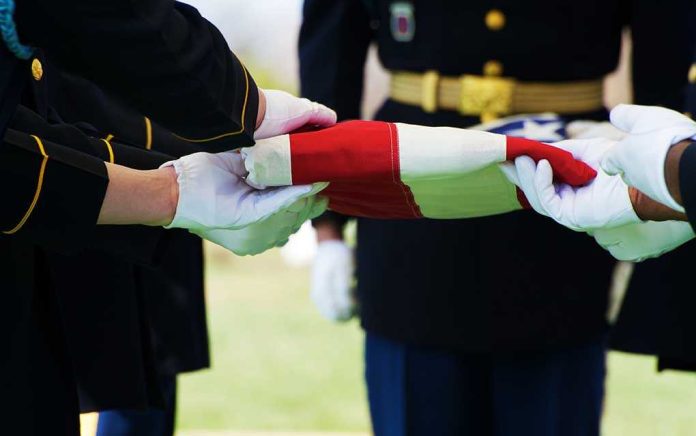
The United States guarantees military funeral honors at no cost to eligible service members and veterans — typically a two-person uniformed detail, the playing of Taps, and, when appropriate, a flag-folding and presentation. That entitlement is not pay-to-play; there is no lawful scenario in which a family must fund the honor guard. The Department of Defense’s own family-facing guidance states this plainly: ceremonies are provided at no cost, and requests for payment are a hallmark of fraud. The Army’s casualty assistance officials say the same in their public warnings: if someone phones you demanding money to “secure” an honor guard, you are speaking to an impostor, not to the military.
This matters because the target is not just a budget line; it is a moment of public respect for a life in uniform, delivered when families are most vulnerable. Scam architecture thrives on grief, time pressure, and the confusion that can surround government benefits. The point of clarity that defeats much of the con is simple and categorical: honors are free. Full stop.
How the scam works: the script and the tells
Impostors present themselves as honor guard coordinators, military personnel, or government staff. They claim a new policy, an “insurance bond,” or a processing fee is required to field the detail at the graveside. Then comes the pressure: pay immediately by card, wire, Zelle, or gift cards or the honors will be canceled. The speed and the irreversible payment rails are deliberate — they move the victim from doubt to transaction before a trusted advisor can intervene. These details recur across official advisories and Army-linked reporting: the demand for immediate payment, the pitch for a “refundable insurance policy,” and the explicit threat to withhold honors if money isn’t sent.
Two reliable tests short-circuit the script. First, the military does not cold-call families to collect fees for honors; no one will ask for your card number to schedule a detail. Second, the legitimate point of contact is your funeral director or a recognized funeral honors coordinator — the same channels that handle paperwork, timing, and coordination for taps and the flag presentation. If a stranger on the phone inserts themselves as a pay gate, you’re not in the official process.
What’s legitimate: how honors are actually arranged
The process is straightforward by design. Families request funeral honors through the funeral home or the local funeral honors coordinator listed in the Military Funeral Honors Directory. Those officials handle eligibility confirmation and scheduling with the responsible military service; the family does not pay the honor guard, and the honor guard does not bill the family. This is how the program has been operated and explained across DOD’s family resources and the National Cemetery Administration’s guidance. For interments in VA national cemeteries, the entitlement ecosystem is broader — gravesite, opening and closing of the grave, perpetual care, government headstone or marker, burial flag, and a Presidential Memorial Certificate — again, at no cost to the family.
This division of roles is intentional. It concentrates logistics with professionals who do this daily, reduces the surface area for fraud, and shields families from ad hoc demands. When a caller tries to bypass that channel, treat it as a red flag, not as a helpful shortcut.
Why this fraud persists: grief, urgency, and impersonation
Funeral-related cons are a durable subclass of benefits-impersonation scams. The Federal Trade Commission documents tactics that repeat across cases: pretending to be the funeral home, invoking an unexpected fee, and threatening to cancel services unless payment is sent immediately. The Department of Veterans Affairs has likewise warned that scammers target surviving family members soon after a veteran’s death, exploiting the moment when benefits conversations begin and attention is scattered. In that context, the military funeral-honors con is not an outlier but a tailored variant that borrows the trappings of rank, ceremony, and solemnity to overcome skepticism.
There is a second ecosystem of fraud that never touches families but still causes headline confusion: bogus internal reimbursements for funeral honors duties that were never performed. Federal cases have detailed schemes in which reservists or pay technicians submitted false claims, siphoning funds from the government while families received nothing or were never involved. Those prosecutions underscore that the military honors program is a financial target — but they do not contradict the family-facing truth: honors are free to next of kin.
Army Warns of 'Heartless' Funeral Scam Targeting Deceased Veterans' Families https://t.co/ruvKlvgD9M
— Deen Coldwell III (@deen_iii) October 2, 2026
How to protect your family without becoming cynical
Build a short, practical checklist into your planning. First, route all honors scheduling through your funeral director or the recognized funeral honors coordinator; do not transact with unsolicited callers. Second, memorize the rule: no payment for honors, ever. Third, if someone claims a last-minute problem requiring immediate funds, hang up, call your funeral director, and verify through official channels. Finally, report attempts to extract money — even if you didn’t pay — because complaint volume helps enforcers map patterns and shut down operations; the FTC’s reporting portal is the right first stop.
If you want help understanding benefits beyond honors — headstones, burial flags, national cemetery eligibility — rely on official resources. Military OneSource and the VA publish current, plain-language guides and direct contacts, designed to answer questions without selling anything. When in doubt, ask the funeral home to place the call while you listen. Real officials are patient; fraudsters are not.
Bottom line
Honor guards exist to honor service, not to bill survivors. The clarity of that promise is your best defense. Keep your coordination within the official lane, treat any demand for money as disqualifying, and give grief the quiet it deserves by refusing to negotiate with a caller who thrives on urgency and fear.
Sources:
military.com, stripes.com, militaryonesource.mil, va.gov, usa.gov, news.va.gov, cem.va.gov