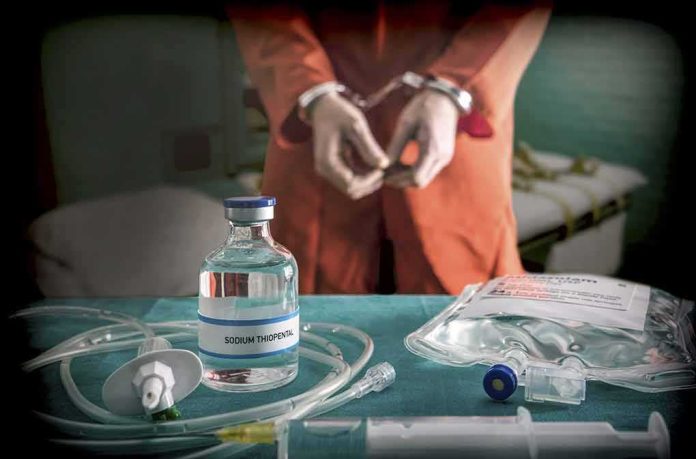
When an execution fails in public view, the controversy is not just about a single night; it exposes whether a state’s death machinery can do what it promises—produce a predictable, legally defensible death through medicalized procedures carried out behind curtains.
The Short Version
- Tennessee officials insist the execution team followed the state’s lethal-injection protocol, which authorizes a backup dose if death does not occur after the first.
- Witnesses and Pike’s attorneys reported sustained breathing, snoring, and complaints of arm pain after two pentobarbital doses—classic signs of IV-access failure.
- Governor Bill Lee paused executions and ordered an independent review; Corrections Commissioner Frank Strada resigned days later.
- The unresolved fault line is technical, not rhetorical: drug potency versus line placement and process control in a closed environment with limited real-time verification.
What Tennessee Says Happened—and Why It Matters
Tennessee’s Department of Correction (TDOC) stated the execution team followed each step of the attorney general–approved protocol, including the provision for a secondary set of syringes if the inmate is not deceased after the first administration. The department has characterized pentobarbital—the state’s one-drug method—as consistently effective and treated the incident as an isolated operational failure rather than a design flaw. Governor Bill Lee amplified that account, saying officials understood the team to have acted as the protocol prescribes, even as he ordered a comprehensive third-party review and paused executions statewide while evidence is gathered and assessed.
That official posture matters legally and operationally. If the written protocol was executed faithfully and the drug was sound, the state will argue the method retains constitutional legitimacy and that what went wrong resides in a fixable execution-room variable. The practical stakes are obvious: Tennessee cannot resume executions without a defensible account of mechanism and cause, and without answering the question a reviewing court—and the public—will ask next: will the same thing happen again?
What Witnesses Reported Inside the Chamber
Media witnesses and Pike’s attorneys described a different picture: audible snoring and regular breathing patterns long after two pentobarbital doses were administered; complaints of arm pain (“feels like it’s about to burst”) consistent with infiltration or a blown vein; and periods when curtains were closed and microphones cut while Pike could still be heard breathing. After more than an hour from the start, witnesses said they were escorted out while she remained alive, and an ambulance departed the prison shortly thereafter.
From a pharmacology and anesthesia standpoint, those observations align with an IV-delivery problem more than with drug inefficacy. Intravenous pentobarbital, properly delivered into the venous system at execution doses, reliably induces deep coma and respiratory arrest; persistent rhythmic snoring suggests continuing spontaneous respiration, which would be unexpected if the bolus reached central circulation as intended. In lethal-injection litigation nationally, the weakest link has repeatedly been vascular access: locating, cannulating, and maintaining patent lines under pressure, on a fixed timeline, in an adversarial setting, by teams working outside routine hospital guardrails.
The Mechanism Question: Drug Potency Versus Delivery
When an execution with pentobarbital fails to produce the expected physiologic sequence, two hypotheses dominate. First, the drug might be subpotent or degraded (a procurement and storage issue). Second, venous access failed partially or completely, so the drug pooled in tissue, leaked, or never reached central circulation at the necessary concentration (a line-placement and monitoring problem). Tennessee’s written protocol reportedly authorizes a second set of syringes if the inmate remains alive after the first, but commentary and coverage have noted a conspicuous silence on what to do if the inmate is still alive after the second—precisely the situation witnesses described here.
The reason this distinction matters is evidentiary. Potency can be tested with lot numbers, compounding records, and temperature logs; line integrity can be reconstructed through insertion notes, catheter type, site photos, and infusion documentation, often corroborated by anesthesiology review. Without those records, a state’s bare assertion of protocol compliance cannot resolve whether the failure was a known failure mode the protocol did not adequately manage—or a rare, idiosyncratic malfunction.
Pattern, Not One-Off: Two Failed Attempts in the Same Year
Even if one treats Pike’s case as fundamentally about line patency, Tennessee faces a pattern problem. Earlier in the year, officials halted a separate execution after spending about an hour attempting to establish IV access; they abandoned the effort when they could not secure the backup line and a central line attempt failed. Two failed attempts in close succession—both turning on vascular access—undercut the claim that this is a once-in-a-generation aberration and instead suggest a system that asks too much of a fragile step under conditions that resist quality control.
Nationally, courts and scholars have documented the same fault line: methods that read cleanly on paper, then falter at the bedside because the decisive task—safe, patent IV access—is not reliably executable in the execution chamber as currently constituted. That is why Alabama, Ohio, and others have faced repeated, hours-long attempts to find veins, sometimes abandoning the execution mid-procedure; the jurisprudence recognizes the phenomenon even as it sets demanding standards for method-of-execution challenges.
Where the Dispute Truly Lies
There is little dispute about the public-facing sequence: two doses administered; sustained breathing and snoring reported; curtains closed for parts of the procedure; transfer by ambulance. The dispute is causal and documentary. TDOC says the team followed the book; witnesses and defense counsel say the body told a different story. The governor’s suspension and third-party review are a tacit acknowledgment of unresolved facts, not a repudiation of the protocol outright; yet they also signal that “we followed the rules” will not suffice without the underlying checklist, medical logs, and pharmacy records that show why the rules failed to produce the intended physiologic endpoint this time.
The most constructive next steps are technical, not rhetorical: release the operative protocol and appendices; disclose IV placement documentation, including catheter gauge and site diagrams; produce drug lot, compounding, and storage records; and time-synchronize chamber logs with media-witness timelines. Those are the materials that allow an anesthesiology expert to determine whether venous access was lost, whether bolus volumes were complete, and whether backup steps were attempted, abandoned, or precluded by the protocol’s own limits.
This AP story contains a major development: Tennessee Department of Correction Commissioner Frank Strada is resigning following the failed September 30 execution of Christa Pike.
Gov. Bill Lee announced that Strada will leave the department this month while an independent…
— Lucky Mendez (@lucky_mendez3) October 3, 2026
Consequences for Policy, Law, and Administration
Commissioner Frank Strada’s resignation days after the attempt highlights the administrative stakes. Even if an independent review ultimately validates the protocol’s structure, Tennessee must show that its training, staffing, and escalation pathways can reliably manage the known risks of IV failure; repeating the same high-consequence miss twice in a year is the very definition of an enterprise risk that compels change. In litigation, method-of-execution challenges remain difficult—Bucklew and related cases require prisoners to identify feasible, readily implemented alternatives—but the evidentiary record born of a failed attempt often reshapes what courts are willing to scrutinize about protocol secrecy, drug sourcing, and monitoring practices.
There is also a vocabulary question that matters for public legitimacy. Analysts distinguish a “failed” execution (the inmate survives) from a “botched” one (something goes wrong but the inmate dies); Pike’s case is unusual precisely because it combined a witnessed physiological failure with survival and hospital transfer. That rarity will continue to color debate around whether a single-drug barbiturate method, administered via peripheral IVs by execution teams rather than clinical anesthesia staff, can ever deliver the “clean” death its designers promise, particularly in older inmates, those with compromised veins, or settings where central-line placement fails or is unavailable.
The Bottom Line
Tennessee’s account rests on protocol adherence; the counteraccount rests on physiology observed in real time. The gap between them is not philosophical—it is evidentiary and mechanical. Until the state answers the line-versus-drug question with documents and data, pauses and resignations will read not just as prudence, but as acknowledgment that the system’s most failure-prone step remains exactly where critics have long said it lives: in the venous access and drug delivery the public never sees.
Sources:
tennessean.com, bbc.com, wkrn.com, www-cdn.abcnews.com, clarin.com, abcnews.com, cnn.com, pbs.org, wsmv.com, edition.cnn.com, law.cornell.edu, npr.org, lawcommentary.com