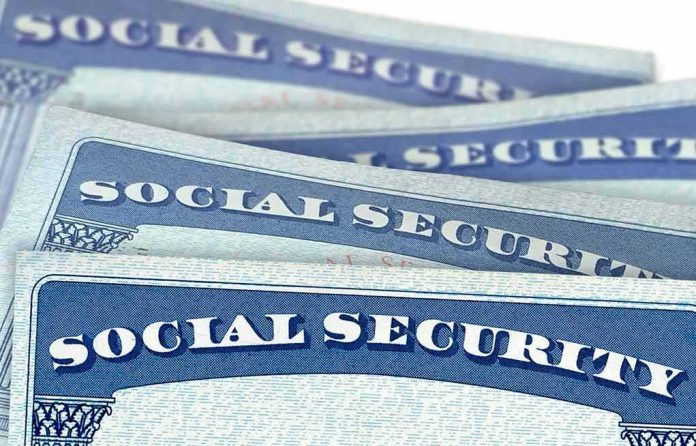
Identity theft tied to Social Security numbers is not an edge case in federal enforcement; it’s a durable method criminals use to convert a stolen identity into credit, goods, and even public benefits—and prosecutors increasingly stitch those frauds together into coherent cases that are straightforward to charge and difficult to defend.
At a Glance
- Federal complaints charged five defendants with using Americans’ Social Security numbers to obtain retail credit, run up debts, and attempt to shed roughly $140,000 through bankruptcy.
- The charging pattern—misuse of SSNs, access-device fraud, and bankruptcy abuse—tracks long-standing federal practice in immigration-adjacent identity theft cases.
- Agencies treat SSN misuse as a gateway to multiple frauds: credit, employment, tax, healthcare, and benefits.
- Base rates matter: federal watchdogs have documented high volumes of SSN misuse allegations for decades, and DOJ regularly secures convictions and restitution in similar schemes.
What Prosecutors Say Happened
Federal authorities charged five individuals after an enforcement sweep targeting a specific identity-theft pattern: the alleged use of other Americans’ Social Security numbers to obtain credit—often from retailers—followed by rapid spending and an effort to jettison the resulting balances via bankruptcy. A contemporaneous account quoting First Assistant U.S. Attorney Bill Essayli describes four arrests out of five charged, and summarizes the government’s theory succinctly: stolen SSNs, fraudulent credit, and more than $140,000 in debt that the defendants then sought to erase in bankruptcy proceedings. While each complaint will rise or fall on its facts, the structure of the case fits a well-worn federal playbook that pairs identity theft counts with fraud involving “access devices” (credit instruments) and false statements connected to financial applications.
Although the reported total dollar figure is modest by the standards of sprawling benefits or tax schemes, prosecutors tend to treat credit-based SSN misuse as a high-impact crime because it leaves real victims with corrupted credit files, collection harassment, and the administrative burden of unwinding fraudulent accounts. Retail lenders and payment platforms, for their part, are increasingly cooperative data sources—providing application logs, device fingerprints, and transaction histories—which makes the evidentiary spine of these cases sturdier than it was a decade ago.
How These Schemes Actually Work
At the core is the Social Security number, a unique identifier never designed to serve as the universal authenticator it has become. Once a number is paired with biographic data—name, address, date of birth—fraudsters can pass basic identity checks on retail credit portals and point-of-sale financing apps. The fraud flourishes where credit decisioning is fast, risk models emphasize growth, and identity verification relies on data an outsider can buy or steal. The next step is spending: consumer electronics, gift cards, and resellable goods are favored because they can be liquidated quickly. The final move, alleged here, is strategic bankruptcy—an attempt to formalize the write-off and close the trail before lenders or investigators fully reconcile the identity anomalies. This is not theoretical: federal press releases across districts routinely describe nearly identical sequences, sometimes braided with immigration-status violations, sometimes not.
Investigators typically combine lender records with government data. Credit pulls, IP addresses, shipping logs, surveillance from in-store pickups, and telecommunications metadata can triangulate who actually orchestrated the purchases. When SSNs trace back to real victims—who can attest to having neither applied for credit nor purchased the goods—the aggravated identity theft count becomes viable, provided prosecutors can show the defendant knew the identifier belonged to a real person, a standard shaped by Supreme Court precedent in Flores-Figueroa v. United States.
Why This Pattern Is Common in Immigration-Adjacent Cases
Identity fraud is not unique to noncitizens; citizens commit it as well. But in immigration-adjacent enforcement, SSN misuse appears frequently because a borrowed or stolen identity can serve multiple functions: it facilitates employment, builds a credit file, and opens access to benefits or loans. Federal charging matrices reflect this overlap. U.S. Attorney’s Offices have secured convictions where long-term SSN misuse enabled disability and Medicare payouts, with restitution orders measured in the hundreds of thousands of dollars. Other matters combine illegal reentry with fraudulent use of an SSN and aggravated identity theft, resulting in multi-year prison sentences. And task-force cases have charged groups of foreign nationals with SSN misuse for employment and related identity offenses in a single takedown. These examples illustrate a baseline: prosecutors regularly braid document fraud, SSN misuse, and downstream financial crimes when the paper trail supports it.
The government’s oversight bodies have long flagged the scale. The Government Accountability Office reported that allegations of SSN misuse jumped from roughly 11,000 in fiscal year 1998 to about 65,000 in 2001, a fivefold increase as identity data became widely tradable and verification systems lagged behind. Years later, Social Security’s Office of Inspector General told Congress it still received on the order of 10,000 SSN misuse allegations annually and pursued approximately 1,500 criminal cases a year—an enduring caseload rather than a passing spike. Those base rates explain why a credit-and-bankruptcy pattern, even at $140,000, commands federal attention: it is part of a chronic, system-wide exposure.
The Statutes Prosecutors Reach For—and Why
Three charging tools recur. First, 18 U.S.C. § 1028A, aggravated identity theft, imposes a mandatory two-year consecutive sentence when a defendant uses another person’s identity in relation to certain felonies, including fraud. Second, 42 U.S.C. § 408(a)(7) criminalizes false representations of a Social Security number, a flexible count that covers credit applications, benefits forms, and bank onboarding alike. Third, access-device fraud statutes capture the obtaining and use of credit cards or account numbers to execute purchases over specified thresholds. Layered together, these statutes align the conduct (acquiring credit with someone else’s SSN, making transactions, laundering or discharging the debt) with penalties designed to deter repeat behavior. DOJ press materials highlight how these combinations have produced convictions, restitution, and custodial sentences across districts and fact patterns.
Bankruptcy fraud may enter the picture when there is evidence the filing itself was part of the scheme—concealing assets, making false statements, or using an alias—and when the timing suggests a plan to exploit discharge mechanisms rather than resolve legitimate insolvency. In the reported California sweep, prosecutors allege exactly that: a quick turn from newly incurred debts to bankruptcy as a means to erase obligations that were illegitimately obtained in the first place.
🚨 ONEMAIN FINANCIAL HIT WITH CLASS ACTION OVER DATA BREACH: A proposed nationwide class action filed in Maryland federal court alleges OneMain Financial failed to adequately protect customer information exposed in a recent breach, including names, addresses and Social Security…
— MDBayNews (@MDBayNews) October 4, 2026
What It Means for Victims, Lenders, and Policy
For individuals whose SSNs are misused, the harm is administrative and financial. Credit files must be cleaned, fraudulent tradelines disputed, and—if benefits are implicated—eligibility records corrected. Federal agencies and consumer bureaus offer effective tools, but they demand initiative: credit freezes at all three bureaus, E-Verify Self Lock for employment misuse, and a Social Security “block electronic access” option that prevents online or phone changes to SSA records until the block is lifted. Those measures, publicized by SSA and widely recommended by identity-theft practitioners, blunt precisely the vectors exploited in cases like these.
For lenders and retailers, the case reinforces the cost of fast-but-thin onboarding. Device-binding, in-person pickup verification, and tighter velocity checks for high-risk categories reduce exposure without sacrificing legitimate approvals. And for policymakers, the through-line remains the same as it has for decades: the SSN performs an authentication function it was never designed to bear. Until identity-proofing shifts toward cryptographically strong credentials and real-time authoritative checks, prosecutors will keep seeing the same movie—new actors, familiar plot.
Sources:
townhall.com, justice.gov, oig.ssa.gov