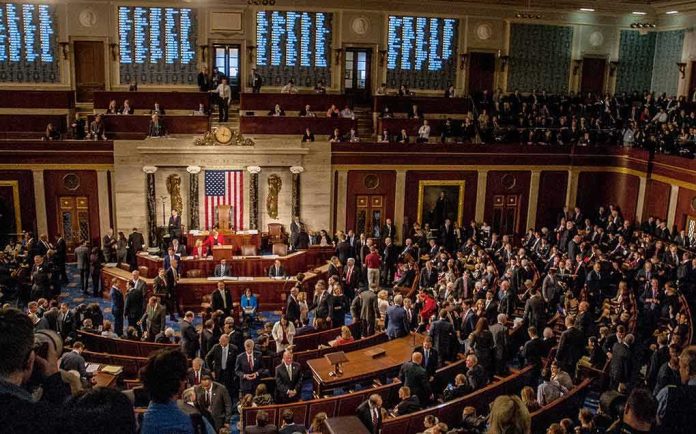
At the heart of Representative Thomas Massie’s impeachment case against Defense Secretary Pete Hegseth is a hard constitutional claim, not a partisan flourish: Congress decides when the United States goes to war and how long unauthorized hostilities can continue; executive branch workarounds—especially the theory that a cease-fire “pauses” the War Powers clock—cannot rewrite that allocation of authority.
The Short Version
- Massie introduced articles of impeachment alleging Hegseth initiated and sustained hostilities against Iran without congressional authorization, violating the War Powers Resolution.
- Hegseth’s public defense hinges on a cease-fire “pause” theory and Article II authority; lawmakers and legal experts have rejected the pause theory as contrary to the statute’s text.
- Congress formally asserted itself through Iran-related war powers votes, including passage of a resolution to end operations—evidence of legislative opposition to continued hostilities.
- The fight fits a durable pattern: presidents push expansive readings of unilateral authority while Congress struggles to enforce statutory limits in real time.
What Massie alleges—and why it matters
Representative Thomas Massie formally filed articles of impeachment charging that Secretary Hegseth “willfully participated in and directed” U.S. hostilities against Iran without the declaration of war or specific statutory authorization the Constitution and the War Powers Resolution require. That is a serious accusation anchored in a statute designed to constrain unilateral war-making: after 60 days of hostilities initiated without authorization, the President must terminate those hostilities absent congressional approval. Reporting and the filed resolution place Hegseth’s decisions and legal posture squarely against that framework.
Massie’s case draws strength from two strands of public record. First, Congress actively litigated the Iran question: the House considered competing war powers measures in the spring of 2026 and ultimately passed a resolution aimed at ending operations, establishing that the legislature had not granted the authority the administration claimed in practice. Second, Hegseth himself articulated a legal theory to lawmakers—that a cease-fire paused or stopped the 60-day clock—treating the statute’s deadline as elastic rather than bright-line. Massie’s filing treats that posture not as a good-faith dispute but as an evasion that defeats Congress’s purpose in enacting the law.
Hegseth’s defense: cease-fire pauses and Article II power
Hegseth’s public position is clear. He told Congress the administration believed it did not “currently need congressional authorization” because hostilities were in a cease-fire status and, in the administration’s view, the War Powers Resolution’s 60-day clock “pauses or stops” during such a period. He also emphasized that final determinations about authorization would rest with the White House and its counsel, and underscored the view that the President possessed adequate Article II authority regardless—language consistent with decades of executive-branch practice pressing constitutional powers in the absence of specific statutes. An administration official echoed the key premise to reporters: that, for War Powers purposes, the relevant hostilities had “terminated,” implying the deadline no longer ran.
As statutory interpretation, the cease-fire theory has drawn immediate, specific pushback. Senator Tim Kaine’s succinct rejoinder—“I do not believe the statute would support that”—captures what many war powers specialists argue: the War Powers Resolution contains no text authorizing a pause or reset once the clock starts; it speaks in terms of introduction of U.S. forces into hostilities and a hard 60-day limit absent authorization. Legal commentator Bruce Fein’s critique is more categorical: the statute “never says anywhere” the deadline stops for a cease-fire.
How the War Powers structure fits this dispute
The War Powers Resolution compels consultation and reporting when U.S. forces enter “hostilities,” and it sets a termination deadline—typically 60 days plus a 30-day withdrawal window—unless Congress authorizes continued action. Successive administrations have narrowed the definition of “hostilities,” treated brief or intermittent engagements as legally distinct, or relied on Article II to justify sustained operations without a specific authorization. Congress, in turn, has toggled between passing sense-of-Congress statements, targeted prohibitions, and concurrent resolutions seeking to force withdrawal—tools that are symbolically potent but, in practice, hard to enforce against a determined executive.
Against that backdrop, Massie’s filing is notable because it tries to convert a structural grievance into personal accountability: the allegation is not merely that the executive branch as an institution pressed an aggressive theory, but that a named officer executed and perpetuated hostilities contrary to statutory limits and to Congress’s expressed will. The filed resolution text uses that frame explicitly, accusing Hegseth of acting “without a declaration of war or specific statutory authorization” and thereby frustrating Congress’s constitutional role.
What Congress actually did—and why that record matters
The spring 2026 votes are the hinge between rhetoric and legal consequence. Early efforts to curb the Iran campaign fell short in March; by June, the House had passed a war powers measure aimed at ending operations, an unmistakable assertion that authorization had not been given and that continued hostilities lacked Congress’s blessing. That sequence undercuts any suggestion that Congress acquiesced through silence. In war powers practice, contemporaneous legislative action—especially when it culminates in a passed resolution—hardens the case that statutory deadlines apply and that unilateral extensions are improper.
To be sure, war powers enforcement is more political than judicial; courts have repeatedly avoided refereeing these fights. But the evidentiary record here is unusually concrete for a congressional-executive dispute: a filed impeachment resolution laying out a theory of statutory violation, public statements by the Secretary positing a cease-fire pause, and final-passage votes signaling Congress’s contrary view.
Massie is no longer relevant and he hasn't figured it out yet…
GOP Rep Thomas Massie introduces 8 articles of impeachment against War Secretary Pete Hegsethhttps://t.co/m4yfSJiwsI
— Margie Kaz (@MargieKaz) September 15, 2026
Where the genuine disagreement lies
The narrow legal question is whether a cease-fire pauses the War Powers clock. The statute’s text provides deadlines keyed to the introduction of forces into hostilities; it does not include a pause clause. Hegseth’s view reframes “hostilities” as episodic, arguing that a cessation—however temporary—terminates the period for counting. Critics point out that such elasticity would incentivize tactical lulls to avoid triggering congressional oversight, defeating the statute’s core design to force either authorization or withdrawal on a fixed schedule. On this contested point, the public, named, on-the-record rebuttals from lawmakers and legal experts weigh against the administration’s theory.
The broader constitutional question is familiar: how far Article II extends in the absence of statute. Executive-branch lawyers have long asserted authority to conduct limited or defensive operations without authorization; Congress has long insisted on the opposite in principle, and rarely sustained it in practice. Massie’s move attempts to make the principle bite by personalizing accountability for an asserted statutory breach, banking on the House’s war powers record to show that, this time, Congress did not merely grumble—it acted.
What it means going forward
Two implications stand out. First, if the cease-fire theory were to stand as practice—even without formal judicial blessing—it would erode the War Powers Resolution’s central mechanism. Any executive could toggle between brief pauses and resumed strikes to keep the clock from ever expiring. Second, if the House uses impeachment to police statutory war limits, it would mark a rare instance of Congress transforming oversight into enforcement—painful for the official targeted, but clarifying for constitutional governance. The filed resolution and the Iran votes give this episode more documentary spine than most war powers squabbles; that makes it a consequential test of whether the statute is a speed bump or a guardrail.
Sources:
youtube.com, politico.com, thegatewaypundit.com, axios.com, militarytimes.com, cnn.com, cbsaustin.com, cryptobriefing.com, democrats-foreignaffairs.house.gov, sanluisobispo.com, aljazeera.com, news.cgtn.com, congress.gov