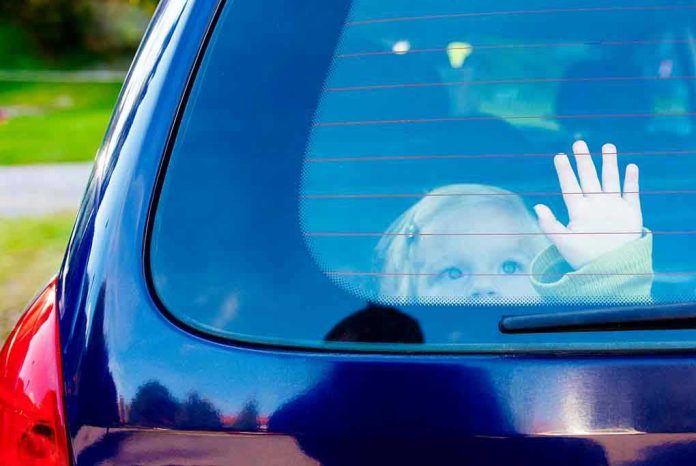
On a 97-degree Kansas afternoon, police say two parents chose chicken wings over their six children’s safety in a locked, sweltering car.
Story Snapshot
- Police say Michael and Tiffany Krueger left six children, including two infants, in a shut-off car while they ate at Wingstop.
- Officers report the kids sat 20 to 30 minutes with only one window partly down in extreme heat.
- All six children were checked by medics, showed no clear injuries, and were placed in protective custody.
- The parents now face six felony counts of aggravated child endangerment under Kansas law.
What Salina Police Say Happened Outside Wingstop
Salina police were called just after 2 p.m. to a Wingstop on South Ohio Street after someone spotted several children alone in a parked car. Officers arrived to find the vehicle turned off, with only one window partly rolled down. Inside were six children ranging from about thirteen years old down to two infants around seven months. Investigators say the outside temperature was ninety-seven degrees, with a heat index over one hundred degrees.
Police and witnesses say the parents, fifty-three-year-old Michael Douglas Krueger and forty-year-old Tiffany Krueger, had gone inside the restaurant and stayed seated for roughly twenty to thirty minutes while the children remained in the car. Officers say the adults did not return to check on the kids during that time. Salina Emergency Medical Services evaluated all six children at the scene and reported no obvious signs of serious injury. The children were then taken into protective custody.
Felony Child Endangerment Charges And What The Law Says
Prosecutors in Saline County charged both Michael and Tiffany with six counts of aggravated endangering a child, one count for each child in the car. Under Kansas law, endangering a child means knowingly and unreasonably placing a child under eighteen in a situation where the child’s life, body, or health may be endangered. Aggravated endangering a child is classified as a severity level nine person felony, carrying potential prison time, not just a fine.
The criminal complaint, as described in local reporting, states that each parent recklessly caused or allowed every child to be placed in a dangerous situation inside the overheated vehicle. They are accused of choosing to dine inside the restaurant instead of removing the children from the car or ensuring a safe, cool environment. The case remains in early stages, which means prosecutors will now present the evidence from officers, witnesses, and medical staff to a court.
Hot Cars, High Heat, And A Growing Pattern Of Risk
This case fits a larger national pattern many safety experts have tracked for years. Researchers note that dozens of children in the United States die each year after being left in hot cars, with parked vehicles turning deadly much faster than most people realize. National data show an average of about thirty-seven child hot car deaths annually, even on days that are not as extreme as ninety-seven degrees. Temperatures inside a car can soar far above the outside heat in minutes.
Studies of these tragedies show that about half happen because a caregiver simply forgets a child is in the vehicle, while a smaller but still serious share involves adults who leave children in cars on purpose while they shop, work, or run errands. Police in Salina allege this Kansas case falls into that second group, claiming the parents knowingly chose to leave six children, including infants, unattended so they could eat at Wingstop. That allegation, if proved, cuts against the idea of an absent-minded mistake and instead suggests conscious risk.
How Prosecutors Weigh Harm, Intent, And Common Sense
Child endangerment cases tied to hot cars rarely look the same, and outcomes can vary sharply. Legal analysts point out that some parents face the harshest charges, including manslaughter or homicide, when a child dies from heatstroke in a vehicle. Other cases, especially where a child survives and facts suggest an accident, have led to lesser charges or, sometimes, no charges at all. Prosecutors often weigh three key issues: the risk, the result, and the intent.
Kansas parents allegedly left 6 kids, including 2 infants, in hot car while they dined at fast food chain https://t.co/Urvlm2gKoa pic.twitter.com/m9V2ODyd3d
— New York Post (@nypost) July 13, 2026
From a common sense, conservative point of view, leaving six children in a shut-off car in triple-digit heat for up to thirty minutes looks less like a tragic lapse and more like a reckless choice that ignores basic parental duty. Even if these parents did not want to harm their kids, choosing convenience over safety crosses a line many Americans see as non-negotiable. Personal responsibility is not a partisan slogan here; it is the minimum standard when children’s lives are in your hands.
Sources:
nypost.com, kwch.com, facebook.com, case-law.vlex.com, criminallawyer-chicago.com, johndaylegal.com, spectrumlocalnews.com, pmc.ncbi.nlm.nih.gov, injuryfacts.nsc.org, nhtsa.gov