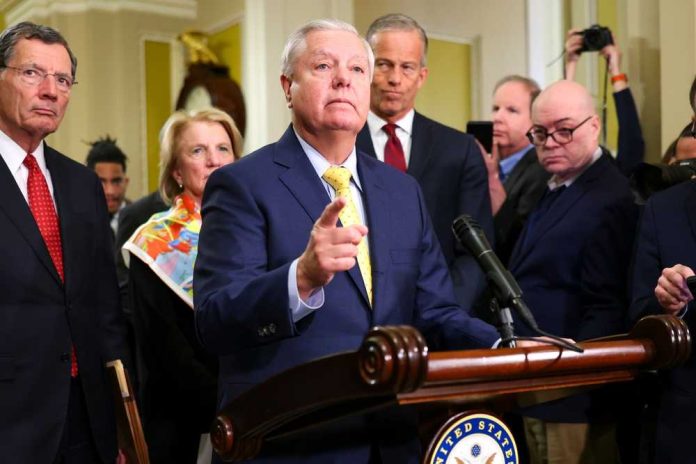
A six-word warning Lindsey Graham fired at Donald Trump in 2016 is now haunting Washington as people measure his legacy against a party and a country that feel more broken than ever.
Story Snapshot
- In 2016, Lindsey Graham warned Republicans they would be “destroyed” if they nominated Donald Trump.
- After Trump won, Graham shifted from sharp critic to close ally, backing key parts of Trump’s agenda.
- Graham’s death sent that old warning viral, as Americans debate whether his prediction came true.
- The story highlights how both parties’ leaders often bend to power, feeding mistrust of the “deep state.”
The 2016 Warning That Will Not Go Away
In May 2016, as Donald Trump closed in on the Republican nomination, Senator Lindsey Graham posted a blunt message on social media: “If we nominate Trump, we will get destroyed… and we will deserve it.” He had already called Trump a “destructive force” in the party and said Trump’s style mixed race-based attacks and religious bigotry. At the time, Graham spoke for many Republicans who feared Trump would blow up conservative ideas and stain the party’s brand for years.
Graham’s warning did not disappear after Trump won. Fact-checkers confirmed the quote and noted it stayed up on his official account even as he became more loyal to Trump. Years later, during a debate, Graham admitted he had not deleted it because he simply forgot it was still online. That awkward admission showed something many people sense about Washington: leaders say one thing when it is safe, then move on when power shifts, leaving their old words hanging in the air as inconvenient reminders.
From Fierce Trump Critic to Loyal Partner
Once Trump became the party’s standard-bearer, Graham’s public stance changed. He went from backing Trump’s rival Ted Cruz and warning that Trump would wreck the party, to working closely with Trump on judges and foreign policy. He defended Trump’s Supreme Court picks and pushed hard-line positions overseas, especially on Iran and Ukraine, giving Trump cover as a seasoned national security voice. Over time, major outlets described Graham as one of Trump’s closest allies in the Senate, not his opponent.
This shift did not come with a clear public explanation from Graham about why his view changed so sharply. The record shows his early attacks, his later praise, and a few moments of distance, such as after the January 6 attack, when he said “this is too much for me… I’m out,” before drifting back toward support. What is missing is a detailed account of his thinking. That gap feeds a common belief held by many on both the right and the left: politicians adjust their morals to fit the moment, not to fit the people who elected them.
Death, Tributes, and a Viral Reminder
Graham’s sudden death at age 71 from a brief illness set off a wave of official mourning and praise. Former President Trump quickly hailed him as a “true American Patriot” and “close ally,” saying they had spoken by phone just hours before Graham died. News networks and statements from leaders focused on his long career, his influence on foreign policy, and his role as a loyal partner in the Trump era, cementing an image of unity between the two men in his final years.
Lindsey Graham: The Senator Who Became One of America’s Most Influential Foreign Policy Voices
Senator Lindsey Graham’s death marks the end of a decades-long political career that shaped debates over war, national security, immigration, the judiciary, and the future of the… pic.twitter.com/1IihGWIY9P
— CENTRITE (@CENTRITEHQ) July 12, 2026
Almost at once, that 2016 warning post roared back into public view and spread across social platforms. Commentators and ordinary users shared it as a kind of uncomfortable epitaph: a reminder that Graham once saw Trump as a danger to his own party. Some podcasts and critics argued that Graham’s legacy shows “the worst of him,” saying he gave up moral clarity for influence. Others pointed to his work on judges and foreign policy as proof he helped shape big decisions. The clash over his memory is really a clash over what we expect from leaders in a system many now see as rigged.
Why This Story Hits a Nerve Across Party Lines
Many conservatives today feel Trump’s rise did “destroy” parts of the old Republican Party, replacing limited-government ideas with personality politics and constant scandal. Many liberals feel Trump-era policies deepened inequality, weakened norms, and made political violence seem normal. Yet both groups also feel something larger: that most elected officials, including people like Graham, follow power first and principle second, whether that power sits in the White House, party leadership, or donor circles.
Research on political behavior backs up that frustration. Studies show leaders often misread public opinion and cling to their inner circle even when voters want change. Analysts describe “Teflon” political figures who break rules and face few real consequences because their own side sticks with them out of fear or tribal loyalty. Graham’s journey—from warning that Trump would wreck his party, to standing beside him, to being remembered mainly for that early warning—captures this deeper problem. The system rewards loyalty to the powerful more than loyalty to the truth, and everyday Americans on both sides are left wondering who, if anyone, is really fighting for them.
Sources:
mediaite.com, facebook.com, x.com, nbcnews.com, thehill.com, instagram.com, kcra.com, politico.com, youtube.com, frontiersin.org, cambridge.org, tandfonline.com, bsc.hks.harvard.edu, carnegieendowment.org