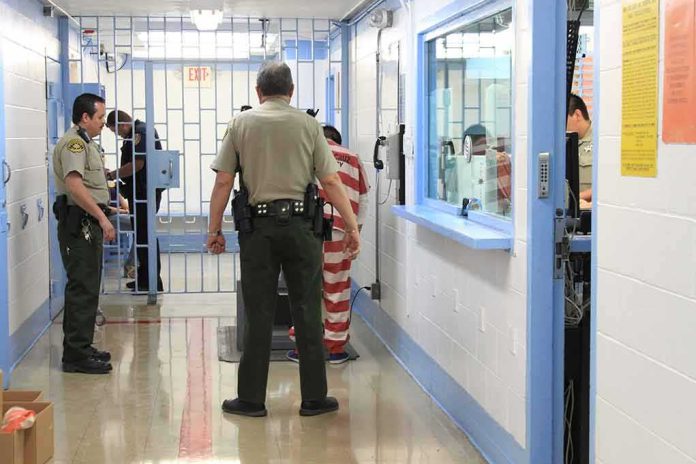
The most shocking fact in this case is simple and brutal: an 18-year-old murder suspect was stomped to death on camera inside a Mississippi jail while the people paid to keep him alive watched a collapsing system grind on around him.
Story Snapshot
- Teen murder suspect Mielun Butler died after a filmed jailhouse assault inside Hinds County’s Raymond Detention Center.
- The coroner says Butler was “stomped to death,” with shoe prints covering his head and face.
- Sheriff Tyree Jones calls the killing “street justice” and possible gang retaliation tied to Butler’s murder charge.
- The case exposes a dangerous mix of overcrowding, understaffing, and violent inmate culture in local jails.
A teenager goes from murder arrest to brutal jailhouse killing in 48 hours
Jackson police and United States Marshals arrested 18-year-old Mielun Butler on July 1 in connection with the shooting death of 32-year-old Melvin Edwards during a June 13 incident in Jackson. Butler was booked into the Hinds County Detention Center in Raymond on a murder charge and placed in a housing unit with other inmates. Less than two days later, on the morning of July 3, detention staff found Butler unresponsive in his cell and sent him to Merit Health hospital, where doctors pronounced him dead.
Hinds County Sheriff Tyree Jones quickly told local media the cause of death “appears to be an assault” inside the jail. State authorities at the Mississippi Bureau of Investigation took over the criminal probe, while the sheriff’s office began an internal review of what happened on the unit where Butler was held. On social media, stunned residents saw headlines that the second suspect in the Edwards homicide case was now dead himself, with almost no time spent in court and no conviction on his record yet.
A coroner’s report and a leaked video remove any doubt about violence
As rumors swirled, Hinds County Coroner Jeremiah Howard put hard detail to the story during an interview with Mississippi Today. He said Butler was “stomped to death” and described shoe prints all over the young man’s head. That kind of trauma fits a focused, repeated attack, not a brief scuffle. By July 3, a cell phone video began to circulate online showing a limp, bloodied body on a jail floor as another man in sandals kicked and stomped him while others watched and yelled.
At a July 6 news conference, Sheriff Jones confirmed the video was real. He said the clip showed the assault that killed Butler inside the Raymond Detention Center and called the footage “deeply troublesome” and “very, very concerning.” Jones confirmed inmates recorded the beating with a contraband phone and shared it online. One detail from reporting makes the scene feel colder: in one clip, someone orders Butler to say “Long live Melvin” as he is being stomped, a clear tie to the Edwards homicide that Butler was accused of.
“Street justice,” gang retaliation, and a failing local jail system
Sheriff Jones has framed Butler’s killing as “street justice” carried out behind bars. He has suggested the fatal beating was likely retaliation for Edwards’ death and said investigators are looking at gang activity as a possible driver. That framing lines up with what many Americans already believe about jail violence: that inmates run their own code and will punish anyone accused of harming their friends or neighborhood. From a conservative common-sense view, it sounds like evil men doing evil things to each other.
Yet that is only half the picture. Jones has also admitted his jail is overcrowded, understaffed, and plagued by long-standing facility problems. He has urged local, state, and federal leaders to move pretrial inmates through the courts faster so they are not warehoused for months or years without trial. National research backs up his concerns. Local jails, built for short stays, have become some of the most dangerous institutions in the country because they now warehouse mental illness and deep poverty while lacking enough officers to keep people safe.
Violence behind bars is common, and weak institutions make it worse
Studies of men’s prisons and jails show physical assaults are part of daily life for many inmates. One major survey found about 21 percent of male inmates are physically assaulted in just a six-month period. Those attacks are not rare freak events; they happen at all hours and in many housing units. They often occur where staff presence is thin and where officers are overwhelmed with too many inmates and too few tools to control the unit.
🚨FOUND DEAD🚨
A murder suspect was stomped to death inside a Mississippi jail.
Mielun Butler, 18, was arrested by US Marshals after the murder of 32-year-old Melvin Edwards.
Days after Butler’s arrest, he was killed.
Video of the attack is circulating on social media.… pic.twitter.com/Fjl409fSEO
— Breanna Morello (@BreannaMorello) July 13, 2026
When you connect those numbers to Butler’s death, a troubling pattern appears. Yes, inmates may have chosen to take “street justice” into their own hands. But they could only do that level of damage, record it, and share it because the jail’s basic security had already failed. From an American conservative viewpoint that values law, order, and personal responsibility, both sides matter. Inmates must be held responsible for murder behind bars. Government must be held responsible for letting jails become places where murder behind bars is easy.
Accountability pressure mounts as courts demand hard numbers
After Butler’s killing and other recent deaths at the Raymond Detention Center, a Mississippi chancery court judge ordered the Hinds County Sheriff’s Office to release records on inmate deaths, ruling the agency violated the state public records law by withholding them. The court gave the sheriff seven business days to turn over documents showing how many people have died in custody, the causes of those deaths, and whether any steps were taken to prevent them. A state lawmaker has already called for greater accountability once those records become public.
Sources:
nypost.com, mississippitoday.org, wapt.com, facebook.com, youtube.com, newsfromthestates.com, paloaltou.edu