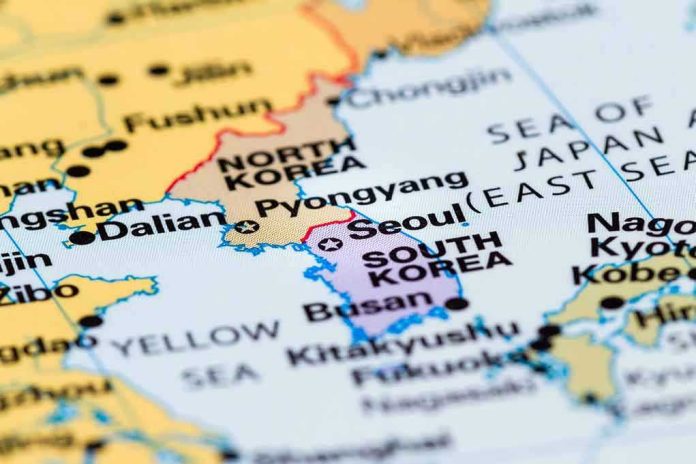
When a head of state pairs a nine-figure number with named steel-in-the-ground projects, it signals more than a press moment; it sets a financing agenda, an industrial policy map, and a diplomatic marker that capital and supply chains are meant to follow.
At a Glance
- President Trump announced a South Korean plan to invest up to $200 billion in U.S. energy infrastructure.
- Flagship elements include Alaska LNG (with a $54 billion tranche), a six-gigawatt gas-fired power project in Texas, and eight new large-scale nuclear plants.
- The package ties to South Korea’s broader pledge to invest hundreds of billions in the United States under a recent trade framework.
- If executed, these projects would reshape gas export routes, add baseload power, and deepen U.S.–ROK industrial and strategic alignment.
What was announced and why it matters
President Trump outlined an investment agreement under which the Republic of Korea would deploy up to $200 billion into U.S. energy infrastructure, singling out three anchors: the long-discussed Alaska liquefied natural gas (LNG) project with a $54 billion allocation, a six-gigawatt natural gas power generation complex in Texas, and eight new large nuclear power stations sited across multiple states. Major outlets independently reported the same contours and headline figures, framing the package as one of the largest foreign-led energy infrastructure drives in U.S. history. The throughline is strategic: convert allied capital into U.S.-based capacity that secures supply to domestic consumers and Indo-Pacific partners while hardwiring a deeper industrial partnership with Seoul.
The Texas facility’s scale—6 GW—is utility-system defining, roughly equivalent to several large combined-cycle plants co-located or an integrated campus designed for grid stability and efficiency. Eight new nuclear units would, if developed, represent a generational addition to U.S. baseload capacity. And Alaska LNG—an 807-mile gas pipeline from the North Slope feeding a liquefaction terminal for Pacific exports—would be the first U.S. West Coast export route with direct Asian access, aligning U.S. molecules with the world’s growth market for LNG.
Mechanism: how these projects work
Alaska LNG combines upstream gas offtake on the North Slope, long-haul pipeline transport, a liquefaction facility at tidewater, and shipping to customers in Japan, Korea, and Southeast Asia. It is fully permitted at the federal level—a rarity among U.S. Pacific projects—removing a critical development risk and making it the logical target for large allied financing. Recent commercial steps include Glenfarne’s leadership stake and precedent gas sales arrangements aimed at enabling a phased final investment decision, with offtake interest recorded from leading Asian buyers. The announced $54 billion tranche, if mobilized, would underpin construction-scale contracting and signal to lenders and EPC firms that sponsor equity and sovereign-aligned capital are available at scale.
The Texas 6 GW project points to a multi-block natural gas generation complex. In practice, such a build relies on high-efficiency combined-cycle gas turbines, grid interconnection upgrades, and long-term fuel supply. At this capacity, developers typically pursue phased commissioning to align with transmission readiness and regional load growth. Nuclear development—eight large-scale reactors—implies a standardized design pathway, likely pairing a proven Generation III+ or advanced Gen III design with a repeatable supply chain to tame cost and schedule risk. Westinghouse’s U.S. footprint and the recent push to reconstitute nuclear manufacturing know-how are consistent with a programmatic build across multiple states.
Origins and policy context
The announcement nests inside a broader U.S.–ROK investment framework reported over the past two years, in which South Korea committed hundreds of billions for targeted U.S. sectors, including energy. Outlets tied the $200 billion energy headline to that umbrella, with the Alaska LNG slice repeatedly identified at $54 billion. The logic is straight out of post-2020 industrial policy: align allied capital with strategic U.S. infrastructure so that supply chains and energy security are less exposed to adversarial choke points, while both sides capture jobs, technology spillovers, and resilient procurement lanes.
Alaska LNG’s strategic value predates this moment. The project has cycled through partners and financing concepts for more than a decade, from supermajor consortia to state-led development, and early capital coordination from institutions such as Bank of China and Goldman Sachs during a different era of global LNG economics. In 2025–2026, Glenfarne’s majority stake, long-term gas marketing effort, and a fully permitted posture repositioned the project as the only U.S. West Coast-scale LNG option with a near-term path to execution, especially if backed by government-to-government investment frameworks.
Industrial strategy: why Korea, why now
South Korea is a natural counterpart for a U.S. build-out of this type. It is a top-tier LNG buyer, a nuclear technology and heavy-industry powerhouse, and home to EPC firms capable of delivering complex plants at scale. By mobilizing Korean capital and companies into U.S. projects, both governments effectively onshore energy security: the United States adds firm generation and export capacity; Korea helps secure reliable fuel and industrial opportunities that hedge global volatility. Media accounts connected the package to tariff and trade negotiations, portraying the investment flows as the strategic counterpart to market-access concessions.
The payoff matrix is wide. For U.S. grids, new gas and nuclear capacity reintroduce dependable, dispatchable power—a prerequisite for integrating more variable renewables while maintaining reliability. For export strategy, Alaska LNG diversifies U.S. routes beyond the Gulf Coast, shortens shipping time to North Asia, and reduces Panama Canal dependence. For both countries, the program strengthens deterrence by resilience: allies that share energy infrastructure and capital are harder to coerce.
Execution realities and project sequencing
Announcing “up to $200 billion” is a policy umbrella; deploying capital at that magnitude arrives through discrete project financings with off-take contracts, EPC wraps, regulatory milestones, and state-level permits. That is normal for cross-border mega-projects. News accounts consistently break out Alaska LNG’s $54 billion as the program’s first major leg, reflecting its permitting maturity and advanced commercial posture. The Texas complex, given interconnection and fuel logistics, would likely ladder in blocks, synchronizing with ERCOT planning and pipeline capacity. Nuclear projects, historically prone to delay when bespoke, tend to succeed when standardized; a fleet approach under coherent federal-state coordination is the credible path to eight units.
Commodity-cycle timing also matters. LNG project economics hinge on long-term sales agreements, construction costs, and shipping. Recent procurement by buyers in Japan, Korea, Taiwan, and Thailand for 11 million tons per annum signals durable demand, consistent with Asia’s electrification needs and coal-to-gas transitions—even as renewables scale. With a West Coast route, the U.S. can cost-competitively meet that demand without Gulf shipping constraints.
🚨 MAJOR U.S.–SOUTH KOREA ENERGY INVESTMENT ANNOUNCEMENT
President Trump is unveiling plans for $200 BILLION in South Korean investment across major U.S. energy projects, including:
⚡ A 6-GW power facility in Texas
☢️ 8 large-scale nuclear reactors
🔥 Roughly $54B toward… pic.twitter.com/tGYwGvEQ71— Daniel Prado (@danvprado) September 30, 2026
What it means going forward
If realized on the scope described, this U.S.–ROK investment program would reset several baselines. It would reestablish the U.S. as a builder of large nuclear fleets rather than one-off plants, expand firm capacity in a grid strained by electrification, and add a strategic LNG outlet that aligns U.S. supply with allied demand in the Indo-Pacific. It would also validate a model of allied industrial policy where trade concessions, capital deployment, and technology partnerships are negotiated as a package, not as isolated deals. The projects named—Alaska LNG, a 6 GW Texas complex, eight nuclear units—are not abstractions. They are the scaffolding of an energy system that is reliable, allied, and built to endure.
Sources:
pbs.org, nytimes.com, politico.com, mk.co.kr, x.com, aljazeera.com, adn.com, tradersunion.com, chosun.com, accf.org, gem.wiki, lba.akleg.gov