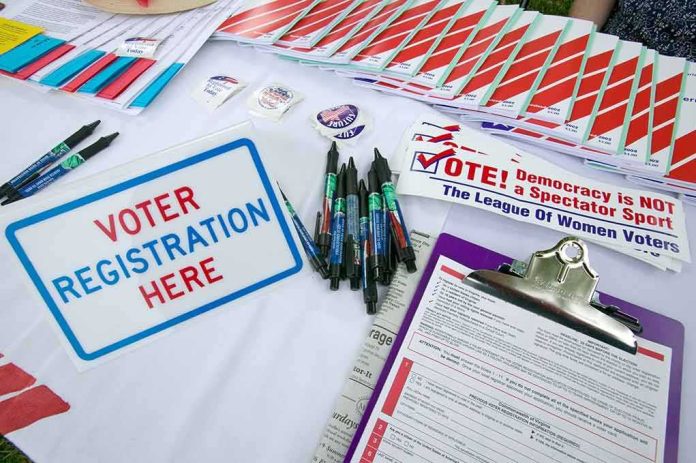
The Virginia story of 6,531 “declared noncitizens” removed from the voter rolls is not primarily about catching fraud; it is about how states use blunt administrative data to police eligibility and how easily that same machinery can collide with federal protections against wrongful purges.
Key Points
- Virginia cancelled 6,531 voter registrations over two years based on DMV records in which those registrants had indicated they were not U.S. citizens.
- The removal program rests on a 2006 state law and, more recently, an executive-order push to identify noncitizens, but it ran into federal National Voter Registration Act (NVRA) limits on pre-election “systematic” purges.
- Federal courts found the program likely violated NVRA’s 90‑day quiet period and that at least some of the 1,600 people removed in an accelerated 2024 purge were in fact eligible U.S. citizens.
- Judicial Watch’s records and state statements do not show whether any of the removed registrants actually voted, leaving the practical impact on unlawful voting—and on wrongly disenfranchised citizens—unclear.
Virginia’s Noncitizen Removal Program: How It Works
Virginia’s recent controversy sits atop a long‑standing premise in election law: only U.S. citizens may vote in state and federal elections, and voter rolls should therefore exclude noncitizens. The mechanism the commonwealth has used to enforce that rule is deceptively simple. When residents interact with the Department of Motor Vehicles, they are asked whether they are U.S. citizens. Those who check “no” are captured in a DMV list of “all persons who have indicated a noncitizen status” during license or ID transactions. That list is then transmitted to the Virginia Department of Elections (often referred to as ELECT), which cross‑matches those individuals against the statewide voter registration database.
If DMV data show a person has declared noncitizen status and ELECT finds a corresponding voter registration, local registrars send a notice letter advising the registrant that records indicate they are not a citizen and therefore not eligible to vote. Reporting on Youngkin’s 2024 executive order described a 14‑day window: if the person does not respond and affirm citizenship within that period, their registration is cancelled. In operational terms, this is “systematic list maintenance” driven by a single data field—citizenship—captured at DMV and used to trigger removal in election records.
Between June 2024 and June 2026, records obtained by Judicial Watch from the Virginia Department of Elections show that the state cancelled 6,531 registrations categorized explicitly as “declared noncitizen.” Judicial Watch’s president, Tom Fitton, has emphasized that these are not speculative flags; they are individuals who, at some point, told DMV they were not citizens and later appeared on the voter rolls. The pattern is consistent with earlier figures from Youngkin’s 2024 initiative, where state communications described removing just over 6,300 suspected noncitizens in a shorter window.
Legal Foundations: State Law, Executive Orders, and NVRA Constraints
The policy does not arise in a vacuum. Governor Glenn Youngkin framed his 2024 push as enforcement of a 2006 Virginia statute directing election officials to cancel registrations of people identified as noncitizens in official records. That law predates the current partisan environment and, according to state defenders, has been applied under both Republican and Democratic administrations. What changed in 2024 was the tempo and timing. Youngkin’s Executive Order 35 instructed election officials to conduct daily checks using DMV data, explicitly aiming to remove noncitizens before the November general election.
That timing triggered the more complex layer of federal law. The National Voter Registration Act requires states to keep rolls “clean,” but it also imposes a 90‑day quiet period before federal elections, during which states cannot conduct systematic purges of voter lists that might erroneously delete eligible voters. Executive Order 35 was signed on August 7, 2024—the very date NVRA’s 90‑day clock began for the November election. Virginia proceeded to cancel more than 1,600 registrations flagged as suspected noncitizens under the accelerated program.
The Department of Justice, joined by voting‑rights groups, sued. U.S. District Judge Patricia Tolliver Giles concluded that the state’s daily, automated removals violated NVRA’s 90‑day ban on systematic maintenance and found that at least some of the 1,600 cancelled registrants were U.S. citizens eligible to vote. She ordered Virginia to reinstate those registrants and to confine any further removals in the quiet period to case‑by‑case determinations rather than batch automation.
Virginia appealed and asked the Supreme Court for emergency relief, arguing that it was simply enforcing a lawful noncitizen‑removal statute based on self‑attested DMV data. In a brief unsigned order, the Court granted a stay of Judge Giles’ injunction, allowing the state to continue removing suspected noncitizens while litigation proceeded. That stay did not resolve the merits of the NVRA claim, but it did signal that Virginia’s legal theory—that noncitizens may be systematically purged even close to an election when using self‑attested status—was at least plausible enough to warrant emergency consideration.
The 6,531 “Declared Noncitizens”: What the Numbers Do—and Don’t—Show
The headline figure—6,531 cancelled “declared noncitizen” registrations over two years—comes from Virginia’s own election maintenance records released under public records law. Those records indicate that each registration was removed for the specific reason code associated with DMV‑based noncitizen status, not for inactivity, felony conviction, or death. From an election‑administration perspective, that is a substantial volume: thousands of registrants whose status, on paper, violated the citizenship requirement.
However, the same records expose the limits of what can be inferred. Judicial Watch reports that Virginia produced no voting‑history data alongside the list, so we do not know how many of those 6,531 registrants ever cast a ballot. Some may have registered inadvertently and never voted; some may have voted multiple times; without history, the practical impact on unlawful voting is opaque. The data also reflect only individuals who interacted with DMV during the two‑year window and declared noncitizen status at that time. As Fitton himself has argued, that creates a selection bias: noncitizens who never seek a driver’s license, or whose DMV records are outdated, would not appear in the list, suggesting that 6,531 could be a floor, not a ceiling.
Equally important, the list is categorized by what DMV records say, not by a fresh adjudication of citizenship. NVRA litigation and media reporting have highlighted cases where U.S. citizens—particularly naturalized citizens—were caught in the purge because DMV data never updated to reflect their new status. That is the core vulnerability in this model: citizenship is treated as a static field in a database, and removal decisions are automated off that field even though people’s status can change, and bureaucracies can mis‑record it.
Evidence of Wrongful Removal: Citizens Caught in the Net
The strongest counter‑case to Virginia’s narrative is not ideological; it is judicial. Judge Giles explicitly found that “at least some” of the more than 1,600 people removed under the August 2024 accelerated program were U.S. citizens eligible to vote. NPR’s coverage of the case profiled such individuals, including voters who discovered their registrations had been cancelled despite being citizens, often naturalized, with years of valid voting history.
Civil‑rights plaintiffs have argued that the DMV‑driven method is structurally prone to misclassifying naturalized citizens whose records were never updated or who answered DMV questions under circumstances that did not reflect their later status. The League of Women Voters, in describing the associated lawsuit, warned that Executive Order 35’s reliance on DMV citizenship indicators, without independent verification, risked improperly removing eligible voters, particularly naturalized citizens. Those critiques do not dispute the legitimacy of removing true noncitizens from voter rolls; they target the reliability of the trigger.
At the same time, the public counter‑record does not yet offer a full audit of the 6,531 removed between 2024 and 2026. Litigants have cited individual stories and the judge’s findings, but they have not released a comprehensive breakdown showing what percentage of those registrants were in fact citizens, what proportion were noncitizens, and how often DMV data was wrong. That gap leaves both narratives partial. Supporters can point to thousands of registrations tied to self‑declared noncitizens; critics can point to documented citizen removals and NVRA violations. Neither side can yet quantify error rates across the entire two‑year cohort.
NVRA’s Quiet Period and the April 2026 Settlement
After the bruising 2024 litigation, Virginia adjusted. In April 2026, under Governor Abigail Spanberger, the commonwealth entered into a settlement with the Campaign Legal Center and allied groups, agreeing to pause its program to remove “declared noncitizens” during the 90 days before federal elections. That change effectively acknowledged NVRA’s bright‑line rule: systematic list maintenance aimed at ineligible registrants can continue most of the year, but must halt in the immediate run‑up to an election to protect eligible voters from last‑minute administrative error.
The Attorney General’s letter referenced in Judicial Watch’s release confirms that this new policy is now embedded in Virginia’s voter‑list maintenance guidance. Declared noncitizens may still be removed, but not on an automated, daily basis during the quiet period. If officials wish to act within that window, they must rely on individualized, case‑by‑case determinations consistent with Judge Giles’ injunction framework.
From a systems perspective, this is a classic example of federal–state calibration. Virginia retains its substantive rule that noncitizens may not remain on the rolls and may be cancelled when DMV data show they self‑identified as such. NVRA imposes a procedural overlay: the timing and method of that cancellation must be constrained to avoid sweeping in citizens when there is too little time to correct mistakes.
Election Integrity vs. Voter Protection: What This Case Teaches
Virginia’s experience underscores a broader empirical pattern in American election administration. Investigations routinely find registration errors and instances of ineligible individuals appearing on voter rolls; large‑scale, intentional fraud is far less common than political rhetoric suggests. The Brennan Center has documented that when purge programs go wrong, the most frequent harm is wrongful removal of eligible voters, not failure to catch organized schemes of noncitizen voting.
The 6,531 “declared noncitizen” cancellations are therefore best understood as a signal of list‑maintenance pressures, not proof of a hidden wave of illegal ballots. They demonstrate that administrative systems can and do place ineligible names on the rolls—through self‑attestation failures, clerical mistakes, or software glitches similar to New Jersey’s case where 6,600 noncitizens were mistakenly registered due to DMV software error.[CNN transcript] They also demonstrate that when states respond aggressively, using automated data without robust verification, they can and do strip valid voters of their registrations.
For citizens concerned with both election integrity and civil rights, the Virginia episode offers a clear, practical lesson. Maintaining accurate voter lists is necessary; noncitizens should not remain on the rolls and should not vote. But the methods used—especially when tied to other bureaucratic datasets like DMV records—require careful timing, transparent error auditing, and accessible remediation paths for those wrongly flagged. Without that infrastructure, an effort framed as “cleaning up” the rolls can unintentionally disenfranchise the very people NVRA was designed to protect.
Shortly after Virginia removed more than 6,500 noncitizens from its voter rolls, Gov. Abigail Spanberger said she has restored voting rights for over 66,000 convicted felons in the state.
“I’m proud that—after contending with my predecessor’s efforts to deny Virginians their… pic.twitter.com/UqDuwqI6Pm
— Daily Signal (@DailySignal) August 3, 2026
Where the Evidence Still Falls Short
What we do not yet have is the forensic backbone that would move this debate from rhetoric to measurement. Neither Judicial Watch’s records nor the court filings in the NVRA litigation include a full, voter‑level audit showing, for each of the 6,531 cancelled registrations, the person’s actual citizenship at the time of removal, any change in status over time, and their voting history. Absent that, arguments about “how serious” the problem is—whether it reflects hundreds of illegal ballots or largely inert registrations—remain speculative.
Similarly, there is no public study of DMV’s false‑positive rate: how often does a person marked “noncitizen” in DMV records turn out to be a citizen in federal or naturalization databases, and what safeguards exist to reconcile those conflicts before cancellation? Without those metrics, it is difficult to say whether Virginia’s program is a narrow, well‑targeted enforcement tool or a blunt instrument that disproportionately endangers naturalized voters.
What the existing evidence does support is narrower, but important. Virginia has used DMV self‑attestation to cancel thousands of registrations tied to declared noncitizens. That approach is lawful in principle but becomes legally vulnerable when executed as systematic automation inside NVRA’s 90‑day quiet period and practically risky when the underlying data are stale or incomplete. Courts have already found citizens caught in the net. The next step for any serious reform effort is empirical: a transparent, independent audit of the cancellations and the error rate of the data that drove them.
Sources:
judicialwatch.org, theindianalawyer.com, epec.info, washingtonexaminer.com, democracydocket.com, lwv.org, youtube.com, usatoday.com, apnews.com, texasattorneygeneral.gov, vpm.org, campaignlegal.org, nbcnews.com, justice.gov