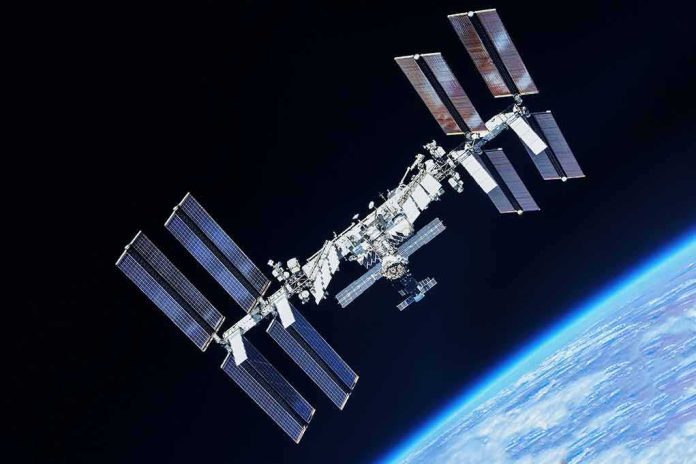
The International Space Station is dying on a schedule, and for the first time in a quarter-century, the United States has no government-owned successor waiting to take its place — only a bet that private industry can build one in time.
Key Points
- NASA released its final Request for Proposals for commercial low-Earth-orbit space stations, with industry bids due December 8 and contract awards expected by spring 2027.
- The solicitation asks companies to design, build, certify, and operate full station systems — not just submit concepts — continuing a model NASA has funded since 2020.
- Four companies have already received a combined $400 million-plus in NASA seed funding: Axiom Space, Blue Origin, Nanoracks/Voyager Space, and Northrop Grumman.
- NASA’s own Inspector General and the Government Accountability Office have warned of a possible gap in U.S. human presence in orbit once the ISS retires around 2030.
- Independent analysts question whether a self-sustaining commercial market — beyond NASA’s own subsidy — actually exists yet.
What NASA Just Asked Industry to Do
On Friday, NASA published the final version of its Request for Proposals inviting American companies to submit full development plans for the next generation of commercial space stations in low Earth orbit. This is not a request for sketches or white papers. The solicitation lays out requirements for companies to design, build, test, certify, and ultimately operate complete station systems, including the transportation and crew-support infrastructure needed to keep astronauts alive and working in orbit. Proposals are due December 8, and NASA expects to make contract awards in spring 2027. The agency frames the move plainly: this is the next step toward “a future where commercial space stations lead the way in low Earth orbit,” with NASA positioned as a customer rather than an owner-operator.
That distinction — customer instead of owner — is the whole story. For fifty years, NASA built, owned, and operated every orbital platform Americans worked on, from Skylab through the ISS. The new solicitation asks industry to flip that arrangement: private companies own the hardware, set their own commercial terms, and sell NASA a seat at the table alongside paying tourists, foreign space agencies, and corporate researchers. It is a profound change in how the United States maintains a human foothold in orbit, and it did not happen overnight.
How the Commercial-Station Strategy Was Built
The groundwork goes back to 2020, when NASA awarded Axiom Space a contract to attach at least one habitable commercial module to the ISS, with the explicit goal of that module eventually detaching to become its own free-flying station before the ISS retires. In December 2021, NASA broadened the bet, signing Space Act Agreements worth nearly $416 million combined with Blue Origin, Nanoracks, and Northrop Grumman to design competing station concepts under the Commercial LEO Destinations program. NASA later topped up those awards — Blue Origin’s Orbital Reef funding rose to $172 million and Voyager Space’s Starlab program, which absorbed Nanoracks, reached $217 million — to keep development moving as designs matured. Axiom, meanwhile, is on track to launch its first module, Axiom Hab One, and attach it to the ISS in 2026.
This staged, milestone-based funding approach is deliberate, and it has precedent. NASA used the same model — paying for development progress rather than buying a finished product outright — in its Commercial Orbital Transportation Services program in the 2000s, which seeded the cargo-delivery capability that SpaceX and Northrop Grumman now operate routinely. The lesson NASA’s own program retrospectives draw from COTS is to keep revisiting the underlying rationale for every requirement rather than over-specifying the solution. The commercial-station solicitation follows that same logic: NASA funds development, agrees to be an anchor customer, and leaves companies free to chase other buyers — tourists, foreign governments, in-space manufacturers — to make the business work on its own.
The Clock Problem: Why the Timing Matters
The urgency behind this RFP is not abstract. The ISS is slated for retirement around 2030, and NASA’s own watchdogs have flagged real risk that commercial replacements will not be ready in time. A NASA Office of Inspector General report warned that aging ISS modules combined with possible delays in commercial station development “heighten the risk of a gap in low Earth orbit destinations”. The Government Accountability Office went further, reporting that NASA has not formally assessed how likely or how long such a gap might be, nor documented the process it will use to decide whether to proceed with deorbiting the ISS on schedule. A NASA-commissioned policy paper argues the stakes extend beyond logistics: it calls an enduring American presence in low Earth orbit a “national imperative,” warning that doing nothing risks ceding that presence at a pivotal moment — language widely understood inside the agency as a reference to China’s operational Tiangong station.
Is the Market Real, or Is NASA Still Carrying It?
The honest open question is not whether NASA is funding this transition — it plainly is — but whether that funding is cultivating an independent commercial market or simply subsidizing a government function under a private label. Industry analysis published this year noted that after more than 25 years of commercial activity aboard the ISS, no breakthrough product or scalable in-space manufacturing market has emerged, orbital tourism remains a niche rather than a mass business, and the U.S. government is still underwriting each successive push toward commercialization. That is a sober counterweight to the “LEO economy” framing NASA uses in its own releases, and it tracks with a pattern seen in other NASA commercial programs: government anchor-tenancy can launch a capability, as it did with cargo resupply, but it does not guarantee the market matures fast enough, or wide enough, to sustain itself once the subsidy tapers off.
"NASA Seeks US Industry Plans for Commercial Space Stations"
__
^https://t.co/yqkLk4jLHD
³🖼️⁴🖼️⁵🖼️⁶🖼️ pic.twitter.com/2h3DfEbeT3— Future Spaces (@SpacesFuture) October 9, 2026
What This Means Going Forward
The December 8 proposal deadline and the spring 2027 award target are the next real checkpoints, not the destination. Whichever companies win — Axiom, Blue Origin’s Orbital Reef team, Voyager’s Starlab, Northrop Grumman, or a newcomer — will be racing against an ISS retirement clock that NASA’s own inspectors say is not fully risk-assessed. The agency’s bet mirrors the one it made successfully with commercial cargo and crew: fund development, commit to buying services, and let private capital and foreign and commercial customers fill in the rest. Whether that formula transfers cleanly from resupply capsules to permanently crewed stations — a vastly more complex and expensive proposition — is the question the next eighteen months will begin to answer.
Sources:
nasa.gov, cnbc.com, spacepolicyonline.com, spacenews.com