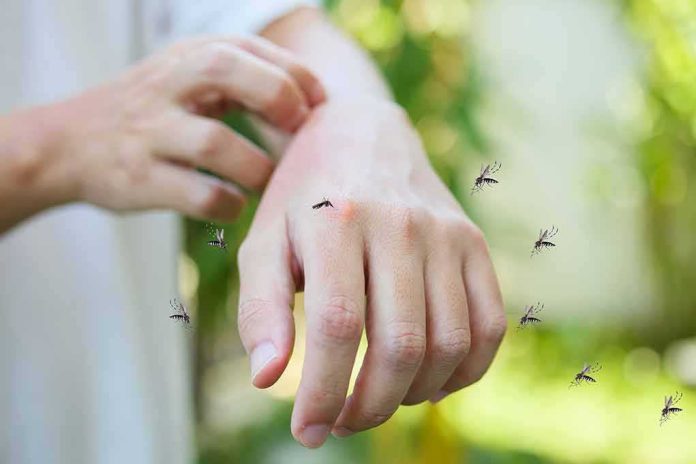
Los Angeles County’s 2026 West Nile season wasn’t merely annoying—it was epidemiologically exceptional, with human illness, infected mosquitoes, and virus-positive birds all pointing to a genuinely elevated transmission cycle aligned with an unusually hot, humid year.
At a Glance
- County health officials logged an early-season surge: 100 human infections and five deaths by September 21, the highest that early in nearly a decade
- Subsequent county reporting showed totals climbing further as surveillance caught up, exceeding recent five-year averages
- Vector and wildlife indicators corroborated risk: hundreds of West Nile–positive mosquito pools and a sharp rise in virus-positive dead birds
- Heat and humidity extended mosquito survival and transmission windows; El Niño–linked moisture coincided with the spike, though precise causal shares aren’t quantified
What made 2026 different: the signal across humans, mosquitoes, and birds
By September 21, Los Angeles County had reported 100 human West Nile virus (WNV) infections and five deaths—levels county officials characterized as the highest this early in nearly a decade. That early-season signal did not fade. As the season progressed and case ascertainment matured, the county’s arboviral report documented even higher cumulative totals, concluding that 2026 exceeded the five-year average for the same period. In vector-borne disease, human case counts can be noisy early on; what distinguished 2026 was the corroboration from the ecological side. The San Gabriel Valley Mosquito and Vector Control District reported 384 WNV-positive mosquito samples and 78 infected dead birds by late September, compared with 104 positive mosquito samples and two infected birds at the same point the year prior—a step change, not a blip.
This multi-layered evidence matters. West Nile is a bird–mosquito zoonosis; humans are incidental, dead-end hosts. When mosquito pools and corvids light up in parallel with human illness, we are observing a whole transmission system that has shifted into a higher gear. The county’s own summary—2026 running above its recent baseline—confirms that interpretation.
Mechanism: why heat and humidity tilt transmission in mosquitoes’ favor
Mosquito-borne viruses are exquisitely sensitive to weather because temperature and moisture shape vector biology at every step. Higher temperatures, within species-specific bounds, accelerate larval development and shorten the extrinsic incubation period—the time the virus needs to replicate inside the mosquito before it can be transmitted. Humidity adds a separate, decisive lever: it extends adult mosquito survival. A longer-lived infected mosquito has more biting days, and therefore more chances to pass the virus to a host. As one Los Angeles vector-control official put it succinctly, “Their lifespan is determined by humidity, so if you have humidity, the infected mosquitoes will live longer and infect more people”.
Southern California in 2026 delivered exactly that combination. Media and local officials pointed to record-breaking humidity layered over extreme heat and El Niño–related moisture influx, conditions that aligned with the observed surge in WNV activity. The causal chain from moisture to survival to transmission is well-established in vector biology; in this case the weather backdrop and the surveillance outputs moved in the same direction at the same time. While the county did not publish a formal attribution model quantifying how much of the increase was due to heat, humidity, El Niño, or other drivers, the mechanistic plausibility and the ecological corroboration are strong.
How the season unfolded in public health terms
Los Angeles County confirmed its first human WNV case of 2026 in mid-July, a timing that foreshadowed an early and active season. By late August, the county reported its first WNV-related death. In September, with 100 infections already recorded, officials warned residents they were seeing the highest early-season total in nearly a decade and urged aggressive personal protection—using EPA-registered repellents, wearing long sleeves at dawn and dusk, and eliminating standing water around homes. Those advisories tracked with standard CDC guidance, which emphasizes that changes in vector and bird surveillance indices can predict elevated human risk several weeks ahead of onset if acted upon.
Vector-control organizations responded with the classic integrated mosquito management toolkit: expanding trap networks to track hotspots, larviciding known breeding sites, and targeting adulticide applications when infection thresholds and risk criteria were met. The point isn’t that mosquitoes can be eliminated—Los Angeles’ climate, urban water use, and heterogeneous microhabitats guarantee their persistence—but that targeted, timely interventions can suppress the peaks that produce human disease.
What the numbers can and cannot tell you
Two realities coexist in WNV surveillance. First, severe neuroinvasive disease is rare as a proportion of all infections, and roughly 70–80% of infections are asymptomatic; reported counts therefore understate the true infection burden. Second, within the reported universe, cumulative season totals change as lab confirmations land and case investigations close—inflating early differences when compared week to week. Los Angeles exemplified both: the county’s September press release showed 100 infections and five deaths, and later technical reporting captured higher end-of-season tallies and explicitly stated that 2026 outpaced the five-year average. Neither update “reverses” the earlier message; they reflect the ordinary maturation of an epidemiologic dataset and the reality that reported cases are the visible tip of a larger transmission iceberg.
That is why the ecological indicators—the sheer jump in positive mosquito pools and infected birds—are so useful. They are not proxies for nuisance; they are independent measures of viral amplification in the vector–host system. When they surge alongside human illness, they reduce the odds that the pattern is a surveillance artifact alone.
Los Angeles is facing a significant public health challenge as West Nile virus cases surpass 180. Officials report that record-breaking heat and environmental conditions have created a breeding ground for a surge in Aedes mosquito populations across the pic.twitter.com/PdtWWunW5J
— Azat TV (@azattelevision) October 11, 2026
Implications for residents and for the region’s preparedness
For individuals, the 2026 season reiterates three durable truths. First, personal protection works: consistent use of proven repellents and basic home hardening—screens intact, yard containers emptied weekly—materially reduces bite risk during peak months. Second, timing matters: Southern California’s WNV season typically builds through late summer into fall; vigilance should not wane after Labor Day. Third, risk is uneven but dynamic: nocturnal Culex drive most WNV transmission, while day-biting Aedes are a different public-health challenge; both thrive when heat and humidity align, so behavioral adjustments should match the entomology in your neighborhood.
For public agencies, 2026 validated the importance of integrated surveillance and nimble operations. Early detection in birds and mosquitoes can buy weeks of warning before human disease surges, aligning with CDC guidance on anticipating risk and calibrating interventions. As climate variability delivers more frequent hot–humid episodes, especially in El Niño years, Los Angeles will benefit from continued investment in fine-grained weather–vector analytics: pairing trap data, infection prevalence, and human onset dates with local temperature, precipitation, and humidity to forecast hotspots street by street. That level of resolution is not academic; it makes larvicide crews, outreach teams, and adulticide decisions more efficient and more acceptable to communities.
Bottom line
Los Angeles County’s 2026 West Nile season was genuinely elevated by the standards that matter: more human illness and death early in the season, a confirmed overage versus the recent baseline, and strong ecological corroboration from infected mosquitoes and birds. The biological story is coherent—heat and humidity extend mosquito survival and transmission—while the operational lesson is enduring: integrated surveillance, targeted control, and practical personal protection remain the tools that keep a bad mosquito season from becoming a worse human one.
Sources:
feedpress.me, lacounty.gov, latimes.com, publichealth.lacounty.gov, mynewsla.com, dailynews.com