A blockade declared on television is not the same thing as a blockade enforced at sea, and the gap between those two things is exactly where the Red Sea’s newest crisis now sits — with a fifth of the world’s maritime oil traffic hanging in the balance.
Key Points
- Yemen’s Houthi movement declared an “eye for an eye” naval blockade of Saudi Arabia on July 20, 2026, after accusing Riyadh of striking Sana’a airport days earlier.
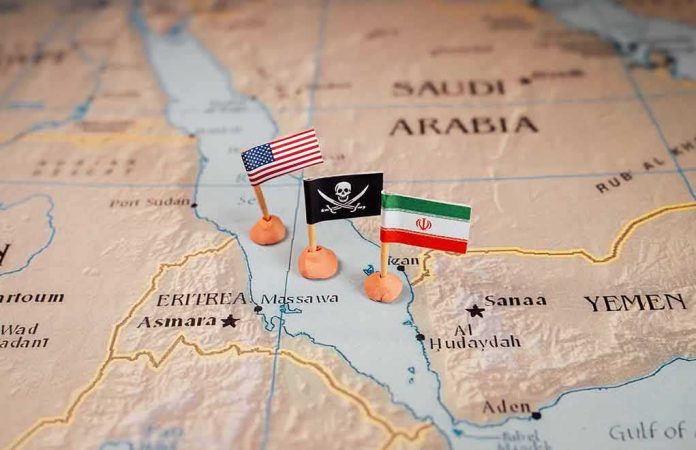
- The target is the Bab el-Mandeb Strait and the Saudi East-West pipeline network that now carries the bulk of the kingdom’s oil exports around a separately blockaded Strait of Hormuz.
- Saudi Arabia has flatly denied the underlying premise, calling the blockade narrative “false” and citing continued shipping into Yemeni ports as proof.
- Under the law of naval warfare, a genuine blockade requires public notice, effective enforcement, defined geography, and impartial application — standards this declaration has not yet visibly met.
- Even a partially enforced blockade compounds an existing chokepoint crisis, since Saudi Arabia built its Red Sea export route specifically to escape Iran’s grip on Hormuz.
What the Houthis Actually Declared
On July 20, 2026, Houthi military spokesman Yahya Saree announced what he called a maritime embargo against Saudi Arabia, framing it in explicitly retaliatory terms: “The Yemeni Armed Forces declare a maritime embargo against the criminal Saudi enemy, based on the equation of ‘an eye for an eye,’ effective immediately upon the issuance of this statement.” The stated trigger was a Saudi-linked strike on Sana’a International Airport the previous week, which the Houthis say occurred as the kingdom attempted to prevent an Iranian aircraft from landing. The Houthis have cast the move not as new aggression but as a mirror of what they describe as Saudi Arabia’s own long-running air, sea, and land blockade of Houthi-held Yemen, a policy with roots stretching back to the 2015 Saudi-led intervention.
This is not the Houthis’ first invocation of naval power as leverage. The group spent much of 2023 and 2024 harassing commercial vessels in the Red Sea over the Gaza war, driving Suez Canal traffic to its lowest levels in half a century and dragging the United States into a sustained air campaign against Houthi positions. That history matters here: it establishes that the group has both the missile and drone inventory and the demonstrated willingness to act on threats of this kind, even if the current blockade’s operational reach remains, for now, unconfirmed.
Why the Bab el-Mandeb Matters More Than It Used To
The strait connects the Red Sea to the Gulf of Aden and, from there, the Indian Ocean — the route by which Suez-bound cargo and a large share of the world’s seaborne petroleum reach European and Asian markets. Roughly 7.4 million barrels of oil per day transited the passage as recently as mid-2023, close to 7% of global output, and that traffic has taken on outsized strategic weight for one specific reason: Iran has spent months intermittently choking the Strait of Hormuz, forcing Saudi Arabia to reroute the majority of its crude exports overland via the East-West pipeline to the Red Sea port of Yanbu instead. Estimates of that diverted volume run from roughly 4 million to as high as 7 million barrels a day, depending on the reporting window — but the direction is unambiguous. Saudi Arabia built its Hormuz workaround through the very waters the Houthis are now threatening to close.
That is the mechanism that turns a regional militia’s declaration into a global economic story. A blockade confined to the Bab el-Mandeb would not merely inconvenience Saudi Arabia; it would strip away the kingdom’s primary hedge against an already-blockaded Strait of Hormuz, leaving Riyadh’s oil exports squeezed from both directions at once. Brent crude has responded accordingly, climbing toward five-week highs on the news, though prices remain well below the war’s earlier peaks — a gap analysts attribute partly to elevated global inventories, including stockpiles in China approaching 2 billion barrels, which cushion markets against short-term supply shocks even as the geopolitical risk premium rises.
Riyadh’s Rebuttal and the Legal Definition Problem
Saudi Arabia’s response has been categorical denial rather than acknowledgment-with-justification. The kingdom’s government called the entire premise “false,” pointing to trade data showing more than 300 commercial vessels carrying food, fuel, and construction materials entered the Houthi-controlled ports of Hodeida, Salif, and Ras Isa during just the first half of 2026. The Saudi-led coalition separately vowed to protect commercial shipping through the strait “with force,” and Egypt — whose Suez Canal revenue depends heavily on undisrupted Red Sea traffic — issued its own condemnation of the blockade threat.
This is where the word “blockade” itself becomes a battleground distinct from the physical one. Naval law scholars and the San Remo Manual on international armed conflict at sea set a demanding bar for what counts as a legally cognizable blockade: it must be publicly declared with a defined start date and geographic limits, it must be enforced by a force actually capable of preventing passage, and it must be applied without favoritism toward any flag. Analysis of the broader Iran-linked conflict has already identified several distinct “blockade-style” operations underway in the region, each resting on different legal authorities and each falling short, to varying degrees, of that classical standard. Rhetorical blockades — announced on state television, amplified through a group’s media wing, but never matched by intercepted tonnage — are common in modern irregular warfare precisely because the label itself carries coercive value independent of enforcement. Riyadh’s insistence that shipping into Yemeni ports continued unimpeded is, in effect, an argument that the Houthi declaration fails the “effectiveness” test even by its own logic.
What Happens Next
The precedent for how this resolves already exists in Yemen’s own history: a 2017 Saudi-led closure of Yemen’s air, land, and sea ports, justified at the time as counter-smuggling policy against Iranian arms shipments to the Houthis, drew international condemnation and was partially unwound under UN pressure within weeks. Blockades of this kind are frequently walked back once the political cost — humanitarian criticism, allied pushback, market disruption — exceeds the strategic gain. A Houthi delegation was reportedly still engaged in parallel talks with Saudi officials in Oman even as the blockade was announced, suggesting the declaration functions partly as negotiating leverage rather than a closed door.
Still, the risk of miscalculation is real and rising. Iranian Revolutionary Guard vessels have separately intercepted tankers running dark — transponders switched off to evade tracking — a sign that enforcement mechanisms for exactly this kind of chokepoint pressure are already being tested elsewhere in the theater. If Yemen’s blockade moves from declaration to interdiction, even intermittently, insurers will reprice Red Sea transits, shippers will divert around the Cape of Good Hope as many already did during the 2023–24 Houthi campaign, and the cost will land on global energy consumers regardless of which side’s account of the underlying siege is accepted as accurate.
Maps show where new blockade could choke off oil and gas shipments
Iran-backed Houthis have declared a naval blockade on Saudi Arabia. That could disrupt energy shipments and increase the risk to global markets.https://t.co/IrjSpBrmc7
— Vincent Johnson (@VOJay_Pgh) July 21, 2026
The Durable Lesson
Strip away the day’s headlines and a pattern recurs across decades of maritime conflict: the announcement of a blockade is cheap, its legal validity is contestable, and its economic effect depends entirely on enforcement capacity that is usually uncertain at the moment of declaration. What is not uncertain is the vulnerability it exposes — a global energy system that now depends on two chokepoints, Hormuz and Bab el-Mandeb, both controlled in part by actors aligned against Saudi Arabia and the United States. That structural exposure, more than any single spokesman’s statement, is the story that will outlast this particular news cycle.
Sources:
jpost.com, cfr.org, news.sbs.co.kr, arabnews.jp, digital-commons.usnwc.edu, assets.cambridge.org