
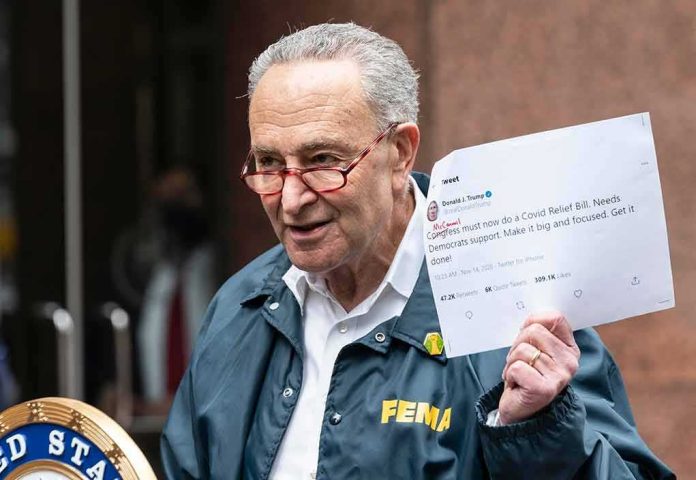
The most durable weapon in American political combat isn’t a policy argument at all — it’s the accusation of hypocrisy, and nothing illustrates its cheap power quite like watching a senator’s carefully staged anti-corruption rollout get hijacked by four words: “you back genocide.”
Key Points
- A protester interrupted Senate Minority Leader Chuck Schumer at a National Press Club event as he unveiled anti-corruption legislation targeting President Trump, accusing him of hypocrisy over U.S. support for Israel’s war in Gaza.
- The protester has been identified in reporting as Sam Husseini, a self-described journalist and Palestinian Christian activist, who was removed from the room after the outburst.
- The confrontation fits a years-long pattern: Schumer has been publicly heckled over antitrust inaction, the Capitol riot no-fly list, and repeatedly over Gaza policy outside his Washington and Manhattan offices.
- No on-record, point-by-point rebuttal from Schumer’s office directly answering the genocide accusation has surfaced in the available reporting — a gap worth noting, though it does not change the documented facts of the incident.
- The episode is best understood not as an isolated viral clip but as a case study in how hypocrisy charges function in politics: low-cost to make, hard to fully extinguish, and largely immune to the underlying policy merits.
What Happened at the Press Club
Schumer had gathered reporters and allies to promote what his office billed as sweeping anti-corruption legislation, the proposed Anti-Corruption Bureau Creation Act, framed as a direct rebuke of President Trump’s business dealings while in office. The event, hosted with the consumer advocacy group Public Citizen, was designed to project a simple message: the presidency has become, in Schumer’s telling, a vehicle for personal enrichment, and Democrats intend to build the institutional machinery to expose it. That message lasted only a few minutes before a voice from the audience cut through it.
“How can you talk about corruption when you back genocide?” the man shouted, before being escorted from the room. Reporting identifies the protester as Sam Husseini, an activist and self-identified journalist with a Palestinian Christian background, who framed his objection explicitly around Schumer’s support for Israel’s military campaign in Gaza. Fox News described the moment as leaving Schumer “slammed for his ‘diabolical record,'” derailing an event built entirely around the opposite message. Social media posts captured Schumer’s clipped response to the disruption — “thank you for your diatribe” — a dismissal rather than a rebuttal, and one that did not engage the substance of the charge.
A Recurring Confrontation, Not a One-Off
Anyone who has followed Schumer’s public appearances over the past several years will recognize the shape of this moment, because it has happened before, in different rooms, over different grievances. In 2022, roughly twenty anti-Big Tech advocates confronted him in Washington over stalled antitrust legislation. In 2021, on a New York City street, a protester called him a “racist, coward, anti-semite” while he addressed the Capitol riot no-fly list, a jarring accusation given that Schumer is Jewish. And Gaza policy specifically has generated the most sustained friction: demonstrators have been arrested by the dozens, and at times by the hundreds, outside his Manhattan and Washington offices over U.S. arms transfers to Israel, with organizers including Jewish Voice for Peace explicitly demanding he use his leadership position to halt the war. Protesters even gathered outside his Brooklyn apartment following the U.S. airstrike that killed Iranian general Qasem Soleimani.
What ties these episodes together is not any single policy dispute but a durable public perception that Schumer’s foreign policy record sits uneasily beside his broader reformist branding — whether the subject is corporate power, ethics, or war. The National Press Club heckle simply concentrated that tension into fifteen seconds of video, aimed at the exact moment he was asking the country to trust his judgment on corruption.
Why Hypocrisy Charges Travel So Well
There is a structural reason accusations like this land with such force regardless of party or era: they are cheap to make and expensive to fully answer. A hypocrisy charge does not require the accuser to prove that a policy is wrong on the merits — only that the accused’s conduct is inconsistent with the values they publicly claim. That is precisely why the same rhetorical weapon gets used across the ideological spectrum against Schumer himself. Senator Pete Ricketts accused him of “breathtaking” hypocrisy over shutdown negotiations, while radio host Charlamagne tha God separately called out Schumer and House Democratic Leader Hakeem Jeffries for suddenly discovering concerns about money in politics despite a donor base heavy with corporate contributions. The genocide accusation at the Press Club is simply the Gaza-era version of a pattern that recurs whenever a political figure builds a public identity around integrity: the record gets audited by opponents looking for the gap between message and conduct.
This dynamic explains why the moment generated so much attention beyond the immediate news cycle. It wasn’t really about parliamentary procedure or press-club etiquette. It was a test of whether an anti-corruption message can survive contact with an audience that judges the messenger’s entire record, not just the specific bill on the table.
What the Record Does and Doesn’t Show
It is worth being precise about what the available reporting actually establishes and what it does not. The confrontation itself, the protester’s identity, and the specific wording of the accusation are well documented across multiple outlets. What is not documented in the public record reviewed here is any subsequent, substantive response from Schumer’s office that engages the genocide allegation directly — a comparison of his voting record on arms transfers, a defense of specific policy votes, or a rebuttal of the legal notice activists have referenced regarding potential liability under international law. The absence of that response is not proof of anything about the underlying policy question; it simply means the public debate, for now, remains anchored to the clipped confrontation rather than a fuller accounting on either side.
"Thank you for your diatribe."
Senate Minority Leader Chuck Schumer's anti-corruption speech goes off the rails after he's confronted by a protester accusing him of being a "genocidal maniac."
Schumer repeatedly responded, "Please sit down, please sit down," before telling the… pic.twitter.com/Z00hCwGS0Z
— Fox News (@FoxNews) July 31, 2026
Why It Matters Going Forward
Gaza policy is not receding as a live political fault line, and neither is the broader appetite for anti-corruption messaging from both parties. That combination guarantees more moments like this one: a politician stakes out high ground on ethics or institutional integrity, and an audience member with an unrelated grievance uses the platform to collapse the distance between rhetoric and record. The lesson for anyone trying to evaluate these episodes honestly is to separate the theater from the substance — the heckle is real and vivid, but resolving whether the underlying hypocrisy charge holds requires the kind of documentary comparison that rarely survives past the viral clip. Until that fuller accounting happens, on Gaza or any comparable fault line, expect the same confrontation to recur, aimed at whichever official is currently claiming the moral high ground.
Sources:
timesofindia.indiatimes.com, foxnews.com, reddit.com, yahoo.com, usatoday.com, nydailynews.com, youtube.com, punchbowl.news