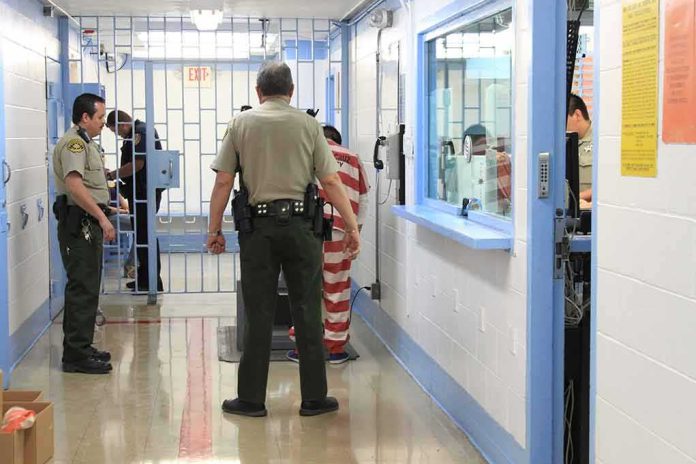
Florida did something almost no modern state has dared to do: it killed two convicted murderers in one day, one of them a former cop who raped and murdered an 11-year-old girl, and the other an 80-year-old who shot his ex-girlfriend’s parents.
Story Snapshot
- Florida carried out a rare double execution, its first in roughly six decades.
- Former officer James Aren Duckett was executed for raping and murdering an 11-year-old girl.
- Dominick Anthony Occhicone, 80, was executed for murdering his ex-girlfriend’s parents.
- Both executions followed years of appeals, DNA testing, and Supreme Court review.
Florida turns its death chamber into a statement
Florida did not just enforce two old death sentences; it made a point about crime, punishment, and how far a state will go to defend order. On one Tuesday at Florida State Prison near Starke, the state executed James Aren Duckett around midday and Dominick Anthony Occhicone six hours later, the first time in about 60 years that Florida has put two people to death in a single day. That timing was no accident; it was signed and scheduled by Governor Ron DeSantis.
Duckett’s case hit a nerve because he was not just any killer; he was a small-town police officer, convicted of raping and murdering 11-year-old Teresa, then leaving her body in a lake in 1987. Tire tracks tied to his patrol car and the girl’s fingerprints on his hood became anchors of the case, and for many ordinary Floridians, that evidence and the uniform he wore made his crime feel like an attack on the badge itself. One family member said he “took advantage of his badge,” capturing the deep sense of betrayal.
The cop, the child, and the question of innocence
Duckett never stopped claiming he was innocent, even as the execution date drew near. Florida’s Supreme Court postponed his earlier March execution so new DNA testing could be done on crime scene evidence, a rare pause in a system that usually values finality. When the test came back, the state called it “inconclusive” and left the conviction untouched, which means it did not prove he was innocent, but it also did not strengthen the case against him. This is where death penalty critics see a problem: once someone is dead, you cannot correct a mistake.
Duckett’s lawyers pushed one more angle, arguing to the United States Supreme Court that Florida’s lethal injection method risks a botched execution. The high court declined to stop the process, which cleared the way for the warden to move forward. From a common-sense conservative view, you can see two truths at once. First, the crime against an 11-year-old girl, committed by a sworn officer, is exactly the kind of evil capital punishment was designed for. Second, if the state itself admits new science is “inconclusive,” many people will say that the safer course is life in prison without parole instead of death.
An 80-year-old killer and the Eighth Amendment debate
Six hours after Duckett died by lethal injection, Florida executed Dominick Anthony Occhicone, an 80-year-old man convicted of murdering his ex-girlfriend’s parents in 1986. Prosecutors said he drove to their home and shot them after a bitter breakup, turning a family dispute into a double murder. Unlike Duckett, Occhicone’s case was not about innocence; his lawyers focused on whether killing a frail, elderly man comports with the ban on “cruel and unusual punishment” in the Eighth Amendment.
Florida executes 2 men in a day, including an octogenarian
AP — Florida on Tuesday became the first state in nearly a decade to carry out two executions in a single day, putting to death an 80-year-old man who was the second-oldest inmate known to receive a lethal injection in… pic.twitter.com/pfuTJeWrb6
— Black Page (@WorldNEWS0_) July 30, 2026
Death penalty opponents argue that executing an 80-year-old with health problems crosses a moral line, because the man is no longer a threat outside prison walls and the punishment looks more like vengeance than protection. Many conservatives answer plainly: age does not erase responsibility. If anything, allowing killers to escape the full penalty because enough years passed undermines justice for victims who waited decades. Yet even among tough-on-crime voters, there is growing unease about using the death chamber on octogenarians, especially when the state has other tools, like strict life sentences.
Why this double execution matters beyond Florida
Florida’s double execution did more than end two lives; it signaled a broader shift. The state has ramped up executions, and its law now allows death sentences when only eight of twelve jurors agree, the lowest threshold in the country. That makes it easier to send people to death row and harder for late-stage doubts to matter. The United States Supreme Court once struck down Florida’s old death sentencing system for giving judges too much power, but lawmakers have since rebuilt a process that critics say still cuts corners.
Governor DeSantis has not explained publicly why these two men were chosen for the same day, even though other inmates sit on death row. That silence raises reasonable questions. Is the timing meant to send a message to criminals, to activists, or to voters? Without clear answers, the risk is that execution dates look political rather than purely legal. At the same time, victims’ families in these cases waited nearly four decades for the sentences a jury and judge pronounced. To them, this is not a spectacle; it is the state finally keeping its word.
The uneasy balance between justice and doubt
Florida’s double execution forces a choice about what justice looks like in a free society. Many Americans, especially on the right, still believe that the death penalty has a narrow but necessary place: for the worst murders, like the rape and killing of a child, or the planned shooting of innocent parents in their own home. Those same citizens also want a process that is rock-solid on facts, honest about risks, and sparing with secrecy.
Duckett’s inconclusive DNA test, Occhicone’s age, and the quiet scheduling decisions show how hard it is to meet both goals at once. If you care about order, you do not want soft justice. If you care about limited government, you do not want the state wielding irreversible power without full transparency. Florida’s death chamber, on that July day, sat directly at that crossroads. Whether you cheer or recoil, you cannot say the stakes were small.
Sources:
youtube.com, apnews.com, people.com, floridacourtrules.com, fl.elaws.us, alligator.org, npr.org