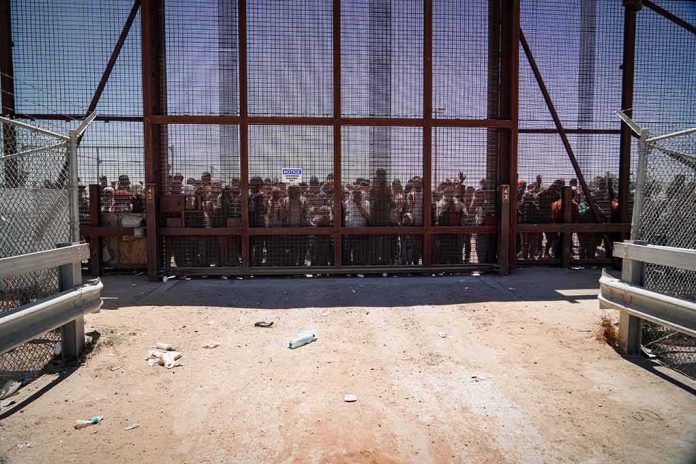
When nearly 50,000 people cross a fortified external border of the European Union in a single day, the story is not just about one enclave overwhelmed, but about how fragile Europe’s migration architecture becomes when a single link in the chain fails or is withdrawn.
Key Points
- Spain’s Interior Ministry estimates roughly 49,000 migrants entered the tiny Spanish enclave of Ceuta from Morocco within about 24 hours, a figure larger than half the city’s population.
- The influx unfolded as Moroccan border forces largely pulled back and Spanish controls were rapidly overrun, forcing Madrid to deploy the military and emergency assets to regain basic order.
- Reception capacity in Ceuta collapsed almost instantly: a center built for a few hundred people faced tens of thousands, with many migrants sleeping in car parks and on streets without food, sanitation, or shelter.
- The incident has reignited tensions between Spain and Morocco and triggered a sharp political backlash inside the EU, with calls from some leaders to sanction or even suspend Spain from the Schengen free-movement area.
The Day Ceuta’s Border Gave Way
Ceuta is a six-square-mile Spanish enclave on the north coast of Africa, facing the Strait of Gibraltar and surrounded by Moroccan territory. It is one of only two land borders between Africa and the European Union, fortified for decades with double fences, watchtowers, and a heavy presence of Spain’s Civil Guard and National Police, backed on the Moroccan side by gendarmes and auxiliary forces. In late July 2026, that system effectively failed for a full day. Spain’s Interior Ministry told reporters that about 49,000 people crossed from Morocco into Ceuta in roughly 24 hours, most of them irregularly. Other official and local estimates range from “nearly 50,000” to around 60,000, but all agree the scale was unprecedented in modern European border management.
The crossings took two main forms. Thousands swam around the Tarajal breakwater, often using inner tubes, improvised flotation devices, or inflatable toys to propel themselves in the dark sea, while others walked along a narrow strip of shoreline at low tide. Video and photography from Spanish and international outlets show dense crowds moving around the sea fence, some in street clothes and flip-flops, others in little more than swimwear, heading for Ceuta’s beaches. At the same time, large groups surged over or through sections of the land fence and border gates. Spain’s state agency EFE, cited by Reuters, reported that “hundreds of youths could be seen scaling the security fencing — which was not being guarded by police at the time,” while Moroccan auxiliary forces responsible for ground security “withdrew as the young people passed.” For several crucial hours, the combination of sea and land routes turned Ceuta’s border from a hardened perimeter into a porous corridor.
Moroccan Non‑Enforcement and the Diplomacy Behind It
Spanish officials, and many EU observers, link the incident directly to a sudden relaxation of Moroccan controls. On ordinary days, Rabat’s security forces are the first line of defense, intercepting migrants long before they reach the fence or the surf; Moroccan authorities have boasted of blocking nearly 80,000 attempts to enter Ceuta in a single year. In this case, reporting from Reuters, Le Monde, and others converges on the same pattern: as crowds of predominantly young Moroccan men and teenagers gathered near the border, Moroccan forces largely stood back or left positions altogether, allowing mass movement toward Ceuta.
This is not without precedent. In May 2021, roughly 8,000 people entered Ceuta over two days amid a sharp diplomatic row after Spain admitted the leader of the Polisario Front, which opposes Morocco’s claim to Western Sahara, for medical treatment. Spanish media and several European outlets later described that episode as a deliberate “loosening” of Moroccan border enforcement to signal displeasure. The 2026 surge unfolded against similarly strained relations, with analysts again suggesting that a combination of negligence and tacit political signaling from Rabat made the numbers seen in Ceuta physically possible. Official Moroccan statements have emphasized later cooperation in returns, but the photographic and testimonial record indicates that for a crucial window, border policing on the Moroccan side was minimal.
Humanitarian Collapse Inside the Enclave
Ceuta’s reception system is built for steady pressure, not a tidal wave. The main migrant reception center has capacity for roughly 600 people. It was already under strain after about 1,500 arrivals in the preceding days when, in the span of 24 hours, tens of thousands more came ashore. Local authorities, including Ceuta’s regional president, warned Madrid that the city was “overwhelmed” and on the brink of collapse. Spain quickly deployed army units, armored vehicles, naval patrols, and military divers to patrol beaches and waters, while additional Civil Guard and National Police contingents were flown in from mainland Spain.
The scenes inside Ceuta bore out the warnings. Journalists on the ground reported migrants sleeping in parking lots and doorways, without organized provision of food or sanitation. Doctors and emergency services scrambled to treat hypothermia, dehydration, and injuries from fence-climbing or being crushed in crowds. At least 18 to 19 people are confirmed to have died in the attempt, most by drowning near the Tarajal breakwater, with some sources citing initial tallies of up to 34 deaths that later settled lower as duplicate reports were reconciled. For a city of roughly 83,000 residents, the sudden arrival of a population equal to more than half its own was experienced by many locals as a shock bordering on existential threat; residents interviewed in European and Spanish media spoke of “invasion,” “apocalypse,” and being afraid to open their doors.
Who Crossed, and Why?
Most of the migrants were young Moroccan men, roughly between 15 and 25 years old, according to Spain’s Interior Ministry and on-the-ground reporting. There were also smaller numbers of sub-Saharan Africans and some families with children, but this was not primarily an exodus from distant conflict zones; it was largely a regional movement driven by economic desperation, social frustration, and the perception of a fleeting opportunity. Interviews gathered by broadcasters and newspapers reveal a consistent narrative: people had heard, often via social media and word of mouth, that the border was “open” and that Spain would be unable to expel swimmers quickly because of legal constraints.
Those expectations intersected with Spain’s domestic policy signals. Madrid’s recent regularization program, which offered legal status to around 500,000 undocumented migrants already living and working in Spain, was widely covered and sometimes misinterpreted in sending communities as a general “amnesty” for anyone able to reach Spanish soil. At the same time, a Spanish Supreme Court decision clarifying limits on so‑called “hot returns” — summary expulsions of people intercepted at the fence or immediately on landing — was read by some migrant networks and traffickers as meaning swimmers could not simply be pushed back. Whether or not that legal reading was accurate, it contributed to a belief that a risky swim could pay off.
Spain’s Response: Emergency Measures and Mass Returns
Faced with numbers no border or small city can comfortably absorb, Spain moved rapidly from ad hoc policing to crisis footing. The Interior Ministry first reinforced Ceuta’s security forces, then activated military support, including naval units and helicopters to monitor the coastline and discourage further departures from Moroccan beaches. On land, soldiers helped cordon off crowded areas and secure key infrastructure, while police tried to separate minors from adults and identify those with potential asylum claims.
Parallel to security operations, Madrid turned to diplomacy. Within a day, Spanish and Moroccan officials announced an agreement for the “urgent return” of those who had crossed irregularly but had no basis for protection claims. By the following afternoon, Spain estimated that roughly half of those who entered — around 25,000 people — had already gone back to Morocco, either through organized returns or simply by swimming or walking back when it became clear that food, work, and onward travel were not forthcoming. The speed of that reversal underscores a key structural fact: surges of this kind are highly contingent. The same border that appears “open” for a few hours can become practically closed once both states re‑engage enforcement and the immediate lure of opportunity fades.
European Political Shockwaves
Even as Spain tried to restore control locally, the optics of tens of thousands of people entering EU territory in a day reverberated across Europe. Italy’s Prime Minister, Giorgia Meloni, quickly framed the episode as evidence that Spain could not meet its Schengen responsibilities and floated the idea of suspending Spain from the passport-free travel area, a stance that found some echo in Finland’s rhetoric. France, more quietly but just as tellingly, announced tighter checks on its border with Spain, mindful of secondary movements of migrants who might leave Ceuta for the Iberian mainland and then travel onward by land.
Spain’s government pushed back hard against the implication that it was failing in its obligations. Officials pointed out that they had mobilized the army within hours, were coordinating closely with Morocco on returns, and had long shouldered a disproportionate share of EU irregular arrivals along with Italy and Greece. Madrid also summoned the Italian ambassador to protest what it called “weaponization” of migration for domestic political purposes in other EU capitals. The dispute laid bare a longstanding tension in European migration politics: every crisis at the external border becomes fodder for internal arguments over burden-sharing, solidarity, and who is “soft” or “tough” on migration.
A Recurring Fault Line, Not a One‑Off Shock
The 2026 Ceuta incident is best understood not as an isolated catastrophe but as the most extreme point so far in a recurring pattern. In 2021, thousands crossed in a matter of days amid a diplomatic quarrel; in 2024, Moroccan authorities publicly highlighted having blocked thousands more after social media calls for a mass rush on the fence. In 2025, even far smaller episodes of around one hundred swimmers at a time were enough to push Ceuta’s small reception capacity to the brink. Each time, three elements converge: changes in Moroccan enforcement posture, political or legal signals from Spain and the EU, and organized or semi‑organized mobilization by migrants who share information rapidly.
From a systems perspective, Ceuta is a stress test for Europe’s broader border and asylum regime. It concentrates several structural vulnerabilities in one tiny place: dependence on a non‑EU neighbor’s cooperation, limited local capacity, EU‑wide political contention, and a legal framework that rightly constrains the use of force and summary removal but is poorly adapted to sudden surges on this scale. The 2026 surge simply pushed all of those elements to their limits at once.
What This Means Going Forward
In the immediate aftermath, Spanish and European policymakers face two distinct but related tasks. One is technical: reinforcing early-warning systems, contingency reception capacity, and joint operational planning with Morocco so that the next attempted mass crossing does not translate into another day of “absolute chaos” on European soil. That will likely involve more resources for Frontex, more robust maritime surveillance, and formalized triggers for rapid redeployment of police and military units to Ceuta and Melilla.
The second is political and diplomatic. As long as border control at Ceuta remains heavily dependent on Moroccan choices, migration will remain a lever in Rabat’s broader negotiations with Madrid and Brussels over Western Sahara, trade, and aid. The 2026 crisis illustrates how powerful that lever can be: a few hours of laxity on the Moroccan side produced the largest single-day irregular arrival event in EU history. Spain and the EU will have to decide how much they are prepared to pay — in funding, diplomatic concessions, or deeper partnership — to limit the temptation to use migration as a bargaining chip, and how to embed that relationship within a more coherent European approach to legal pathways, labor migration, and returns.
Migrant deaths rise to 41 in massive crossing into Spain's Ceuta from Morocco; over 37,500 migrants returned to Morocco voluntarily, say officials #España #CeutaEsEspaña https://t.co/7uAx1fDmzo pic.twitter.com/B2DvJf9D2W
— Gulf Today (@gulftoday) July 31, 2026
Sources:
reuters.com, en.wikipedia.org, euronews.com, nypost.com, abc.net.au, theguardian.com, washingtonpost.com, facebook.com, instagram.com, france24.com, semafor.com, colombiaone.com, nytimes.com, cbc.ca, english.elpais.com, bbc.com, straitstimes.com, youtube.com