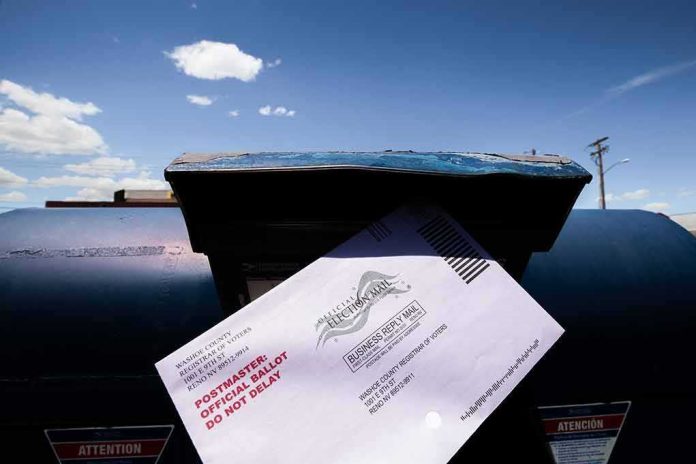
The fight over federal limits on mail voting is not about fraud statistics; it is a constitutional tug-of-war over who sets the rules—states, Congress, or the executive branch—and whether the U.S. Postal Service is a carrier of ballots or a gatekeeper deciding which ones move.
The Short Version
- Federal courts repeatedly blocked attempts, under President Trump’s direction, to tighten mail voting via USPS rules; judges said the Constitution leaves core election administration to states and Congress, not the president or USPS.
- USPS still published a 95-page final rule to “flip on” if injunctions were lifted, underscoring a strategic bet on rapid implementation despite active court orders.
- The contested mechanics—state ballot lists, mandatory barcodes, and delivery refusals in noncompliant states—would shift USPS from neutral carrier to conditional gatekeeper, a role courts found likely unlawful.
- Broader lesson: modern mail-voting disputes hinge less on fraud claims than on institutional authority, legal timing, and operational disruption to state-run systems.
What the courts actually decided—and why it matters
When the administration moved to narrow mail voting using USPS as the operational pivot, it met fast, specific judicial resistance. In June, a federal judge in Boston enjoined key parts of the executive order, writing plainly that the Constitution grants no specific election powers to the president and that the order exceeded executive authority by attempting to reshape state-run election procedures. A First Circuit panel later declined to let the administration implement the order in 23 states, keeping a major brake in place. Separate litigation targeted USPS’s implementing rule; a federal judge issued a temporary restraining order blocking core provisions after finding they risked disenfranchising voters and were likely unlawful under the Constitution’s allocation of election authority to the states.
These were not generalized doubts; they were concrete rulings, anchored in constitutional structure and the statutory limits of USPS. The thread across cases is consistent: the Postal Service is a federal carrier, not an election regulator empowered to condition delivery on new federal standards. That distinction—carrier versus arbiter—proves dispositive when courts weigh institutional roles against the urgency of pre-election changes.
The proposed mechanics: from carrier to gatekeeper
The Postal Service’s final rule, published with the stated intent to activate quickly if courts relented, would have required states to transmit rosters of voters who received mailed ballots and to apply unique barcodes to outbound and return envelopes; in noncompliant states, USPS would not deliver ballots under the new standards. Operationally, these requirements would embed a federal checkpoint inside the flow of election mail, with USPS verifying state-provided lists and envelope attributes before conveying ballots. Supporters framed this as a quality-control and chain-of-custody upgrade; critics saw a de facto power grab by a federal carrier to police eligibility and design—functions historically and legally housed in state law and local administration.
Court reactions followed the critics’ view: once USPS conditions movement of ballots on new, nationwide standards, it ceases to be only a neutral logistics layer. Judges emphasized that federal executive actors cannot unilaterally dictate eligibility screens or delivery conditions that alter state election architectures in the short runway before voting.
How we got here: a legal and operational collision course
The legal playbook against late-cycle voting rule changes is well developed. Courts scrutinize who has authority to act, how late the change lands, and whether it will sow confusion or disrupt systems already under load. That framework has shaped election litigation for years, and mail-voting cases are no exception. Analysts have stressed that these fights usually turn less on contested fraud rates and more on governance boundaries and timing effects on voters and administrators. Meanwhile, states have steadily liberalized mail-voting eligibility since 2020, with some adopting permanent all-mail elections—deepening state reliance on stable postal handling, not new federal chokepoints.
Against that backdrop, USPS’s move to finalize a detailed rule during active injunctions was legally unusual but strategically clear: be ready to implement at once if appellate relief arrived. The agency explicitly said as much, publishing the 95-page rule “despite” a court order because it wanted immediate effect upon any judicial opening. Courts, however, interpreted that readiness as incompatible with earlier orders and, in one case, as a likely constitutional overreach, reinforcing the line between carriage and administration.
Where the real disagreement lies
The core dispute is not whether USPS can set internal mail-handling practices—it can, and has for decades—but whether it can impose external compliance conditions on state election processes as a prerequisite to ballot movement. The administration argued that Congress had not barred USPS from promulgating handling standards touching election mail; opponents countered that these were not mere handling standards but functional eligibility filters and design mandates that displaced state prerogatives. The rulings sided with opponents: when a rule instructs USPS to refuse ballots from states that do not adopt federalized standards, it effectively reassigns election administration choices from state law to a federal carrier, without congressional authorization.
That is why the litigation traction was strongest on constitutional structure and statutory authority, not on empirical claims about fraud prevention. Even if the operational requirements are sensible in isolation—barcodes for traceability, list-matching for accuracy—the constitutional question is who gets to require them and on what legal timeline before an election.
5/ The Trump administration’s core arguments: Congress never barred USPS from setting handling standards for election mail. The rule does not seize state election administration. It requires states that want USPS to carry their ballots to submit the same data they already have…
— Ryan (@NecroSignatures) September 1, 2026
What it means going forward
First, expect more emphasis on congressional channels, not executive directives, for any federal standards touching election mail. If federal uniformity is the goal, legislation—not a USPS rulebook—will be the durable path. Second, anticipate tighter judicial policing of late-cycle changes. The closer to an election a rule lands, the more skeptical courts become about its disruptive potential, regardless of the proponent’s rationale. Third, watch for renewed, state-led investments in mail-ballot integrity that respect the carrier–administrator divide: unique ballot identifiers and ballot-tracking portals enacted by state law, data-sharing compacts with USPS that do not condition delivery, and transparent service standards that preserve USPS’s neutrality as a carrier.
The constitutional architecture here is resilient. States design the process; USPS moves the mail. When those roles blur, courts intervene. The episodes of injunctions and rapid-fire rulemaking did not just resolve a one-off skirmish; they clarified boundaries that will govern every future attempt to hardwire election administration into federal postal regulations. For the voter, that means fewer abrupt changes at the mailbox. For policymakers, it is a reminder that durable election reform runs through statutes and state systems, not the loading dock of a federal carrier.
Sources:
redstate.com, reuters.com, scotusblog.com, cnn.com, naacpldf.org, npr.org