
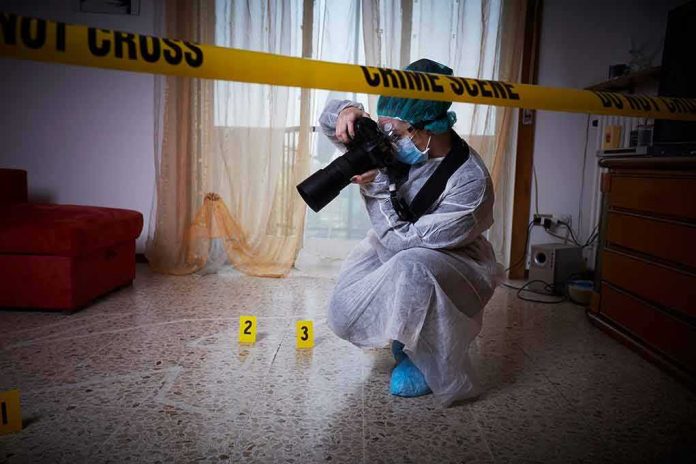
The backpack bombing that tore through the entrance of a Monaco apartment building was not random terror but a meticulously staged, cross-border assassination attempt on a sanctioned oligarch and his family—one that exposes how Europe now manages violence around high-net-worth targets under the legal label of organized crime, not terrorism.
Key Points
- Monaco’s prosecutor has formally classified the blast as attempted premeditated murder linked to organized crime, not a terrorist attack.
- The attack used an improvised explosive device hidden in a backpack at the entrance of Vadym Ermolaev’s residence, detonating as he, his partner, and their son entered.
- Investigators identified a Ukrainian suspect, Anastasiia Berezovska, who allegedly disguised herself as a man; an Interpol Red Notice was issued before she was later found shot dead near Kyiv.
- The case now spans Monaco, France, Germany, and Ukraine, illustrating how oligarch-focused violence is routed through organized-crime frameworks to avoid the diplomatic consequences of a terrorism label.
A deliberate assassination attempt, not a terrorist incident
From the outset, Monaco’s authorities made a conscious legal and political choice: this blast was to be treated as a targeted attempted killing, not terrorism. Shortly before 9 p.m., an improvised explosive device—packed into a backpack or parcel—was left at the entrance of a residential building on Rue Révérend Père Louis Frolla, near the French border. The device exploded as the occupants of a ground-floor apartment approached or passed through the doorway, critically injuring a wealthy Ukrainian-born businessman, his partner, and their teenage son.
Though officials initially declined to name the victims, converging reporting from French, Ukrainian, and international outlets identified the target as Ukrainian construction and real estate magnate Vadym (or Vadim) Ermolaev/Yermolaiev, along with his partner and their 13-year-old child. The injuries were severe: multiple shrapnel wounds, extensive burns, and, in the case of the woman, catastrophic trauma to her lower body described in some accounts as the loss of both legs. For Monaco—a microstate that markets itself as one of Europe’s safest, most tightly controlled jurisdictions—the attack was unprecedented in recent history.
Legally, however, prosecutors were careful. Stéphane Thibault, Monaco’s Prosecutor General, stated repeatedly that the investigation was opened for attempted murder and the placement of explosives in a public area, and “not an attack classifiable as terrorism,” based on the evidence available at the time. The working theory set out publicly was a “settling of scores” linked to organized crime, even as Thibault insisted that no motive had yet been established and no single hypothesis was being favored.
How the attack was staged: surveillance, disguise, and the backpack bomb
Mechanically, the Monaco bombing fits a now-familiar pattern in European attacks on high-net-worth individuals: a compact improvised explosive device, concealed in a bag, placed where the target’s routine movements can be predicted. Surveillance footage from the building and surrounding streets captured a heavyset figure in dark clothing—a long-sleeved top, black hat or hood—carrying a backpack into the lobby minutes before the explosion. Investigators believe the device was either set with a timed detonator or remotely triggered when the family reached the entrance, a detail that emerging Ukrainian evidence suggests may have been deliberately recorded by the perpetrators.
The blast itself appears to have relied on shrapnel to maximize lethality. Monaco’s Minister of State, Christophe Mirmand, described the device as containing bolts and pellets; other reports referenced nuts, bolts, and metal fragments packed inside the bag. When it exploded at close range, the confined entryway turned into a killing zone. Glass shattered, metal fragments sprayed out, and the victims—entering or exiting their home in predictable fashion—absorbed the full force of the blast.
Crucially, the suspect did not vanish into Monaco’s narrow streets. CCTV tracked the figure fleeing uphill toward Beausoleil, just across the border in France, where French police joined the Monegasque Sûreté Publique in a joint manhunt. That immediate cross-border flight is one reason prosecutors tied the case to organized criminal networks rather than lone-wolf extremism: whoever planned the attack understood both the geography and jurisdictional seams of the Riviera, and exploited them.
The suspect: Anastasiia Berezovska and the problem of a dead witness
Within days, Monaco’s investigators moved from an anonymous silhouette on CCTV to a named suspect. Interpol issued a Red Notice for 39-year-old Ukrainian citizen Anastasiia Berezovska, identified by Monaco as the main suspect behind the bombing. According to the deputy prosecutor, Berezovska was “disguised as a man” during the operation, padding her figure and using male-coded clothing to mislead witnesses and cameras about the bomber’s identity.
This identification did not rest solely on the original surveillance footage. Ukrainian authorities later announced they had recovered and restored video evidence that the suspects had attempted to destroy—recordings apparently made to document the success of the operation for whoever ordered it. In that footage, Berezovska is said to be seen walking ahead of Ermolaev and his family, leaving the backpack in place as they approach, and then moving clear of the blast zone before detonation. The image is chilling: an operator who knows the victims’ routine well enough to lead them into the trap and then step aside.
Yet Berezovska never stood before a Monaco court. On 6 July 2026, she was found shot dead near Kyiv; Ukrainian prosecutors stated that her killing was an intentional murder, and a local court later ordered the detention of two suspects—Vladyslav Reut, reportedly an officer of Ukraine’s military intelligence agency (GUR), and Vitalii Zhykovych, a former Security Service of Ukraine (SBU) agent—in connection with her death. By the time Monaco’s file named her the chief suspect, its key witness was already gone. For prosecutors, that transforms the case from one that might rest on confession and direct testimony into one built almost entirely on circumstantial and forensic evidence.
Victim profile: a sanctioned oligarch in a “safe haven”
To understand why someone might invest the effort and risk required for such an attack, one has to look at the victim’s trajectory. Vadym Ermolaev built his fortune in Ukrainian construction, real estate, and alcohol distribution, most prominently through the Aleph group in Dnipro. In recent years he acquired Cypriot nationality, moved much of his life to the French Riviera, and positioned himself as part of the globalized class of sovereign-wealth expatriates.
His reputation, however, was contested. Ukrainian authorities sanctioned Ermolaev in 2023 over alleged financial wrongdoing, including claimed links to fraudulent call-center operations, allegations he publicly denied. Some investigative reporting and intelligence commentary have suggested that a “settling of scores” tied to these business disputes may be more plausible than a politically motivated hit, despite isolated speculation about Russian intelligence or Ukrainian state involvement.
Here, Monaco’s legal framing intersects with its economic model. The principality depends on being perceived as a secure, predictable haven for wealthy residents, with minimal overt political turbulence. Categorizing the bombing as attempted murder linked to organized crime, rather than terrorism, avoids triggering EU-level counterterrorism mechanisms and helps contain reputational damage to a narrative of exceptional criminality, not systemic insecurity. In practical terms, it also keeps primary jurisdiction in Monaco’s hands, with French and Ukrainian cooperation on criminal grounds rather than under the more politically charged rubric of international terrorism.
Open questions: motive, organizers, and jurisdiction
Despite the clarity around the attack’s mechanics, large parts of the story remain unsettled. Monaco’s attorney general has been explicit that the motive is unknown; investigators have not publicly identified who ordered the assassination attempt, nor have they announced arrests of any alleged organizers. An early detainee in Monaco was released without charge after verification checks, suggesting that, beyond Berezovska, authorities have yet to tie specific accomplices to the bombing with evidence strong enough to support prosecution.
The cross-border nature of the case complicates that task. The suspect’s flight route likely took her from Monaco into France and, according to some reports, onward to Germany before she returned to Ukraine, where she was ultimately killed. Each of those jurisdictions controls parts of the evidentiary chain: camera footage, travel records, communications, and possibly financial transactions, including reported use of cryptocurrency to pay intermediaries or mask funding flows. Ukraine’s prosecutor general has called for an international joint investigation team, and Ukrainian authorities say they have already established one, underscoring Kyiv’s interest in both the bombing and Berezovska’s murder.
Those moves are double-edged for Monaco. On one hand, broader intelligence cooperation might help trace who ordered the hit, especially if the organizers operated out of or through Ukraine-linked networks. On the other, it introduces diplomatic complexity: if evidence points toward state-linked actors, questions of political responsibility and jurisdiction will follow, potentially testing Monaco’s preference for an organized-crime narrative over anything that smells like state terror or covert action.
Pattern and precedent: oligarch violence as organized crime
Viewed against the past decade of European security incidents, the Monaco bombing is neither a one-off nor an entirely new species of violence. Several prior attacks on oligarchs and high-net-worth individuals have used backpack or parcel bombs placed at residential entrances, parking garages, or office lobbies, with prosecutors typically opening cases under attempted murder and organized crime statutes rather than terrorism. Only in rare instances—usually when clear evidence of state sponsorship emerges—have such cases been reclassified as terrorism.
That pattern reflects both legal pragmatism and political calculation. Organized-crime frameworks are well-established, allow for targeted mutual legal assistance, and do not force governments into public debates about whether an ally or adversary has engaged in terrorist acts on foreign soil. Terrorism labels, by contrast, come with diplomatic and economic consequences: travel advisories, security posture changes, and potentially, sanctions. For a jurisdiction like Monaco, which sells stability to investors and residents, anchoring a shocking event in the world of criminal “settling of scores” is a way to signal that the system still works—that this was a breach, not a new normal.
Yet for those who live and invest in such enclaves, the case sends a more sobering message. The idea of “safe havens” for sovereign wealth has always rested on the assumption that physical risk could be outsourced: whatever turbulence existed in the oligarch’s home country, the Riviera or the Alps would remain above the fray. The Monaco bombing, together with similar incidents in other European states, suggests that assumption is eroding. Assassination techniques are traveling with the money, and the legal systems that host the money are adapting by calling them organized crime and promising to restore order—with or without the testimony of the people who carried out the attacks.
🚨 EXPLOSIVE NEW FOOTAGE EMERGES FROM THE MONACO ASSASSINATION ATTEMPT
Ukrainian authorities say they recovered video allegedly recorded by the hit team themselves—reportedly intended to prove the assassination had been carried out.
The target was Ukrainian oligarch Vadym…
— Jim Ferguson (@JimFergusonUK) July 17, 2026
What this means going forward
For Monaco, the Ermolaev case is both a test and a precedent. The principality must demonstrate that it can investigate a sophisticated cross-border bombing, coordinate with at least three other states, and bring a credible case to court without its primary suspect alive to testify. Its prosecutors have signaled that, for now, they will pursue attempted premeditated murder and explosives charges, with organized crime as the operative frame. If forensic analysis of the device, financial trails, and Ukrainian court proceedings around Berezovska’s killers converge on a clear organizing network, Monaco will face choices about how publicly to characterize that network—and whether to keep the narrative anchored in criminal score-settling rather than in geopolitics.
For the wider European security environment, the bombing underscores a trend rather than inaugurating one. Wealthy individuals, especially those under sanctions or embroiled in opaque commercial disputes, are now potential targets even in jurisdictions that have long prided themselves on insulation from such violence. The tools used against them—compact IEDs, cross-border flight routes, layered use of front operators who may themselves be eliminated—sit at the junction of organized crime, intelligence tradecraft, and political messaging. How states choose to label and prosecute these attacks will shape not only legal outcomes but also how safe these so-called safe havens feel in the years ahead.
Sources:
thegatewaypundit.com, reuters.com, news.mc, en.wikipedia.org, npr.org, euronews.com, lemonde.fr, tass.com, bbc.com, youtube.com, nytimes.com, aljazeera.com, usnews.com, news.liga.net, cnn.com, monacolife.net, independent.co.uk, weddings.lavenderhotels.co.uk, internazionale.it, modeldiplomat.com, dw.com