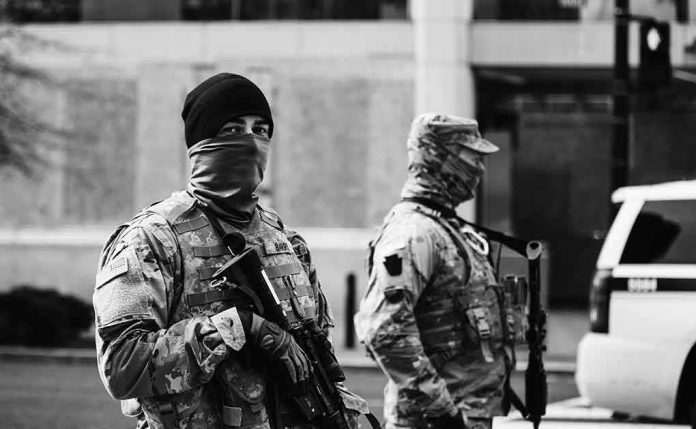
In Afghanistan’s shadow war, the most reliable signature of elite units was often the absence of one: teams succeeded by blending into the human terrain, moving in patterns that looked local, striking with direct-action precision, and vanishing before the battlespace even recognized what had happened.
At a Glance
- DEVGRU’s Silver Squadron is publicly identified as an assault squadron with Afghanistan operations, anchoring the unit’s presence in the theater.
- Direct action in Afghanistan relied on short-duration raids in denied areas; success often turned on language, disguise, and movement that read as “native” to adversaries and bystanders alike.
- Afghan special operators’ local fluency—and longstanding Afghan use of civilian covers—illustrates how disguise is a method, not a myth.
- The Kabul urban environment magnified these dynamics, where blending, not branding, determined access, surprise, and survival.
What an assault squadron does: the role of DEVGRU in Afghanistan
In U.S. special operations, assault squadrons are purpose-built for direct action—short-duration, high-tempo raids designed to seize, capture, exploit, or destroy targets in denied areas. That mission set requires speed, positive identification, route discipline, and a logistics tail that can flex from rotary-wing insertions to covert ground movement. Silver Squadron is publicly profiled as one of DEVGRU’s assault squadrons formed in the late 2000s, with documented participation in Afghanistan, including the 2010 attempt to rescue aid worker Linda Norgrove in Kunar Province—evidence that the unit, its role, and its theater presence are not speculative abstractions but part of the war’s operational record.
Direct action in Afghanistan evolved across a mosaic of terrain: from remote valleys that forced night helicopter infil and rugged egress, to dense urban neighborhoods where the first battle was simply crossing a city without becoming a target. Doctrine frames this clearly: raids are violent, rapidly executed strikes; they aim to compress the timeline between finding, fixing, finishing, and exploiting a target, then leaving before adversaries can mass a response.
Why disguise and “local patterning” became core tradecraft
Afghanistan’s cities, and Kabul most of all, reward units that can pass. Passing is not only clothing; it is cadence, posture, hand signals, the way a vehicle pauses at a checkpoint, the accent of a shouted exchange from a moving car. During the 2021 non-combatant evacuation, Afghan special operators’ language skills, physical appearance, and familiarity with the city allowed them to move through Taliban-held areas, support extractions, and shepherd people to exfiltration points—proof that local fluency is not a footnote but operational leverage in an urban battlespace.
The method has deep roots in Afghan conflict. Historical accounts describe fighters approaching targets as shepherds or civilians to close distance without triggering early warning—evidence that disguise is a pragmatic constant of warfare in this environment, used by multiple actors across decades. In Kabul, such techniques translate into low-signature moves through commercial districts, leveraging common vehicle types, and staging actions at moments when traffic density and noise mask intent. The point is not theatrics; it is permissive proximity to the objective.
How we got here: the special-operations arc in Afghanistan
From the 2001 campaign onward, Afghanistan demanded a hybrid model of clandestine presence, local partnership, and surgical force. CIA teams and U.S. Special Forces linked with the Northern Alliance, calling in precision airpower and operating with dispersed logistics and minimal higher-command micromanagement—a template for autonomy and adaptation that persisted as the conflict shifted from rural battles to complex urban counterterrorism.
As Afghan security institutions matured, Afghan special-operations units expanded—trained, equipped, and mentored to shoulder high-risk missions in their own cities and provinces. That expansion both multiplied CT capacity and diversified tactics, including the ability to move inconspicuously in places where foreign units would stand out immediately. The complementary strengths—U.S. units with exquisite enablers and Afghan units with intimate city knowledge—explain why joint operations often prioritized low-visibility approaches over kinetic spectacle.
Mechanics of an urban DA raid that “looks local”
A credible Kabul raid plan begins with pattern-of-life analysis: how the target moves, which streets bottleneck at what hour, who greets whom at a gate, and which rooftop is blind to the alley below. Route selection emphasizes normalcy; vehicles that match the area’s baseline, drivers who can negotiate in Dari or Pashto, and kit that hides in plain sight until the final approach. Control measures shift accordingly—on-the-fly comms brevity, deconfliction with supporting ISR, and contingency branches that bias toward melt-away rather than a prolonged firefight that lights up the district.
Inside the breach window, the choreography is conventional DA—dominate, separate, exploit—but the exfil intent is different: break contact and dissolve back into the ambient city noise. That shift places a premium on local sensibilities. A wrong turn that looks innocuous on a map can announce “foreign” to anyone watching. Conversely, the right car, with the right dent, taking the right ramp at the right speed, disappears.
Where the public record is strong—and where it is thin
The public backbone for this tradecraft is solid. Official and historical sources define direct action as short, violent raids; Afghan histories document the operational use of disguise; and credible reporting from the Kabul evacuation shows Afghan special operators exploiting local fluency to conduct extractions in Taliban-held areas. Silver Squadron’s existence and Afghanistan activity are documented in accessible profiles, and its participation in a named rescue attempt anchors the unit’s wartime footprint.
By design, however, many mission specifics do not surface in open sources. That is a feature, not a flaw, of clandestine work. What endures in the public domain are the patterns: assault squadrons engineered for surgical raids; Afghan partners whose appearance, language, and streetcraft opened doors no helicopter could; and a Kabul urban fight where a clean approach frequently depended on not looking like an approach at all.
Why it matters now
The lasting lesson is methodological. In irregular warfare, credibility accrues not to the loudest blast but to the unit that can get within arm’s reach of a target without disturbing the air. That requires three competencies: a direct-action core that can compress find-fix-finish; an intelligence picture that maps not only enemies but norms; and local fluency—organic or partnered—that converts streets from obstacles into concealment. Afghanistan’s long war forged that triad. Future urban counterterrorism—whether in South Asia, the Sahel, or dense coastal cities—will demand it again.
Sources:
youtube.com, warhistory.org, businessinsider.com, reddit.com, govinfo.gov, media.defense.gov