Political fights over décor are never just about taste; they are about who is seen to care about the public’s day-to-day burdens, and whether symbols of power reflect stewardship or excess.
At a Glance
- Obama’s Cheesecake Factory quip tethered a style critique of the White House to voters’ frustration over rising restaurant tabs; the price pressure is real, even if the causal link to décor isn’t.
- Trump and senior officials framed the work as restoration of a historic building by government artisans, not gilded vanity, citing cracked plaster, missing ornaments, and limited spending.
- Food-away-from-home prices rose 4.1% in 2025, giving the joke resonance with households who feel dining costs more and delivers less value.
- The White House has long been a screen for national arguments about priorities; disputes over appearance routinely stand in for disagreements about stewardship and economics.
What the joke touched: real price pain meets a vivid symbol
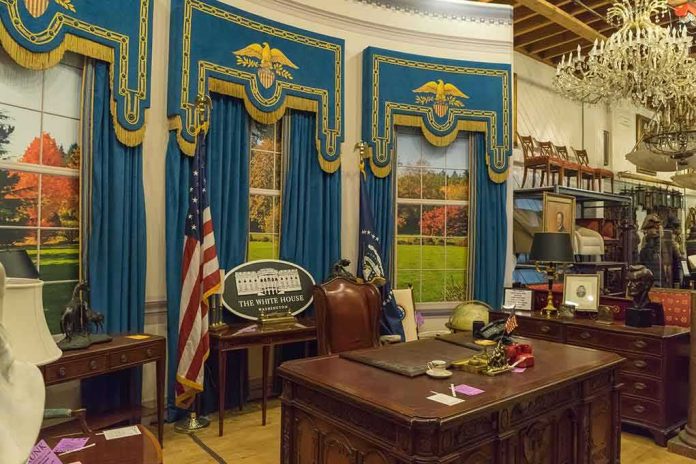
Barack Obama’s line that the White House looks like “Saddam Hussein opened a Cheesecake Factory” landed because it fused two things audiences instantly recognize: the allure of conspicuous gold and the reality that a night out costs more than it used to. The first is symbolic; the second is measurable. The Bureau of Labor Statistics logged a 4.1 percent year-over-year increase in “food away from home” prices in 2025—outpacing overall inflation and turning restaurant spending into a monthly pressure point for many families. That data does not mean any millwork decision inside 1600 Pennsylvania Avenue caused a pricier burger. It does explain why voters reach for symbols that shorthand their sense of misaligned priorities.
That dynamic—material grievance riding on a symbolic vessel—is a staple of American politics. It is effective because it is fast. No family needs a white paper to grasp the difference between a gold-leaf cornice and a bill for four entrées that suddenly crests a hundred dollars. The correlation is emotional, not causal, but the complaint it channels is legitimate.
How the administration answered: restoration, not ostentation
Trump did not contest the spectacle; he contested the premise. His defense cast the work as overdue preservation: fixing cracked exterior plaster, replacing missing ornaments by taking molds from intact elements, repainting, and addressing what he described as broken tile and a damaged column. He praised Interior Department artisans and emphasized frugality, saying the job was done “by very talented people” for “very little money,” and asserting the building was in its best condition since the early republic. That is a familiar preservationist narrative: stabilize the envelope, replicate original details, keep the public rooms presentable.
The rhetorical move is important. By defining the project as stewardship—repairing a national asset—Trump separates it from accusations of frivolity. The specific claims about cracked masonry, missing ornamentation, and low cost are checkable and concrete; they also square with how professional conservators tackle historic fabric. The counterattack on Obama’s taste or legacy, by contrast, is political voltage without evidentiary weight. What endures, if anything does, is the maintenance account, not the clapback.
Why the aesthetics still draw fire: when taste intersects with public symbolism
Presidential houses have long been proxies for fights about class, restraint, and the message executive surroundings send. The White House Historical Association chronicles periodic outcries over renovations from Andrew Jackson to Chester Arthur, and the Truman reconstruction remains a benchmark for how structural necessity can coexist with aesthetic controversy. The recurring accusation is perennial: opulence during strain feels like indifference. Even a legitimate restoration can be framed as a miscue if its visual language leans showy rather than restrained.
That is why a detail like gilded signage or cherubic ornament—whether minimally applied or not—takes on outsized life. It is semiotics, not budgets. Viewers bring their own associations: grand hotel lobbies, themed chain restaurants, and, yes, the Cheesecake Factory’s maximalist mash-up of styles. You need not share the critique to understand its grammar. In a public building, taste is never private; each flourish is read as a statement of values regardless of procurement spreadsheets.
What the price data can and can’t prove
The restaurant bill, meanwhile, has its own mechanics. Operators faced higher input costs—food commodities, labor, occupancy—so menus moved up. The 2025 CPI detail confirms that dining out rose faster than groceries, which is typical in periods when services inflation stays sticky and labor remains tight. Industry surveys in that window showed many operators planning additional increases to defend margins if inflation persisted, a sign that pricing power had not fully rolled over even as headline inflation moderated. None of this implicates a paint scheme in Washington; it does explain why voters hearing a joke about gilding reach for their wallet and nod.
That distinction matters for honest analysis. Symbols can mobilize; they should not be mistaken for causes. The best reading of the episode is narrower and more durable: economic frustration will attach to whatever is most visible, and ornate public décor is very visible indeed. The administration’s case that craftsmen addressed genuine deterioration can be true alongside the public’s fatigue at ostentatious cues. Both can inhabit the same building.
The precedent: the house as a stage for arguments about priorities
Because the White House is both workplace and emblem, renovations are judged on two axes: technical necessity and narrative fit. Past presidents have learned that even defensible projects can backfire if they read as grand gestures while the country is pinching pennies. That is less about line items than about tone. Preservation done in a quiet classical key tends to survive scrutiny; anything that scans as brand-forward invites crossfire. The current dispute fits that lineage neatly, with one side foregrounding repairs and craft, the other yoking ornament to cost-of-living angst.
There is a governance lesson here. Stewardship of national symbols benefits from proactivity: publish scopes of work, document conditions, explain choices in the language of conservation rather than luxury. When the public sees cracked plaster before they see gold trim, it is harder to caricature the outcome. Absent that narrative groundwork, a single striking detail can define the project, fairly or not.
THE PRESIDENT BOUGHT THE CHEESECAKE // Trump's disclosures show up to $175,000 of Cheesecake Factory buying in 2025, and the stock became a campaign punchline
A report built on President Trump's financial disclosures says he bought and later sold shares of The Cheesecake Factory… pic.twitter.com/OGnEVzQXr3
— Dr. Red Candle (@RedCandleRx) October 29, 2026
What endures beyond the punchline
Strip away the theater and you find a durable truth: households judge leaders on whether their priorities feel aligned with everyday pressures. The price of dinner out will remain a proxy for that judgment as long as service inflation outruns wages. The look of the nation’s most famous rooms will remain a proxy for the administration’s sensibility as long as those rooms are on camera. Wise teams manage both—not by denying either sphere, but by respecting the optics while grinding on the economics.
Sources:
yahoo.com, kutv.com, abc3340.com, inquirer.com, rawstory.com, markets.ft.com