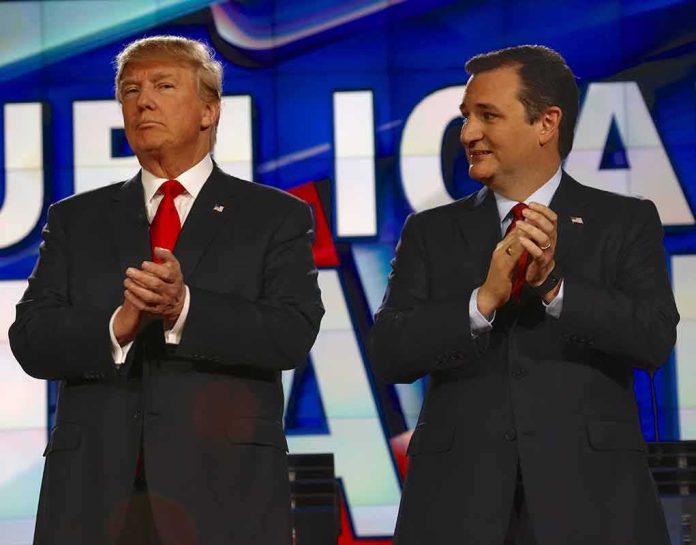
A sitting president naming a specific, living senator as his pick for a Supreme Court seat that does not yet exist is rare enough to merit attention on its own; doing so while predicting a unanimous vote from a chamber that hasn’t confirmed a justice unanimously since the 1960s is the kind of claim that tells you as much about the speaker’s political instincts as it does about the nominee.
Key Points
- President Trump told a Texas rally crowd, with Senator Ted Cruz present, “I would pick Ted Cruz to be the next Supreme Court Justice.”
- Trump predicted Cruz would win “100% of the vote” because Democrats “hate the guy” and Republicans “can’t stand him,” so both sides would want him out of the Senate.
- Cruz has since said Trump raised all three of his first-term Supreme Court vacancies with him privately, and that he declined each time.
- No vacancy currently exists, and no formal nomination process has begun; the remarks remain a public floated scenario, not a White House action.
- Senate history shows unanimous confirmations were once common but have become essentially extinct since the 1980s, making Trump’s prediction a sharp break from recent precedent.
What Trump Actually Said, and Why It Matters
The statement came at a Texas campaign stop ahead of the midterms, where Trump was stumping for Republican candidates and touting energy policy before pivoting to Cruz. The wording, confirmed across multiple outlets including C-SPAN’s own recording, was direct and unhedged: “I would pick Ted Cruz to be the next Supreme Court Justice.” This was not a reporter’s inference from vague praise — it was Trump naming a person for a specific office, in public, with that person standing nearby. That directness is what separates this remark from ordinary speculation about a president’s judicial preferences.
Trump backed the pick with a credentials pitch, calling Cruz “a brilliant guy, brilliant lawyer” and a “top student” with “top credentials” — a framing that leans on Cruz’s record as a former Texas solicitor general and Supreme Court litigator rather than on any specific judicial writing or confirmation-hearing performance. The more striking element, though, was the rationale Trump offered for why Cruz would sail through confirmation: not legal merit, but mutual dislike. “The Democrats will 100% vote for it because they hate the guy and they want to get rid of him,” Trump said, before adding that Republicans would vote the same way because “they can’t stand him” and “would like to get rid of him.”
A Prediction Built on Animosity, Not Precedent
Trump’s arithmetic — 100 senators, 100 votes — is a clean soundbite, but it inverts how Supreme Court confirmations actually function. Nominees typically draw opposition from the party that didn’t appoint them, not unanimous support from opponents eager to see them promoted out of a rival chamber. There is no documented whip count, no senator from either party publicly committing to vote for Cruz, and no indication that Senate leadership has treated the remark as anything beyond rhetoric. The claim rests entirely on Trump’s own assertion of what senators privately feel about Cruz, not on any recorded position from the senators themselves.
That gap matters because the premise — that colleagues dislike Cruz enough to promote him — is itself a double-edged argument. It makes for a memorable rally line precisely because it trades on Cruz’s reputation as one of the Senate’s more polarizing figures, a reputation built over more than a decade of hardline floor tactics, a failed 2016 presidential run against Trump himself, and frequent clashes with colleagues in both parties. Treating interpersonal friction as a confirmation strategy says more about Trump’s showmanship than about any serious vote-counting operation inside the West Wing.
Cruz’s Own Account Complicates the Picture
The more substantive wrinkle comes from Cruz himself. In a Wall Street Journal Opinion Live interview, Cruz said the vacancy discussion was not new: “In the first Trump term, the president spoke to me seriously about all three vacancies, and three times I said no.” That is a meaningful admission — it confirms the idea of Cruz-on-the-Court predates this rally by years and was, at least in Cruz’s telling, a genuine private conversation rather than invented theater. But it also establishes that Cruz has turned the opportunity down three separate times, reportedly because he preferred staying in the Senate’s political fights rather than moving to the bench. A senator who has declined the job thrice is not an obviously eager nominee-in-waiting, whatever the president says from a podium.
That tension — a president publicly naming his pick while the pick has a track record of saying no — is the central fact of this episode. It doesn’t make Trump’s statement any less real or less newsworthy; it simply means the proposal currently exists as a floated preference, not a pending plan with a willing participant and an open seat.
How This Fits the Senate’s Confirmation History
Trump’s “100%” prediction should be read against the actual record of how the Senate has handled Supreme Court nominees. Confirmation was once close to routine: between 1930 and 1968, seventeen of twenty-four nominees were confirmed by unanimous or voice vote. Of the 128 nominations the Senate has confirmed since 1789, a majority — 73 — came by voice vote or unanimous consent rather than a recorded roll call. But that era is over. Every Senate confirmation vote since 1967 has been conducted by roll call, and the modern pattern is starkly partisan: from 1900 through 2020, seventeen of thirty-seven roll-call confirmations split along party lines, with one party’s majority in favor and the other’s in opposition. Neil Gorsuch cleared the Senate 54–45 in 2017; Clarence Thomas squeaked through 52–48 in 1991 over majority opposition from the president’s own non-affiliated bloc of senators in several cases. A genuinely unanimous vote in today’s Senate would not just be unusual — it would be a historical outlier unmatched by anything in the last several decades.
WASHINGTON — President Donald Trump floated nominating Ted Cruz to the Supreme Court for a future vacancy on the nation's high court, joking that the Texas Republican senator's confirmation would earn unanimous support because senators from both parties would like to see him gone
— HPG (@DarkCloud1313) October 28, 2026
What Happens Next
Nothing in the public record points to an imminent vacancy, a formal nomination, or a White House process underway. What exists is a presidential preference, stated plainly and repeatedly, attached to a senator who has already turned the job down multiple times and a Senate math problem that history suggests Trump’s prediction is unlikely to solve. Whether this becomes more than a rally applause line depends entirely on two things outside either man’s control right now: whether a seat actually opens on the Court, and whether Cruz, offered the job a fourth time, finally says yes.
Sources:
thehill.com, yahoo.com, houstonchronicle.com, sacurrent.com