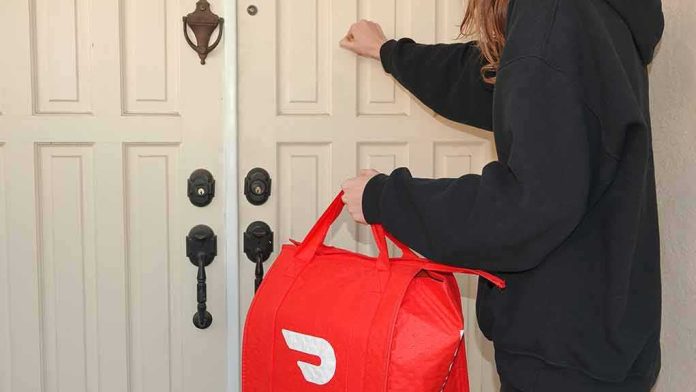
A Ring doorbell camera has become the most reliable witness in the gig economy — the one piece of evidence that turns a single customer’s account into something platforms cannot simply wave away, and that is exactly what happened outside a home in northeast Houston on August 24.
Key Points
- A Houston father, Kiante Matlock, says his Ring camera captured a DoorDash driver standing at his door completely naked after dropping off a food order.
- DoorDash confirmed the driver was permanently removed from the platform the same day it learned of the incident, calling the conduct “abhorrent” and “completely unacceptable.”
- Houston police say a person who appears naked at a residence during a delivery can face criminal charges, and they urged anyone in a similar situation to preserve video and report immediately.
- Matlock discarded the delivered food and received a refund from DoorDash, but did not identify the driver by name.
- The episode sits inside a well-documented pattern of gig-platform safety complaints that surface through viral video long before — or instead of — a formal police record.
What the Doorbell Camera Recorded
Matlock told FOX 26 Houston that he checked his Ring app after a DoorDash order arrived at his home near Homestead in northeast Houston, and found the driver standing outside, undressed, with the delivery already left on the porch. “I open the camera and look, buddy’s completely naked. By the time I got to the front, he was already gone,” Matlock said. His daughter was home at the time, a detail that sharpened his reaction. “It could have been an underage child coming to the door or a woman and you expose that like that. That I mean it’s just sick,” he told the station.
Matlock did not eat the food; he ate leftovers instead and later received a refund from DoorDash. That detail matters less as a footnote than as a signal of how thoroughly the incident soured an otherwise routine transaction — the kind gig platforms depend on happening thousands of times a day without incident.
How DoorDash Responded, and Why the Speed Matters
DoorDash’s public statement was unusually blunt for a corporate response: “What this consumer experienced was abhorrent… This man’s behavior was vulgar and completely unacceptable… we do not tolerate sexual harassment or misconduct of any kind,” the company said, adding that the driver’s platform access was permanently revoked as soon as the report reached them, and that it stood ready to assist law enforcement. That posture is consistent with DoorDash’s published deactivation policy, which lists “exhibiting objectively unsafe behavior” and creating “an unsafe environment for anyone on the platform” as grounds for immediate removal, without requiring a prior warning. The company has also said publicly that severe misconduct — as opposed to minor policy violations — triggers permanent removal rather than a warning email, a distinction it has drawn explicitly in its own enforcement guidance.
That swiftness is itself a data point about how gig platforms manage reputational exposure. A driver’s account can be deactivated within hours based on a single customer report and a video clip, well before any police investigation concludes, because the company’s contractual relationship with its drivers gives it far more latitude to act unilaterally than a police department has to charge someone. The incentive is obvious: platforms that host tens of millions of doorstep interactions a day cannot afford to look slow or indifferent when one of them goes wrong in a way that touches on sexual misconduct or child safety.
The Legal Backdrop: What Public Indecency Actually Means Here
Houston police, in comments to FOX 26, said that people who encounter a similar situation should report it immediately and preserve any video evidence, and confirmed that charges could be filed against someone who appears naked at a residence. That is a statement of general legal exposure, not confirmation that charges were filed in this specific case — the gathered record does not include a police case number or a charging document tied to this incident. Texas indecent exposure statutes do not require physical contact or even direct interaction with a minor to support a charge; exposure alone, under circumstances likely to cause affront or alarm, can be sufficient. Houston has prosecuted comparable cases before, including one involving a police officer charged with indecency with a child and indecent exposure after admitting to similar conduct, underscoring that the underlying offense is treated seriously by local prosecutors regardless of the offender’s occupation.
A Pattern Bigger Than One Delivery
This is not an isolated curiosity in the gig-delivery world; it is one instance of a recurring vulnerability. Academic research on delivery gig workers has found that full dependence on platform work is associated with a 61 percent greater probability of injury and a 36 percent greater probability of assault relative to partial dependence, even after controlling for experience, delivery mode, and hours worked. Most of that research examines drivers as the exposed party, but the same structural feature — a stranger arriving alone at a private residence, with minimal real-time oversight from the platform — cuts both ways, exposing customers and their families to the judgment and conduct of a workforce the company screens but does not supervise in the moment. Sociologists studying ride-hailing platforms have separately noted that sexual misconduct in the sharing economy is likely underreported across the board, precisely because most incidents never produce video evidence and are therefore harder to substantiate publicly.
What makes the Houston case unusual is not the underlying behavior — public indecency complaints against delivery workers surface periodically in local news — but the evidentiary chain a home security camera now supplies. A decade ago, a complaint like Matlock’s would have rested entirely on his word. Today it rests on a timestamped video file, a company statement issued the same day, and a police standard for what conduct crosses into criminal territory. That is a meaningful upgrade in accountability infrastructure, even without a driver’s name attached to the story or a completed court case on the record.
https://twitter.com/FoxNews/status/2094764506601628149
What This Means Going Forward
For customers, the practical lesson is unglamorous but real: doorbell cameras have become the default arbiter of doorstep disputes, and platforms have learned to treat that footage as dispositive enough to act on immediately rather than wait for law enforcement to weigh in. For DoorDash and its competitors, incidents like this one keep pressure on driver-vetting and real-time safety systems that were built primarily around location tracking and identity verification at sign-up, not around behavior at the moment of delivery. The deactivation happened fast; whether any criminal case follows is a separate question that remains with Houston authorities, not with the platform.
Sources:
facebook.com, foxnews.com, fox26houston.com, silive.com, independent.co.uk, help.doordash.com