One man’s death on a Midtown platform was a fast, bounded event—a single chest wound at lunchtime that halted trains and sent hundreds scrambling—but it also illustrates how rare, high-profile violence in the subway can dominate public consciousness even as city shootings fall to historic lows.
At a Glance
- A man was shot in the chest around 12:21 p.m. on the northbound E platform at 7th Avenue–53rd Street and later died at Bellevue Hospital
- Police and MTA halted service through the station and rerouted trains as investigators secured the scene
- No arrest or suspect identification was announced in initial reporting; motive and precipitating circumstances remained under investigation
- The episode is stark but statistically uncommon; NYC recorded record-low shooting incidents citywide in 2025 and through the first three quarters of 2026
What happened on the 7th Avenue–53rd Street platform
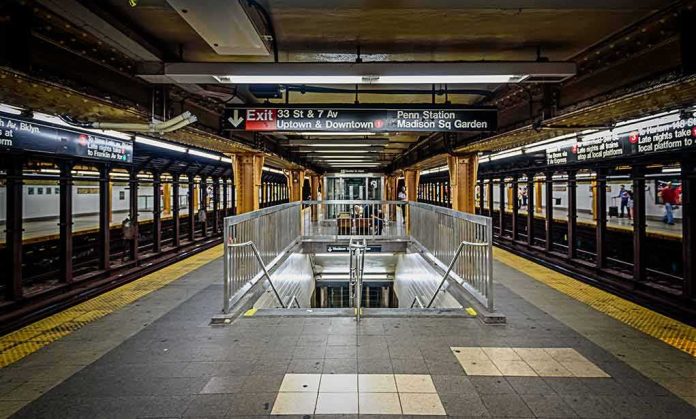
Shortly after noon, amid the Saturday crush of Midtown foot traffic, a man was shot once in the chest on the northbound E train platform at the 7th Avenue–53rd Street station. Police and fire officials placed the time at approximately 12:21 p.m. Responders rushed the victim to Bellevue Hospital in critical condition; he was pronounced dead soon after arrival, with one outlet reporting the time of death at 1:06 p.m. The precision of the location matters for both the investigation and operations: this was not an incident on a moving train or in a mezzanine, but on the northbound E platform itself, where witnesses, cameras, and ballistic evidence are typically denser and cleaner to interpret in the confined geometry of a platform edge.
Within minutes, the MTA diverted service to stabilize the scene. C, D, and E trains bypassed the station, and additional lines experienced delays while NYPD cordoned off entrances and canvassed for witnesses and video. That operational choreography—halt, secure, reroute—is standard in an active felony investigation underground, yet it always reverberates beyond the tape line, rippling through the weekend timetable and producing a second-order public impact that outlasts the initial burst of violence.
What investigators typically do in a platform shooting
Platform shootings compress forensic work into a narrow corridor governed by predictable physics. Investigators begin with immediate scene control: sealing access points, documenting blood spatter directionality, collecting any shell casings, and mapping their positions relative to the platform edge. Because blast overpressure and ricochet are constrained by tile, concrete, and track metal, trajectory work often yields confident shooter-victim positioning. Parallel teams pull digital feeds from MTA cameras that cover fare arrays, platform columns, and stairwells, then stitch those clips to trace the suspect’s ingress and egress. The aim is twofold: corroborate witness accounts against time-stamped movement and identify a clean exit path that likely intersects with street-level cameras along Seventh Avenue and 53rd Street.
Witness canvassing matters as much for what it excludes as for what it confirms. Early bystander impressions frequently diverge—number of shots, whether a dispute preceded the firing, whether the parties knew each other—because acoustic reflections and split-second attention shifts can distort memory. The most reliable early inputs are fixed: the wound location as documented by EMS; any recovered casings, which can indicate caliber; and synchronized video time codes that lock the sequence. Reports here consistently describe a single chest wound and a rapid transport to Bellevue, facts that anchor the timeline. Whether an argument preceded the shot remained an open question in initial coverage; establishing that requires either crisp audio, clear gestural escalation on video, or multiple convergent witness statements memorialized in police paperwork.
Knowns, unknowns, and how to read early reports with discipline
The core facts cohere across outlets: time and place, a single chest wound, Bellevue transport, and death. The victim’s name was not released in initial reporting, which is common when next of kin have not been notified or when the medical examiner has not yet formalized identification. No arrest or suspect description was immediately public, which in turn limits any definitive assertions about motive, prior contact between parties, or whether the shooter fled via stairs, elevator, or an interstation transfer. Those are not gaps in credibility; they are simply the normal state of an active homicide case in its first hours.
Service disruptions, while inconvenient, provide their own evidentiary signal: they confirm that police treated the scene as a live felony investigation requiring platform control and safe access for forensics. Bypasses and delays reported by multiple outlets indicate coordination with the Rail Control Center, a step taken when the expected duration of scene work exceeds a short pause.
Why this single tragedy towers so large in the public mind
A fatal shooting under the city’s streets is rare relative to the scale of daily ridership, yet it commands attention because it punctures the presumption of routine in a deeply communal space. The statistical backdrop is unambiguous: citywide shooting incidents fell 24% from 2024 to 2025 to 688 incidents and continued to set record lows into 2026, with 489 incidents through September, the fewest in NYPD’s modern reporting. Transit shootings likewise declined from pandemic-era spikes. This is not a minimization of a life lost on a platform; it is the context that separates the emotional salience of a headline from the underlying trendline of risk.
The human brain is not a spreadsheet. Availability bias—our tendency to judge frequency by how easily examples come to mind—means one midday platform homicide can outweigh months of quiet commutes in our mental calculus. Policymakers, transit managers, and riders all feel that pull. The responsible response is twofold: address the specific case with urgency and competence, while calibrating policy to the pattern, not the outlier. That means sustaining visible uniformed presence where it deters opportunistic crime, investing in camera coverage and rapid video retrieval where it accelerates arrests, and resisting whiplash policy swings that treat singular tragedies as trend inflections.
The operational and policy implications underground
From an operational standpoint, the 7th Avenue–53rd Street shooting will be judged by how quickly investigators knit together the suspect’s movements from the station grid and adjacent street cameras, and whether ballistic evidence or eyewitness convergence yields a clean probable cause package for an arrest. The MTA and NYPD have strengthened this workflow in recent years: more platform and mezzanine cameras, better retention practices, and closer coordination between Transit Bureau detectives and the Rail Control Center to preserve video before it cycles. Each incremental improvement shortens the window between incident and identification and increases the certainty of the narrative prosecutors ultimately present.
Policywise, the broader risk environment argues for steadiness. Citywide shooting reductions—to record lows in 2025 and through the first three quarters of 2026—reflect a multi-factor mix: focused deterrence on the small cohort driving gun violence, improved gun cases by specialized prosecutors, and more proactive gun recoveries, including in transit. The lesson for the subway is pragmatic: keep doing what measurably lowers the already low odds of serious violence—targeted deployments, environmental design that maximizes sightlines and camera coverage, and fast post-incident investigation—without eroding the openness that makes rapid transit function.
❗️NYC Subway Shooting ❗️
A shooting occurred before 12:30 PM today at the subway station in midtown Manhattan at Seventh Avenue and 53rd Street.
The male victim was said to be in his 30s.
He was taken to Bellevue Hospital where he was pronounced dead.
His name has not been… pic.twitter.com/WL8pmrYnUK— Marishay (@marishayone) October 17, 2026
The bottom line
A man was shot once in the chest on a Midtown platform at lunchtime and died at Bellevue; trains were rerouted, police locked down the scene, and detectives began the meticulous process of reconstructing the minutes before and after the gunfire. Those are the facts that matter most to understanding the event itself. They exist alongside a less visible truth: amid historic declines in shootings, the subway remains a safe system where rare, brutal incidents loom large precisely because they are outliers. Honor the singular loss by insisting on a competent investigation and by shaping policy to evidence, not fear.
Sources:
facebook.com, nbcnews.com, fox5ny.com, newsday.com, nypost.com, cbsnews.com, cnn.com, rmb.reuters.com