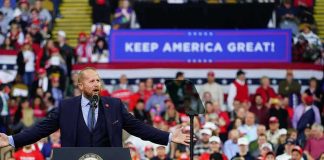
When the U.S. Chamber of Commerce puts its thumb on the scale in a marquee race, it is signaling more than preference; it is telegraphing the policy bargaining it expects to conduct with the next senator. That is the core significance of the Chamber’s endorsement of Ken Paxton in Texas: a national business association aligning with a candidate it believes will fight federal regulation, protect a low-tax posture, and defend the state’s energy economy—and expecting to collaborate on legal and regulatory reform if he wins.
At a Glance
- The U.S. Chamber publicly endorsed Ken Paxton for the Texas U.S. Senate seat, citing free-enterprise and pro-growth priorities.
- The Chamber’s executive VP Neil Bradley named legal reform, regulatory restraint, and energy-sector defense as shared aims.
- The group treats endorsements as a policy instrument, not a lifetime seal; candidates are expected to keep delivering on pro-business measures.
- The move lands in a highly competitive contest, with political coverage casting it as a meaningful boost for Paxton.
What the Chamber actually did—and why it matters
The U.S. Chamber of Commerce announced it would endorse Ken Paxton for the U.S. Senate seat from Texas and previewed the endorsement at an event in Austin. The organization did not merely list a preferred name; it advanced a clear rationale. In the Chamber’s own language, Paxton “has been a defender of free enterprise,” has “pushed back against federal overreach,” supported a “low-tax environment,” and “defended the energy sector from burdensome mandates.” Its policy chief, Neil Bradley, added that the Chamber looks forward to working with Paxton on “meaningful legal reform” that reduces lawsuit abuse and red tape. In the world of business associations, that is code for priorities such as curbing expansive agency rulemaking, tightening standing and venue in civil litigation, and maintaining predictable tax and permitting regimes. The stakes are legislative and administrative, not rhetorical; endorsements like this are calculated to convert into co-sponsorships, coalition letters, and markups where a senator’s vote is dispositive.
Because the Chamber’s political program is structured around advancing free-enterprise policy rather than personally validating candidates, its endorsements are meant to create leverage. The organization says it interviews and evaluates candidates for alignment and expects continued performance after they are in office; endorsements “aren’t set in stone” and are recalibrated when lawmakers diverge from its agenda. In practice, that means an endorsement is both a signal to pro-business voters and donors and a first move in a transactional relationship the Chamber intends to manage over a full Senate term.
https://www.youtube.com/watch?v=ZdiX0RcJ1Bk
How this fits the race’s trajectory and the Chamber’s pattern
The endorsement landed in what state and local outlets have framed as one of the cycle’s top Texas contests, with the decision described as a meaningful jolt for Paxton’s general-election positioning. It also comes after a primary season defined by intraparty realignment. Paxton defeated Senator John Cornyn—widely reported as the Chamber’s earlier preference—in a hard-fought runoff. The Chamber’s imprimatur, post-runoff, reflects an institutional pattern: once a nominee is set, the group often locks in behind the candidate whose votes it will need on committee and floor business, even if the primary preference ran elsewhere. In 2024, for instance, the Chamber endorsed Senator Ted Cruz after having backed a Democrat in a previous cycle—evidence that the organization’s support tracks anticipated policy delivery more than party loyalty in the abstract.
None of that guarantees a measurable electoral shift. Political science on endorsements is sober: effects are variable and frequently contingent on the credibility of the endorser with the specific audience in question. Often, endorsements work by lowering the information cost of a choice—helping busy voters map candidates to policy bundles they prefer—rather than by persuading them via detailed argument. In experimental and conjoint studies, endorsements can change candidate favorability and simplify selection in crowded fields, but results vary across endorser type and voter segment. In a two-candidate general election with saturated media, the typical effect is modest unless the endorser is uniquely salient to the target electorate. For the Chamber in Texas, the main practical value is likely twofold: funder coordination and a policy label that cues pro-business Republicans and business-aligned independents.
What “legal reform,” “federal overreach,” and “energy mandates” mean in practice
Translating the Chamber’s terms of art into legislative action clarifies the stakes. “Legal reform” usually encompasses measures to narrow forum shopping, adjust class-action thresholds, refine standards for punitive damages, or recalibrate fee shifting—changes that materially reduce litigation exposure for employers and manufacturers. “Federal overreach” points to agency rulemakings and enforcement expansions under statutes like the Clean Air Act, the Fair Labor Standards Act, or the National Labor Relations Act. A senator aligned with the Chamber is expected to back Congressional Review Act resolutions to nullify newly finalized rules, support appropriation riders that cabin enforcement, and confirm executive-branch nominees who favor cost-benefit rigor.
“Defending the energy sector” in Texas is even more concrete. It entails opposition to rules that constrain upstream development, midstream permitting, and downstream emissions standards without clear cost-justified benefits. In the Senate, that manifests as votes on permitting reform, methane and flaring regulations, electric reliability standards that balance renewables with dispatchable generation, and tax provisions that shape capital allocation across hydrocarbons and low-carbon technologies. The Chamber’s statement indicates it reads Paxton as a reliable vote and voice on that portfolio—an inference that, if borne out in office, would have palpable consequences for producers, service firms, and the grid in a state where energy is a foundational employer and taxpayer.
Why the Chamber moved now
Timing in endorsements is a tactical choice. Early signals can shape primaries; late signals consolidate a coalition for the general. Here, the Chamber moved after a volatile primary in which Paxton emerged with momentum and significant statewide attention. Coverage in conservative media framed the endorsement as a “big” get in a race Democrats also treat as competitive. For a trade association, that is precisely when an endorsement can maximize downstream bargaining power: attach the brand when the nominee’s coalition is still assembling, then cash the check in committee markups and conference reports next year. The Chamber’s public promise to “work together” on legal reform is not fluff; it is a marker everyone on K Street understands.
How to read the endorsement alongside other signals
Texas politics is awash in endorsements of different pedigrees: elected officials, ideological groups, industry associations, and personalities. Each carries a different cue. Presidential backing tends to dominate intra-party dynamics; business-group support travels through donor networks and policy staff. Academic work comparing endorser types underscores this segmentation: celebrity or partisan figures can shift attention and small-dollar energy, while institutional endorsers like a national chamber are better at coordinating resources and clarifying policy alignment for attentive voters. In a general election, that division of labor matters. The Chamber isn’t trying to ignite rallies; it is trying to secure a governing partner on appropriations, oversight, and rulemaking. The two goals are complementary, not redundant.
U.S. Chamber of Commerce just endorsed Ken Paxton in the critical Texas Senate race, and James Talarico’s team isn’t smiling.
The Chamber, which backed John Cornyn in the GOP primary, is now coming off the sidelines for Paxton in the general. Their EVP/Chief Policy Officer said… https://t.co/7FapKDdfhi pic.twitter.com/b2QCUnLWow
— Patricia 🇺🇸 (@1109Patricia) October 18, 2026
The bottom line
The U.S. Chamber’s endorsement of Ken Paxton is straightforward and significant: the country’s most prominent business association publicly aligned with a Texas Senate candidate on a defined pro-enterprise agenda and invited a working partnership on litigation and regulatory reform. The organization’s own political program makes clear that endorsements are instruments to advance policy, subject to maintenance, and contingent on delivery. Whether the move shifts votes at the margin is, as always, contingent; the strongest effect will likely be in resource coordination and the policy expectations it sets if Paxton takes a Senate seat. For businesses planning multi-year investments in Texas—and for voters who prioritize regulatory restraint, a predictable tax base, and energy reliability—that expectation is the endorsement’s real content.
Sources:
redstate.com, uschamber.com, article.wn.com, knewz.com, dallasnews.com, texastribune.org, sanantonioreport.org, en.wikipedia.org