
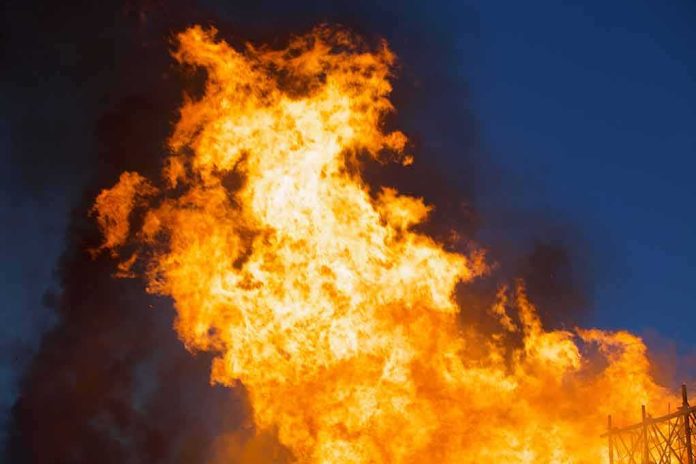
When a mob sets fire to a city’s tourist office rather than a bank or a government ministry, the target itself becomes a message — and in Lyon on the night of October 17, 2026, that message was aimed squarely at the institutions France presents to the outside world.
Key Points
- Lyon’s tourist office was set ablaze during nationwide protests on October 17, 2026, with flames and black smoke documented by multiple independent news organizations.
- Local police said “hostile individuals” blocked firefighters from reaching the blaze while officers worked to disperse violent groups elsewhere in the city.
- Lyon Mayor Grégory Doucet called the destruction of the “iconic, well-known historic building” a tragedy.
- The fire occurred amid a broader night of unrest that produced well over a thousand arrests across France.
- Scene reporting places the fire within a documented pattern: smashed windows, masked demonstrators, and fire both inside and outside the structure.
What Happened in Lyon
On the night of October 17, 2026, Lyon’s tourist office caught fire during a wave of demonstrations that swept across France. Associated Press video footage, published October 18, documented the building burning from the inside, and the Deutsche Welle wire service reported that the tourism office was “set alight,” with flames and black smoke visible billowing from the structure. Reuters, filing on the same night, reported plainly that “in Lyon, protesters torched the city’s tourist office,” placing the building squarely within the night’s catalogue of targeted property.
BBC’s live coverage offered the most granular account of the sequence: masked protesters broke windows at the building before a fire broke out inside, and subsequent images showed demonstrators standing outside a smouldering structure with fire visible both within and beyond its walls, alongside several smashed windows. That reporting was echoed across other outlets covering the same night of unrest, which collectively described a tourist office that went from an undamaged civic landmark to a burning, heavily damaged building within the span of a single evening.
How Authorities Responded — and Why Firefighters Held Back
One of the more striking details to emerge from the incident concerns not the fire itself but the response to it. Local police told the BBC that “hostile individuals” prevented firefighters from safely intervening to tackle the blaze, even as officers were simultaneously occupied with dispersing violent groups elsewhere in the vicinity. That detail matters because it explains, in part, why a fire inside a civic building was allowed to burn long enough to produce the visible damage captured on camera — it was not simply a matter of response time, but of a scene too volatile for emergency crews to enter safely.
Mayor Grégory Doucet addressed the incident directly in comments to BFMTV, calling it a tragedy for the city. “It breaks our hearts because it’s a very iconic, well-known historic building, so the fact that rioters attacked it and set it on fire is a tragedy for us,” he said. His framing — emphasizing the building’s historic and symbolic standing in Lyon’s civic identity — reflects a reaction common among municipal leaders when demonstrations spill over into attacks on landmarks that function less as administrative offices and more as public-facing symbols of a city’s identity and economy.
Where the Lyon Fire Fits in a National Night of Unrest
The tourist office did not burn in isolation. It was one flashpoint within a much larger night of nationwide demonstrations that drew students, trade unions, and Yellow Vest-aligned protesters into the streets across dozens of French cities. Coverage of the broader night reported arrest figures that varied by outlet and by the hour reporting was filed — ranging from roughly 272 arrests tied to specific actions to figures exceeding 1,800 arrests nationally as the night wore on. President Emmanuel Macron publicly condemned the violence, stating there was “no place for violence” in the demonstrations convulsing French cities that weekend.
That national scale matters for understanding Lyon specifically: the tourist office fire was reported as part of a pattern that included clashes with police, looting, and fires at other public buildings, rather than as an isolated act of random vandalism. Reporting from the same period documented a separate, similarly striking case in Limoges, where rioters set fire to that city’s historic city hall — a parallel that underscores how municipal landmarks, not just commercial or financial targets, became focal points of destruction during this cycle of unrest.
Separating What the Evidence Shows From What It Attributes
Video, scene photography, police statements, and a mayoral statement together establish beyond meaningful dispute that Lyon’s tourist office burned on the night of October 17, 2026, and that the fire occurred amid a crowd of demonstrators who had already broken windows at the building. That much is corroborated across independent outlets using separately gathered footage and sourcing — AP’s video record, BBC’s live reporting, Reuters’ wire dispatch, and Deutsche Welle’s scene account all converge on the same basic sequence of events.
Coverage of large, chaotic protest nights inevitably compresses complicated sequences — who broke which window, who carried what material inside, at what precise moment ignition occurred — into shorthand language like “protesters torched” the building. That shorthand is a reasonable summary of what cameras captured and what police described, not evidence of fabrication; it simply reflects the practical reality that a fire breaking out amid a hostile crowd, with firefighters unable to safely approach, rarely produces an immediate, frame-by-frame public account of ignition. What is firmly established is the outcome: a historic civic landmark in Lyon, used daily by visitors and residents alike, was gutted by fire on a night when French unrest reached a scale not seen in years.
Horrifying footage from France. Protesters have turned on the country’s historical heritage. After an arson attack, the 19th‑century town hall in Limoges has been heavily damaged.
The tourist office building in Lyon was ransacked and set on fire. One of the world’s largest and… pic.twitter.com/6eBv8mrOGq
— Doc Hub (@DocHubX) October 18, 2026
Why This Episode Will Outlast the News Cycle
Buildings like tourist offices occupy an unusual place in civic life — unglamorous, administrative, easy to overlook until they’re gone. Their destruction during unrest tends to resonate precisely because they are so ordinary: unlike a bank or a government ministry, a tourist office carries no obvious ideological target, which is part of why mayors like Doucet frame such attacks in terms of heritage and heartbreak rather than politics. Whatever grievances fueled the broader protest movement that night, Lyon’s tourist office now stands as one of the clearest physical markers of how far that unrest reached — a landmark converted overnight into evidence of a volatile moment in French civic life.
Sources:
youtube.com, apnews.com, aapnews.aap.com.au, cnn.com, reuters.com, bbc.co.uk, cogitatiopress.com