When a sitting United States senator uses a vulgarity to describe members of the opposing party on the floor of public debate, the headline write itself — but the more durable story is what provoked it: a six-year documented record of election falsehoods, pressure campaigns, and threats against election officials that Adam Schiff has spent his career cataloguing, first as a House impeachment manager, then as chair of the January 6th committee, now as a senator warning about a repeat performance in 2026.
Key Points
- Schiff’s blunt language sits atop a long, well-documented record of statements calling Trump-era election-fraud claims false and dangerous, not merely a partisan jab.
- His January 6th committee testimony tied the “big lie” directly to harassment and threats against state election workers.
- Independent intelligence assessments and the Georgia phone-call record support his core factual claims about the 2020 election.
- Republicans have countered not with a competing factual record on 2020, but by attacking Schiff’s own credibility over his earlier Trump-Russia statements.
- The dispute has migrated from litigating 2020 to litigating whether the same playbook will be used against the 2026 midterms.
A Career Built on Naming the Lie
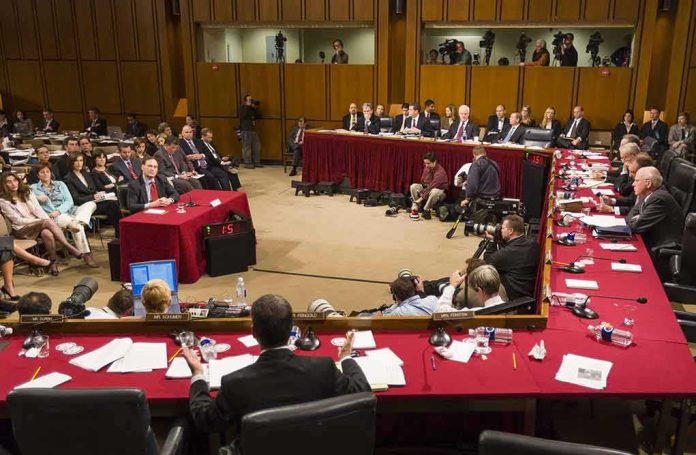
Schiff’s rhetorical style did not appear suddenly on C-SPAN. It has a paper trail. During the House’s January 6th hearings, he told the committee that Trump’s false claim about a stolen election was “a dangerous cancer on the body politic”, and he framed the stakes in near-existential terms, asking what is left to determine political power “but violence” once Americans are convinced their elections cannot be trusted. That is not incidental color; it is the through-line of everything Schiff has said since, including the language that has drawn attention more recently. The vulgarity is new. The argument underneath it is not.
The mechanism Schiff describes is straightforward and, on the specific facts he cites, well supported: a losing candidate alleges fraud without evidence, elected officials and low-level election workers become targets of that allegation, and some subset of an angry public translates suspicion into harassment or worse. Schiff told the committee that Trump’s pressure campaign generated “angry phone calls and texts, armed protests, intimidation, and, all too often, threats of violence and death” directed at officials who refused to alter results. That is a specific, falsifiable claim about consequence, and it is corroborated by the broader public record of threats against secretaries of state and county clerks that emerged after 2020 — even if the research available here does not include a full incident-by-incident tally.
The Georgia Call and the Intelligence Record
Schiff’s factual case does not rest on adjectives alone. He has repeatedly pointed to the recorded January 2021 call in which Trump pressed Georgia’s Republican secretary of state to “find 11,780 votes” that did not exist — a documented request from a sitting president to a fellow Republican official to manufacture an outcome, not merely to recount one. He has also cited the U.S. National Intelligence Council’s 2020 assessment concluding there were “no indications that any foreign actor attempted to alter any technical aspect of the voting process”, directly rebutting claims that a foreign power manipulated vote totals. Taken together, a direct-pressure call to a state official and a formal intelligence finding of no technical interference give Schiff’s underlying position — that the fraud claims were false, not merely disputed — a firmer evidentiary footing than ordinary partisan rhetoric usually enjoys.
None of this means every specific allegation raised by every Republican official since 2020 has been individually adjudicated in a courtroom or audit; the public record on any single claim is sometimes thinner than the sweeping conclusion Schiff draws from it. That is a fair caveat, not a rebuttal. Courts, state audits, and the Justice Department reviewed the major fraud allegations from 2020 and found no evidence sufficient to change outcomes in any contested state — a pattern that undercuts, rather than supports, the position that the election was stolen.
The Counterattack: Litigating the Messenger, Not the Message
Where Republicans have pushed back hardest is not on the Georgia call or the intelligence assessment — it is on Schiff himself. The House voted to censure him in 2023 over his earlier public statements asserting Trump-Russia collusion, with the resolution alleging he misled the public with “falsehoods, misrepresentations, and abuses of power”. Outlets sympathetic to that view have built an extensive case that Schiff has a “long trail” of disputed claims stretching back to the Russia investigation, and Fox News has repeatedly amplified the argument that his credibility is compromised. This is a genuinely different kind of counter-evidence than a competing factual record on 2020 — it is a credibility argument, aimed at making audiences discount Schiff’s warnings regardless of the specific documentary support behind them.
That distinction matters for anyone trying to weigh the dispute honestly. The censure and the Russia-era controversy are real and documented; they are not manufactured grievances. But they do not, on their own, refute the Georgia recording, the National Intelligence Council’s finding, or the testimony about threats against election workers. A senator’s past disputed statements can reasonably invite skepticism about his motives without erasing the independent evidentiary weight of a recorded phone call or a formal government assessment. Readers are entitled to hold both facts at once: Schiff has faced legitimate credibility challenges, and the specific 2020 election claims he condemns have not been vindicated by any court, audit, or intelligence review.
Why the Fight Keeps Repeating
The pattern is now cyclical rather than historical. Schiff has extended the same argument into the run-up to the 2026 midterms, telling ABC News that Trump “intends to try to subvert the elections” and calling the renewed rhetoric “the latest iteration of the big lie”. Whether or not that specific prediction proves out, the underlying dynamic he describes — unsubstantiated fraud claims preceding an election, followed by pressure on officials and hostility toward election workers after it — is now a recognizable feature of American politics rather than a one-time crisis. Scholars of democratic backsliding treat repeated “stolen election” narratives as a distinct risk to institutional trust precisely because the claims persist even after formal review fails to substantiate them.
What keeps the argument alive is not a lack of evidence on the central factual question — courts, state officials, and federal intelligence agencies have consistently found no proof of the fraud alleged in 2020 — but the absence of any single adjudication that both sides accept as final. That gap leaves room for the credibility fight to substitute for the factual one, which is exactly the dynamic playing out whenever Schiff’s language, rather than his documentation, becomes the story.
Sources:
youtube.com, schiff.senate.gov, pbs.org, abcnews.com, en.wikipedia.org, washingtontimes.com, discoverthenetworks.org, congress.gov, nypost.com