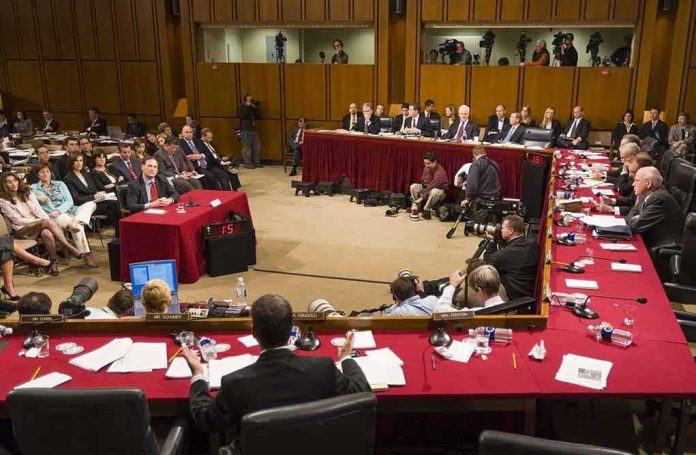
The fight between President Trump and Senator Lisa Murkowski over the attorney general nomination is not just another intraparty spat; it is a stress test of two competing Republican theories of governance — movement loyalty enforced from the top versus institutional guardrails enforced by senators who prize departmental independence even when their party holds power.
At a Glance
- Trump’s critique hinges on portraying Murkowski as chronically disloyal to core Republican priorities, part of a years-long campaign to police party discipline.
- Murkowski’s stated rationale for opposing Todd Blanche centers on preserving Department of Justice independence amid policies she describes as politicized, including a large discretionary fund and immunity provisions.
- The clash fits a broader pattern: Trump publicly penalizes GOP defectors to reinforce movement cohesion; Murkowski cultivates an institutionalist, independent brand that can play in Alaska’s electorate.
- The record supplied does not include the formal Senate roll calls for Merrick Garland or Blanche, so the “inconsistency” charge cannot be adjudicated conclusively here — but Murkowski’s Blanche rationale is specific and on the record.
What Trump is really arguing when he blasts Murkowski
President Trump’s broadside against Senator Lisa Murkowski after her announced opposition to his attorney general pick, Todd Blanche, is consistent with how he has handled high-salience Republican defections for nearly a decade: frame them as betrayals of the party and of him personally, attach reputational costs, and threaten to support primary challenges. He has labeled Murkowski “disloyal,” “worse than a Democrat,” and a “loser,” signaling to Republican audiences that breaking with the leadership’s agenda carries a price. This style is not incidental. It is a deliberate tool to maintain discipline on close votes and to demonstrate continuing control over the boundaries of Republican orthodoxy.
In this episode, Trump and allied voices add a charge of inconsistency: Murkowski, they say, backed Merrick Garland yet balked at Blanche — proof, in their telling, that her objections are partisan rather than principled. That is a politically potent line, but it requires two things to fully land: verified roll-call records and comparable contemporaneous rationales from Murkowski on both nominees. The materials at hand include Murkowski’s Blanche rationale in detail, but not the primary Senate record or a paired, Murkowski-authored statement for Garland. As a result, the “she voted for Garland, but against Blanche” critique cannot be resolved conclusively with this file alone.
What Murkowski is really arguing when she votes no
Murkowski’s stated case is not about personal animus toward Trump or Blanche’s résumé. She acknowledges Blanche’s “decency and capability,” then argues that the Department of Justice has been politicized and that Blanche’s actions and assurances do not convince her he would check the executive branch’s “worst impulses.” Her bill of particulars is unusually specific for a confirmation fight: the handling of the Epstein files, sweeping immunity protections benefiting the president and his family, the Department’s recommendation to pursue charges in politically sensitive contexts, and a nearly $2 billion discretionary fund she describes as a potential slush fund — one she believes is off the table only because the Senate has leverage while the nomination is pending.
Substance matters here. Senators often dress up ideological disagreements as institutional concerns; Murkowski’s argument, however, enumerates particular decisions and mechanisms — immunity constructs, settlement structures, and funding authorities — that, in her view, fuse law enforcement prerogatives with political protection. Whether one agrees or not, that is a traceable standard: independence and constraint at DOJ over alignment and expediency. Senator Susan Collins voiced parallel objections about departmental independence in the same debate, which suggests the dispute was anchored in perceived erosion of DOJ guardrails rather than in routine patronage.
The pattern behind the feud: discipline versus independence
Neither Trump’s reaction nor Murkowski’s defiance exists in a vacuum. Trump has repeatedly used the bully pulpit — rallies, interviews, social posts — to cast dissenting Republicans as enemies within the tent, a tactic he applies on foreign policy checks, voting rules, health care, and personnel. He has done so with Murkowski across cycles, from the Obamacare repeal episode to war powers votes to recent legislative priorities like the SAVE America Act.
Murkowski, for her part, has assembled a record that departs from Trump and some Republican majorities at pivotal junctures: opposing ACA repeal, bucking a Supreme Court nominee, voting to convict on impeachment, later supporting Ketanji Brown Jackson, and joining bipartisan gun legislation. You can disagree with those choices; you cannot dismiss them as an isolated spasm. They are the core of her independent brand.
Is the “Garland versus Blanche” charge decisive?
The asymmetry in the evidence matters. Murkowski’s Blanche rationale is documented in contemporaneous reporting, quoting her reasons at length. The record provided here does not include the formal Senate roll call on Garland, nor a Murkowski floor statement or release explaining her Garland vote at a similar level of specificity. Without that, it is hard to adjudicate whether her standards shifted or remained consistent under different factual predicates. If one wants to prove or disprove inconsistency rigorously, the path is straightforward: retrieve the executive calendar roll calls and her contemporaneous statements for each nomination, then compare the standards invoked.
In the absence of that side-by-side, the stronger specific evidence in this file is Murkowski’s Blanche critique, which stands on its own terms. Trump’s broader pattern claim — that Murkowski is disloyal to the party — is well attested by his own long-running rhetoric and by multiple episodes where he mobilized against her; it explains why he attacks her, but it does not, by itself, rebut her DOJ-independence rationale.
How attorney general confirmations become proxy fights over “weaponization”
Attorney general debates are rarely about curriculum vitae. They are about the rules of engagement: when an attorney general should say no to the president, how investigative discretion should be insulated from political actors, and what tools Congress retains to apply pressure. When senators distrust how those lines are being drawn, they leverage confirmations to force concessions, extract written commitments, or, failing that, to block nominees. That is not new; what is new is the intensity of “weaponization” framing from both sides, with each treating the other’s uses of discretion as existential. Murkowski’s list — files, immunity, discretionary funds — is a map of those pressure points.
There is also a procedural reality that complicates these fights: under vacancies law and internal DOJ orders, an acting attorney general can exercise most authorities for considerable periods while a nomination is pending. That can blunt Senate leverage if a White House is willing to leave a nominee unconfirmed yet in place, raising the stakes for senators who believe only a confirmed attorney general bound by explicit commitments can restore norms. The Blanche dispute unfolded precisely along that seam.
Lisa Murkowski and Susan Collins BOTH voted to confirm Merrick Garland and Ketanji Brown Jackson.
BUT TODD BLANCHE IS TOO EXTREME!
Tells you all you need to know about these RINOs. Time they are retired from the zoo.Trump needs people who love America 🇺🇸 https://t.co/byED5OfnlE
— TRUTH NOW ⭐️⭐️⭐️🗽 🎺 (@sxdoc) August 8, 2026
What this means for the Republican coalition
Trump’s strategy works when the fear of crossing him outweighs local electoral incentives; Murkowski’s strategy works when a state’s electorate rewards independence more than partisan compliance. Alaska’s open, idiosyncratic politics give Murkowski room to maneuver that colleagues elsewhere do not have. That is why the same episode reads, to different Republican audiences, as either party betrayal or constitutional stewardship — and why Trump keeps the pressure on. Publicly branding defectors as “losers” or “worse than Democrats” is not catharsis; it is signaling, intended to deter the next defection as much as to punish the last one.
How to judge the competing standards
For readers who care about outcomes more than theatrics, the question to ask is simple: which standard protects the long-run legitimacy of federal law enforcement when the presidency changes hands? If you favor centralized movement control, you will view Murkowski’s vote as sabotage of a lawfully elected administration’s program. If you favor agency independence as a guardrail, you will judge her criteria — traceable to discrete policies and authorities — as a legitimate basis for withholding consent. Both positions have costs. One risks normalizing partisan alignment of prosecutorial power; the other risks weakening a president’s ability to implement his agenda through his chosen leadership team.
Bottom line
Trump’s attack is politically consistent with his long campaign to police Republican discipline and marginalize intraparty dissent. Murkowski’s opposition to Blanche is substantively consistent with her independent posture and is supported here by specific, on-the-record objections about DOJ structure and practice. The unresolved piece in this particular exchange is the evidentiary link required to convert the “Garland versus Blanche” talking point into a proved inconsistency. Until that record is laid side by side, the fairest reading of the available specifics is that Murkowski cast her Blanche vote on institutional grounds she was willing to defend in detail — and that Trump, true to form, chose to make the price of such independence as steep as possible.
Sources:
thegatewaypundit.com, politico.com, yahoo.com, nypost.com, alaskapublic.org, theguardian.com, washingtonpost.com, cnn.com, youtube.com