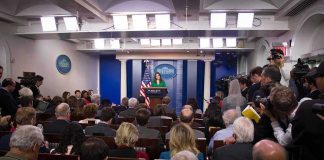
A top Democrat just admitted the SAVE America Act would make it “hard for any Democrat to win,” underscoring how powerful strict proof-of-citizenship and photo ID rules could be for securing future elections.
Story Snapshot
- The SAVE America Act requires documented proof of U.S. citizenship to register for federal elections and photo ID to cast a ballot.
- Representative Elissa Slotkin said the bill would make it “hard for any Democrat to win,” revealing how much the Left fears tighter election rules.
- Democrats and liberal groups claim the bill is “voter suppression” that could block millions of voters, while Republicans say it protects election integrity.
- The Senate, under intense pressure from President Trump and grassroots conservatives, ultimately failed to pass the SAVE America Act after a heated filibuster fight.
What the SAVE America Act Really Does
The SAVE America Act, formally called the Safeguard American Voter Eligibility Act, would change how Americans register and vote in federal elections. The bill requires people to show documented proof of U.S. citizenship when they register to vote or update a registration, not just a regular driver’s license. Acceptable documents include a U.S. passport, a birth certificate with matching ID, a government photo ID showing birthplace in the United States, or military records proving a citizen’s birth in America.
Under the bill, all voters in federal elections would also need a photo identification to cast a ballot, whether voting in person or by mail. Absentee voters would have to include a copy of their photo ID with their ballot, and in some cases also proof-of-citizenship paperwork if the ID does not clearly show citizenship. Supporters say these rules simply confirm that only American citizens vote and that each voter is who they claim to be, closing loopholes that worry many conservatives.
Democrats Admit the Political Stakes
Democratic Representative Elissa Slotkin openly said the SAVE America Act would make it “hard for any Democrat to win an election,” revealing the deep partisan stakes around this bill. Her remark came as Democrats in the Senate tried to rally against the legislation, warning it would reshape the voter pool in ways that hurt their party. This admission lines up with years of research showing that stricter voter ID and documentation rules tend to be pushed by Republicans in order to tighten voting systems.
While Democrats frame the bill as a threat to voting rights, Slotkin’s comment suggests they also see it as a threat to their electoral chances. Liberal legal groups argue that many low-income and younger citizens do not have passports or easy access to birth certificates, and they claim millions could struggle to meet the new paperwork rules. Civil rights advocates say these burdens would fall more heavily on communities of color and rural voters, mirroring past fights over voter ID laws in the states.
Election Integrity vs. ‘Voter Suppression’ Claims
Republicans and many Trump supporters argue the SAVE America Act is about basic election integrity and restoring trust after years of close and disputed races. They note that all states already verify identity in some way, and many already require some form of ID at the polls, but not all demand a photo ID or proof of citizenship for registration. Backers say requiring hard proof of citizenship simply enforces long-standing federal law that already bans noncitizen voting in national elections.
Democrats, including Senate leaders and major civil rights organizations, attack the bill as “Jim Crow 2.0” and “dangerous” voter suppression. They argue there is little evidence of widespread noncitizen voting and say the real impact would be to block lawful citizens who lack easy access to documents. Critics stress that many Americans do not hold passports and that getting one costs money and time, which can discourage participation, especially close to election deadlines.
Trump’s Push and the Senate Filibuster Fight
President Trump made the SAVE America Act one of his top election priorities, pressing the Senate to follow the House, which narrowly passed the bill 218–213. Reports indicated Republicans had secured around 50 votes in the Senate, reflecting strong support inside the party, but they still needed more votes to overcome a Democratic filibuster. Debate stretched for days as Democrats vowed to “kill” the bill on the floor and warned of chaos in state election offices if the rules took effect quickly.
Stories, by Stripped Out News:
Election Reform Debate Reaches Boiling Point Amid Partisan Tensions
Senator Slotkin's remarks on SAVE America Act spark controversy and criticismhttps://t.co/zquHFIPzxeStripped Out News pulls from 200+ sources, removes the bias, and delivers the…
— Stripped Out News (@Strippedoutnews) July 15, 2026
Ultimately, the SAVE America Act failed to advance in the Senate, stalling despite heavy Republican and Trump administration pressure. The collapse was celebrated by voting-rights groups as a major victory and condemned by conservatives who saw a rare chance to lock in tougher national standards. For right-leaning Americans worried about noncitizen voting, loose mail-in rules, and weak ID checks, the fight over this bill shows how far Democrats will go to keep the current system—and how central secure elections have become to future political battles.
Sources:
redstate.com, politico.com, roy.house.gov, majorityleader.gov, naco.org, upi.com, michwomen.com, congress.gov, northjersey.com, docs.house.gov, aclu.org, campaignlegal.org, facebook.com, aclunorcal.org, civilrights.org, americanprogress.org, bipartisanpolicy.org, electionlab.mit.edu, academic.oup.com, carnegie.org