
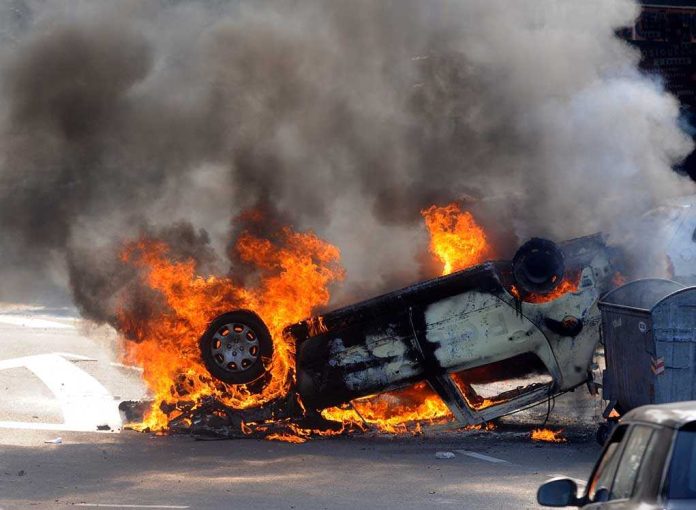
A plumber’s morning ignition likely turned a trunk into a bomb, and the blast rippled through a quiet New Jersey street.
Story Snapshot
- Scanner audio tied the blast to acetylene and the moment the car was started.
- Officials say a leaking acetylene cylinder in the trunk likely ignited, injuring the driver.
- The mayor said bomb experts ruled out an explosive device, narrowing the cause to hazardous gas.
- The official cause remains unconfirmed as the investigation continues.
What happened on Congressional Lane
A car exploded on a residential street in Totowa on a Monday morning, sending debris into nearby townhomes and across the road. One man, identified in reporting as a tradesman, was injured and taken to the hospital. Neighboring homes and vehicles suffered damage from the shock and shrapnel. Police, firefighters, and federal agents swarmed the scene, then blocked off the area for safety checks and evidence collection. Reporters described a concussive blast with no sustained fire.
First responder radio traffic captured by local television linked the ignition to starting the car and explicitly named acetylene as a likely fuel source. The clip included, “Possibly acetylene. Plumber started the car and it ignited.” That real-time detail matches what investigators often see in similar cases: a fuel-air mix accumulates in a closed space, then a small spark triggers a large pressure wave. Early dispatch notes also mentioned a contractor vehicle and a suspected leaking tank.
Why acetylene is the leading theory
Fire officials told reporters they believe a leaking acetylene cylinder in the trunk ignited while the driver sat inside. The Totowa mayor added that the man was a plumber and had an acetylene tank in the trunk. He also said the Bureau of Alcohol, Tobacco, Firearms and Explosives and the bomb squad ruled out a bomb. That chain of facts narrows the options to hazardous gas ignition, which fits the damage pattern and the lack of ongoing flames after the blast.
Several outlets framed the cause as “likely” and “preliminary,” which is accurate during an active probe. The mayor himself said they were not yet sure if the tank caused the explosion. Reporters also noted a detail that may sound odd to lay readers: a powerful blast but little to no fire. That can occur when fuel gas disperses and ignites in a brief pressure event, then leaves too little mixture to sustain burning. A Massachusetts case documented a similar outcome after an in-vehicle acetylene blast.
The open questions still driving the probe
Officials have not released a final forensic report. Media accounts differ on the victim’s trade, describing him as a plumber in some reports and a welder in another, though both jobs commonly use acetylene. Authorities have not published photos of the cylinder or a lab readout that confirms acetylene residue. Those facts will likely sit in the final package: scene photos, cylinder serials, valve condition, trunk gas readings, and an ignition source analysis. That documentation would settle the debate.
ALERT: Small town in New Jersey was rocked this morning after a plumber got in his car and it exploded.
Residents in Totowa were awakened at around 5:40 AM to the sound of a car explosion.
Officials believe an acetylene tank, a highly flammable gas used for welding, was slowly… pic.twitter.com/KEOUgjnI7M
— E X X ➠A L E R T S (@ExxAlerts) July 13, 2026
Social media floated other causes, like a fuel pump gasket mistake. No on-record evidence supports those claims. The stronger leads still point to hazardous gas. Conservative common sense says follow the facts that clear hurdles: a named gas on the scanner, a tank reportedly in the trunk, no bomb, and damage that tracks with a gas-air detonation. That is a tighter story than guesswork about unrelated parts. The prudent stance is to withhold final judgment until authorities publish the lab work.
Safety lessons for every tradesperson and neighbor
Acetylene is a high-energy gas that becomes dangerous in closed spaces. A slow leak can fill a trunk or cabin overnight. The moment you unlock, crank the starter, or even toggle a light, a spark can set it off. Store cylinders upright, with valves fully shut and caps on. Ventilate before starting. Keep tanks out of passenger spaces. If you smell gas, back off and call the fire department. These steps sound basic but stop blasts like Totowa’s.
What to watch next
Expect the final word from investigators, not social feeds. The critical items are the forensic lab confirmation of acetylene, the cylinder’s condition, and the ignition source timeline. If officials release photos that show the tank in the trunk and a lab match on residues, the acetylene theory will move from “likely” to settled. If the evidence shows no acetylene, the case pivots fast. Until then, the smart bet remains on the gas leak scenario backed by first responder accounts and on-scene reporting.
Sources:
facebook.com, newjersey.news12.com, rlsmedia.com, youtube.com