A hateful bomb warning taped to a campus restroom wall did more than scare students—it cracked open a two–year trail of bathroom terror notes and raised hard questions about how America now treats “hoax” threats as real terrorism.
Story Snapshot
- A San Jose State University grad student is charged over a written “mass bomb” warning posted in a men’s restroom.
- Federal prosecutors say he left more than 20 violent, racist threat messages around campus bathrooms.
- The case shows why “hoax” threats still trigger full terrorism-style responses and serious federal charges.
- It also highlights a bigger pattern of school and campus bomb scares that rarely involve actual explosives.
Bathroom bomb warning leads to federal arrest
San Jose State University police and federal agents moved from graffiti patrol to terrorism response when they found a printed sheet taped inside a men’s restroom in MacQuarrie Hall last fall. The paper, slid into a plastic sleeve like a notice on a bulletin board, was titled “WARNING!” in block letters and threatened a “mass bomb” attack the following week. The message was more than a vague scare. It gave dates and paired the threat with crude drawings of swastikas and political slogans that seemed designed to inflame everyone at once.
Near that sheet, scrawled directly on the bathroom wall, someone had written about a “Mass bombing 11/11 and 11/12 guess,” along with calls for violence against Jewish, Muslim, Mexican, and Chinese people using a racial slur. For students who walked in to wash their hands and saw that scene, it looked less like a prank and more like a roadmap for a hate–fueled attack. Campus officials had little choice. They treated it as a credible bomb plot, cleared areas, and called in the Federal Bureau of Investigation (FBI) and the United States Department of Justice (DOJ).
From one note to a pattern of hate and fear
Prosecutors say that first restroom note was not a one–off outburst. According to a federal criminal complaint, investigators linked graduate student Ziheng “Tony” Fang, 30, to at least 20 similar written threats left in both men’s and gender–neutral bathrooms across the San Jose State campus since October 2024. Some messages allegedly warned of bombings, others of knife and gun attacks, many mixing racist slurs, pro–Trump phrases like “MAGA 2028,” and calls for killing Muslims, Jews, Chinese people, and even New York City’s left-wing mayor Zohran Mamdani.
Investigators say they used building entry records and security camera footage to tie Fang’s movements to the locations and timing of these bathroom discoveries. The Justice Department charged him with a single federal count: giving false information and hoaxes about bombs, a crime that carries up to five years in prison. But in court filings and press statements, authorities describe him more like a serial saboteur whose messages repeatedly emptied classrooms, disrupted exams, and put the campus on edge.
Hoax threats still bring real guns, real lockdowns
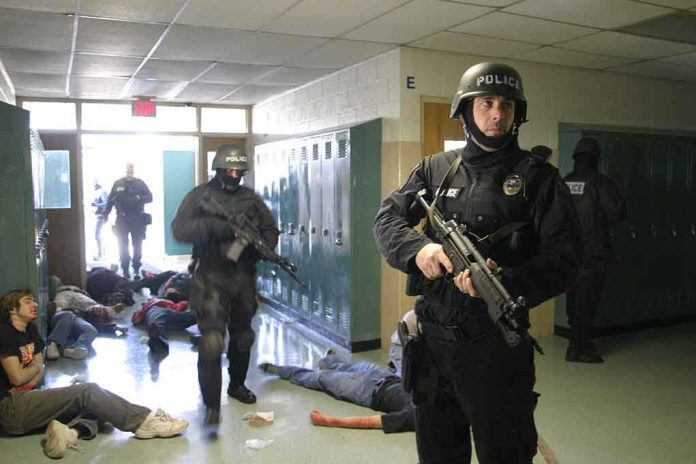
The San Jose State case fits a wider pattern across California and the country. Schools and universities now see bomb and mass–violence threats as a regular part of life, and most turn out to be hoaxes. Police in Palo Alto, for example, recently tracked down a student who wrote a bathroom stall threat to bomb Jane Lathrop Stanford Middle School; they later said the threat “was not credible” and called it a hoax. The campus still spent a day in fear, and officers still had to sweep the site.
Similar scares hit colleges across the country when callers or online posters claim they will shoot students or blow up buildings. Many of these are “swatting” events—hoax 911 calls that send armed teams rushing to campuses and airports. Federal officials treat these as serious crimes because, hoax or not, they can shut down schools, trigger dangerous police encounters, and drain resources meant for real emergencies. That is why the DOJ now uses strong tools, including terrorism task forces, to chase down even bathroom graffiti when it includes bomb dates and specific targets.
Where a hateful hoax meets national security law
Fang’s charge may sound modest compared with true bomb plots, but the law behind it is part of America’s terrorism toolbox. The federal “false information and hoaxes” statute was built to stop people from spreading lies about bombs or biological attacks that could cause panic or hinder real emergency responses. When someone writes “MASS BOMB” and gives dates inside a public building, that law treats the message almost like a fake 911 call about explosives. It does not matter if the writer had no bomb or never planned to build one; the harm is the fear and disruption caused.
‘100% woke’ US grad student charged with hoax over ‘kill Jews,’ pro-Trump graffiti
By Luke Tress Follow
A leftist graduate student in California has been charged with a hoax for allegedly posting antisemitic, far-right graffiti in university bathrooms, the Justice Department…
— Australian Jewish Association (@AustralianJA) July 14, 2026
From a common–sense conservative view, this approach makes sense. Government’s first duty is to protect life and maintain order. If officials shrug off a detailed bomb warning and it turns out to be real, they have failed in the worst way. At the same time, many Americans worry that the line between speech and crime is getting thin. Fang’s case pushes that debate. His messages were vile and specific, but current reporting does not show he ever possessed explosives or attempted an actual attack. The system must punish real threats without turning every ugly note into a pretext for broad speech policing.
Bathroom threats, culture wars, and campus politics
One more twist keeps this story from fitting neat partisan boxes. Fang is described in coverage as “100% woke,” yet his bathroom notes allegedly copied far–right slogans, swastikas, and pro–Trump phrases while calling for murder of Jews and Muslims. That mix suggests the threats were not honest political speech but a kind of weaponized trolling, aimed at painting his own campus as a hive of white–nationalist hate and pushing administrators and conservatives into a fresh fight over bias and safety. Many past campus bomb hoaxes have come from people trying to dodge exams or create chaos. Here, the messages seem tailored to spark a culture–war firestorm.
For everyday readers, the lesson is simple and sobering. When someone turns a restroom wall into a fake terror bulletin, the fallout does not stay on campus. Police mobilize, politics inflame, and the justice system steps in under laws written for true bombers. Whether you see that as smart caution or creeping overreach, bathroom graffiti in 2026 is no longer a small joke. It is treated as a federal case file—and sometimes, as the start of a supposed bomb plot.
Sources:
nypost.com, latimes.com, cbsnews.com, justice.gov, foxnews.com, lbpost.com, popcenter.asu.edu, axios.com