
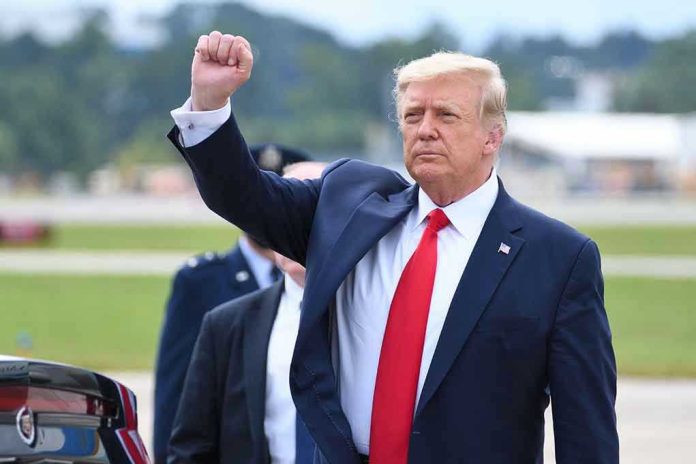
Public claims about assassination “kill lists” tell us more about information warfare and security signaling than they do about any single target’s personal risk; the durable truth in this domain is that states like Iran blend real threats with propaganda, while U.S. figures sometimes amplify ambiguous intelligence to serve political narratives—leaving citizens to sort perception from verifiable danger.
At a Glance
- Donald Trump has repeatedly said he is “number one on Iran’s kill list,” but no primary-source confirmation of a ranked Iranian list has surfaced.
- Iran and its proxies have demonstrably pursued plots and propaganda threatening U.S. officials, creating a real—if often nonspecific—hazard environment for high-profile figures.
- The strongest on-record evidence shows U.S. charges tied to an Iranian-linked murder-for-hire scheme against Trump, but not a ranked, formal “list.”
- Some of Trump’s adjacent claims about Iran’s leadership “decimation” and dramatic military strikes are contradicted or unverified, which undercuts his broader narrative.
What Trump Said, and What the Evidence Can Actually Bear
Across multiple public appearances and press exchanges, Donald Trump asserted that he is “number one on the kill list for Iran,” presenting the statement as a matter of fact and contextualizing it within a larger picture of Iranian threats and U.S. military pressure. He repeated the claim during a NATO press question-and-answer and in an interview setting, treating it as settled intelligence rather than inference. The problem for an evidence-led observer is not that Iran harbors hostile intent toward a former U.S. president—Tehran has loudly vowed revenge for past actions—but that a specific, ranked Iranian “kill list” naming Trump as “#1” remains uncorroborated by independent, primary documentation or by on-record confirmation from U.S. or allied intelligence.
There is, however, a material anchor that separates this from pure rhetoric: the U.S. Justice Department has charged an Iranian national in a murder-for-hire plot that included plans to assassinate Trump. That filing substantiates the core risk of targeted violence, even as it does not authenticate a formal or ranked list. In security terms, this matters; it demonstrates capability, intent, and operationalization on the Iranian side sufficient to trigger U.S. legal action, while leaving the “#1 on a list” component in the realm of unverified assertion.
How States Use Threat Signaling, and Why “Lists” Often Stay Fuzzy
Autocracies and hybrid regimes habitually fuse strategic messaging with internal mobilization. Iran’s security ecosystem—centered around the Islamic Revolutionary Guard Corps (IRGC) and intelligence affiliates—mixes clandestine plots with overt intimidation. Public displays or social media content featuring crosshairs over Western figures, or chants of revenge, are at once threats, morale devices for domestic audiences, and bargaining chips aimed at raising perceived costs for adversaries. Such signaling rarely arrives as a declassified “document with names in rank order”; it more often looks like a patchwork of rhetorical vows, visual intimidation, and covert activity. That is the operational backdrop into which Trump’s claim lands: a real hazard environment, within which the specificity of a formal “#1 ranking” is precisely the kind of detail least likely to be publicly validated.
Historically, U.S. leaders have been the target of numerous plots; the idea that a former president would remain a priority target for a regime that blames him for past strikes is entirely plausible. The distinction that matters isn’t whether Iran wants high-profile revenge—it’s whether a particular claim about rank and documentation is provable, which it currently is not. Analysts therefore separate the verified (plots, charges, open threats) from the performative (ranked lists paraded as fact without corroborating records).
The Credibility Problem: Adjacent Claims That Don’t Survive Scrutiny
Credibility is cumulative. When a public figure pairs a claim like “I’m number one on their kill list” with sweeping assertions that do not align with verifiable events, the entire package suffers. In the same venues where Trump asserted his top-target status, he also described the wholesale destruction of Iran’s leadership strata and dramatic, specific military outcomes that have not been independently corroborated. Notably, statements suggesting Iran’s supreme leader had been killed were contradicted by subsequent reporting, which documented his survival at the time. That discrepancy erodes confidence in other contemporaneous claims that lack documentary support, including the notion of a formal, ranked kill list.
The national security community weighs claims by source reliability, corroboration, and consistency with known operations. On that rubric, the existence of serious Iranian-directed threats is well supported; the precise ranking claim is not. This differentiation is not pedantry—it is the discipline that keeps analysis from drifting into theater.
What We Do Know: A Real Threat Vector Backed by Charges
The most concrete datapoint on the table is the Justice Department’s case charging an Iranian-linked actor in a murder-for-hire scheme targeting Trump. Federal charging documents of this kind are not cable news chatter; they reflect investigative thresholds and evidentiary standards, and they imply that U.S. agencies judge both intent and capacity to be nontrivial. The existence of such a case justifies robust protective measures and lends weight to the proposition that Trump is a priority target for elements aligned with Iran. It still falls short of proving a ranked, written “kill list” bearing his name at position one, but it moves the discussion beyond rhetoric to action.
This is the central analytic balance: acknowledge a real, active risk environment with operational manifestations, while declining to endorse embellishments that outstrip what the evidence can sustain. In practice, protective intelligence treats credible plotted intent as the driver of posture, not whether a hostile service has enumerated targets in public or private.
Why “Rank” Matters Politically More Than Operationally
Inside protective details, order-of-merit rankings are far less important than indicators of imminent threat: surveillance of routes, acquisition of weapons or delivery systems, financial flows to cutouts, communication patterns, and observed dry runs. The politics, however, prize hierarchy—being “number one” connotes singular importance and heightened bravery under fire, which can be mobilized for fundraising, agenda setting, or narrative control. That does not make the claim false; it makes it politically useful. The correct analytic posture is to separate the optics from the tradecraft—elevated risk can be real without a ranked list being proven, and unproven rank does not negate an adversary’s lethal intent.
How to Judge Future Evidence
Were a formal “kill list” ever to surface credibly, it would likely do so via one of three channels: court filings that quote or attach seized communications; intelligence community declassification of intercepts or captured media; or vetted leaks from Iranian insiders with provenance traceable by journalists or oversight bodies. Each path offers distinct validation hurdles. Court records are the most straightforward for public confidence because the defense can challenge authenticity. Intelligence disclosures rely on institutional credibility and often redact telltales, limiting public verification but still providing high confidence when backed by named agencies. Sourced insider leaks demand rigorous chain-of-custody scrutiny to avoid influence operations masquerading as revelations.
Until such material appears, the prudent conclusion is narrow and sturdy: Iranian-linked actors have targeted Trump, as evidenced by U.S. charges; the existence and ranking of a formal list remain unverified. That boundary keeps analysis tethered to facts while recognizing the gravity of the threat environment.
President Trump discusses not going home on the new AF1… and how he is #1 on the Iran “Kill List”
Feels like seeding… I don’t like it. Keep POTUS In your prayers. pic.twitter.com/0oSSRs2uI9
— Trumpusa1 (@Trumpusa1A1) July 8, 2026
The Broader Pattern: Assassination Risk, Political Rhetoric, and Public Understanding
Americans are accustomed to the theater of threat—grand claims interwoven with real dangers. The responsible way to read claims like Trump’s is to parse the stack: propaganda and signaling from adversaries, court-anchored cases reflecting concrete plots, and political communications that translate risk into narrative. Citizens should demand proof for the specific and sensational, without lapsing into cynicism about the general and demonstrable. That approach honors two truths at once: Iran’s apparatus does threaten U.S. leaders, and not every flourish about that threat is borne out by the record.
Bottom Line for Security and Politics
For practitioners, the priority remains steady: posture resources against demonstrable intent and capability, and adjust continuously as investigations mature. For the public, the standard should be equally disciplined: credit what is shown in indictments and corroborated reporting; treat unverified rankings and dramatic totals as claims to be tested, not anchor points for judgment. Applying that standard here yields a clean verdict. Trump’s statement that he is “number one on Iran’s kill list” is a claim without documentary corroboration; his vulnerability to Iranian-linked targeting is unfortunately real. The difference between those two sentences is the difference between rhetoric and evidence—and that difference is how serious people keep their footing when the stakes are life and death.