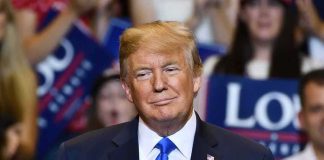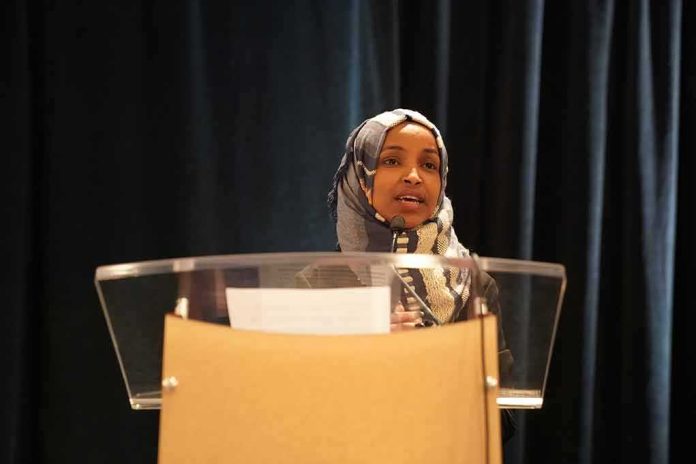
President Trump turned a formal public appearance into a personal assault on Representative Ilhan Omar, using the platform to call her dishonest, question her legitimacy, and tell the audience she “oughta get the hell out of our country” and “shouldn’t be here.” The episode matters not because it introduced a new grievance, but because it shows how a long-running, unverified allegation can be folded into presidential rhetoric and delivered as spectacle rather than evidence.
Key Points
- Trump publicly attacked Omar from the podium in a live, on-record setting.
- He paired the expulsion line with insults about her intelligence and honesty.
- His remarks also revived a brother-related insinuation that had circulated for years.
- The record provided here supports the existence of the accusation, not proof of the underlying claim.
What Trump Said and Why It Landed
In the remarks reflected in contemporaneous coverage and transcript excerpts, Trump did not speak in the language of policy disagreement; he spoke in the idiom of exclusion. He called Omar “a low-IQ person” and “a very dishonest person,” then escalated to the line that she should “get the hell out of our country.” That phrasing is familiar Trumpian terrain: blunt, theatrical, and designed to convert a political adversary into an emblem of everything the audience is meant to reject. The line did its work instantly because it attacked Omar’s personhood and her place in the country at the same time.
The more incendiary part of the episode is the way Trump folded a long-circulating family allegation into the broader tirade. The supplied coverage shows him and the clip transcripts referencing Omar’s brother in a way that implies impropriety, including the phrase “husband number one.” What the provided record does not supply is a full, independent transcript of the exact wording or any documentary proof for the underlying accusation itself. That distinction matters. One can verify that Trump repeated the claim publicly; one cannot, from the materials here, verify that the claim is true.
The Allegation Behind the Spectacle
The Omar-brother rumor did not begin with this speech. The New York Times reported in 2019 that speculation about Omar marrying her brother had circulated since 2016, but that no evidence had surfaced to verify it; Omar, for her part, rejected the rumor as “absolutely false and ridiculous” and gave her own account of her marriage history. That background is essential because it explains why Trump’s repetition of the allegation should be understood as political weaponry, not established fact. A claim can be repeated for years and still remain unsupported; longevity is not corroboration.
That is also why the distinction between accusation and proof is the central analytical issue. The sources supplied for this story document a public attack, not a substantiated finding. They show Trump speaking on the record, they show the allegation being transmitted through broadcast and social clips, and they show the rhetorical force of the insult. They do not supply a marriage certificate, a sworn statement, an investigative report, or any comparable primary evidence that would move the allegation out of the realm of repetition and into the realm of verification.
Why These Attacks Travel So Fast
This kind of episode endures because it is built for the modern attention economy. The political insult is compact, vivid, and emotionally legible; the evidentiary rebuttal is slower, more technical, and less shareable. Once a line like “she should get out” is delivered from a presidential podium, it can be clipped, captioned, and circulated faster than anyone can reconstruct the underlying record. That is especially true when the target is already polarizing, because audiences do not merely hear the claim; they immediately sort it into identity, tribe, and existing belief.
The available coverage also shows how different media environments emphasize different parts of the same event. Broadcast clips and headline-driven reporting foregrounded Trump’s insult, the dinner setting, and the broader spectacle of a president using a high-profile gathering to hammer political enemies. Proponent-friendly coverage repeated the brother allegation more directly, but even there the excerpted material did not present independent documentation proving it. The result is a familiar asymmetry: the attack is fully public, while the factual basis for the attack remains thin or absent in the record provided here.
Ilhan Omar hits 'idiot' Trump back with 3-sentence burn to Correspondents' Dinner ramble https://t.co/f29NFe7nly …Omar you're still under investigation. If you're so innocent, why did you decline requests from Minnesota's Fraud Prevention and State Agency Oversight Committee to… pic.twitter.com/5RcJpVkhow
— Flashgordon (@j_flashgordon) July 25, 2026
What the Record Supports, and What It Does Not
The cleanest reading of the evidence is straightforward. Trump did publicly attack Omar, he did do so in a live setting, and he did revive language suggesting she was illegitimate, dishonest, and worthy of expulsion from the United States. The materials also support the narrower point that he referenced a brother-related allegation in a way that made the insinuation unmistakable. What they do not support is the allegation itself. On the supplied record, the existence of the accusation is proven; the truth of the accusation is not.
That is the enduring lesson of the episode. In politics, especially at the level of presidential rhetoric, the force of a charge often exceeds its evidentiary footing. Once a claim is laundered through repetition, it can function as social fact for people predisposed to believe it, even when the underlying proof is missing. The responsible reading is not to pretend the allegation was never made; it was. The responsible reading is to keep the accusation separate from the evidence, because those are not the same thing.
Sources:
twitchy.com, news.meaww.com, youtube.com, meidasnews.com