
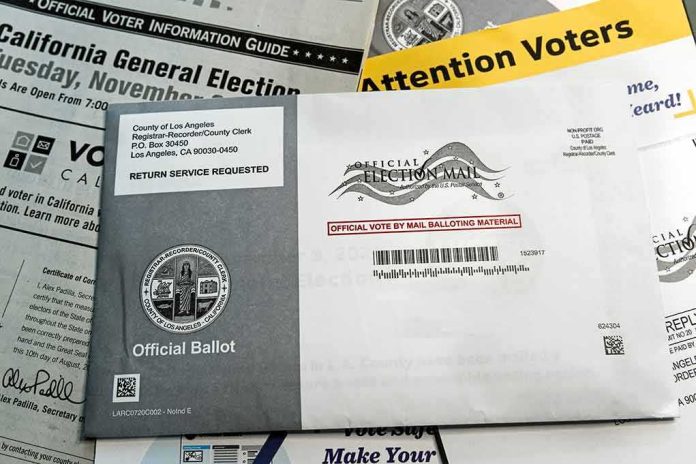
California’s debate over taxing billionaires and requiring voter ID is not a culture-war oddity; it is a stress test of two recurring policy instincts—funding broad social commitments from a narrow, mobile tax base, and tightening election procedures to reassure skeptical voters—each with clear mechanisms, material tradeoffs, and real uncertainty about outcomes.
At a Glance
- Proposition 40 is a one-time 5% levy on billionaire net worth with installments and deferral options; state fiscal analysts project a temporary revenue surge measured in the tens of billions.
- Supporters frame Prop 40 as a backstop for healthcare and other programs; the measure text channels funds accordingly, but revenues are temporary and operationally complex.
- Proposition 39 would require voter ID and citizenship verification; the policy mechanism is straightforward, while evidence of large-scale ineligible voting is limited and research on turnout effects is mixed to null.
- The central uncertainty: whether a concentrated, one-time tax raises near-term cash without unacceptable long-run erosion of the state’s high-earner income-tax base.
What Proposition 40 actually does—and how the money would flow
Proposition 40 is not a vague “wealth tax.” It is a one-time, legally defined 5% charge on the portion of worldwide net worth above the billionaire threshold for California residents and certain trusts, with liability assessed on a specific valuation date. The design permits payment in five annual installments of roughly 1% and allows deferral—with interest—when liquidity is demonstrably constrained. Those features matter: they convert a large nominal assessment into a cash-flow schedule that can be administered over multiple fiscal years, while attempting to avoid forced liquidation of illiquid assets like closely held businesses or private equity stakes.
On the receiving end, the measure directs proceeds to healthcare and related public programs, a statutory channel that gives the “fund Medi-Cal and vital services” claim more than campaign rhetoric. The Secretary of State’s quick guide states health care is the primary destination, with additional funding for K–14 education and food assistance; the explainer connects the tax to backfilling an anticipated reduction in federal support. The instrument, however, is temporary—an issue any serious reader should keep in focus when thinking about multi-year entitlements and hospital financing cycles.
Revenue potential versus durability: what the numbers can and cannot promise
How much money are we actually talking about? The Legislative Analyst’s Office (LAO), which is California’s nonpartisan fiscal referee, describes a temporary revenue increase likely totaling “tens of billions” spread over several years. That phrasing deliberately avoids pinning to a specific dollar figure and acknowledges implementation uncertainty. Proponents lean on a named expert report estimating around $100 billion over 2027–2031 from roughly 250 taxpayers; it’s a plausible scenario given the math of a narrow base and a 5% rate, but it remains an estimate, not a collection record. The LAO also flags a potential ongoing reduction—less than $1 billion a year—in high-earner income-tax receipts, reflecting behavioral responses and relocation risk.
These distinctions are not quibbles. A one-time levy—even one payable over five years—generates a pulse of cash that can stabilize budgets and protect services during a federal downshift. It does not, on its face, create a recurring stream that scales with medical inflation, demographic change, or provider cost growth. That is why opponents frame the policy as a “sugar high,” and why any responsible implementation plan would separate bridge financing (good use of a lump sum) from ongoing obligations that require a continuing revenue base or structural cost controls.
The strongest counter-case: migration, base erosion, and net fiscal impact
The counter-argument is specific and named: Stanford-affiliated economists Benjamin Jaros and Joshua Rauh model lower wealth-tax collections—$28–$36 billion—and substantial income-tax losses from billionaire departures, concluding that in most simulated scenarios the state ends up net negative by roughly $39 billion on average. They report 85% of 100,000 simulations yield a net loss after accounting for continued erosion of the high-earner income-tax base. Whether one accepts their assumptions, this is not hand-waving; it’s a structured forecast calling the bet risky if migration accelerates among the small group that disproportionately pays state income taxes.
How much migration is realistic? International evidence on wealth taxes finds meaningful mobility responses among top-wealth households and modest revenue contributions relative to headline rates—problems of valuation, liquidity, and avoidance recur across jurisdictions. The LAO’s own fiscal note builds in the possibility of lower ongoing income-tax receipts for this reason, even as it affirms the measure’s near-term revenue potential. The hard policy question becomes not “does someone move?” but “how much base erosion over how long would turn a near-term victory into a long-run loss?”.
Administration and litigation: the unglamorous determinants of yield
Implementation will decide outcomes more than slogans. Proposition 40 reaches worldwide net worth as of a set date, treats directly held real estate differently than real estate owned through business entities, and covers certain trusts—each a magnet for valuation disputes, residency fights, and litigation over constitutional constraints. The measure anticipates liquidity issues via installments and interest-bearing deferrals; that helps collections but also extends administrative exposure, invites planning behavior, and increases the importance of accurate, enforceable appraisals. Every ambiguity—residency definition, asset situs, trust attribution—becomes either an assessment or a loophole. The LAO, the measure explainer, and independent tax advisors all highlight this complexity because it is where projected dollars often evaporate.
One additional wrinkle: competing ballot measures can supersede Proposition 40 even if it secures substantial “yes” votes. The interaction rule reported by tax practitioners is straightforward—if an alternative measure on the same subject receives more affirmative votes, it blocks 40’s enactment. That political overlay adds yet another channel through which an apparently decisive public preference can yield to drafting tactics and ballot mechanics.
What Proposition 39 would change—and what the research says
Proposition 39 would require voters to present identification and direct officials to verify that registrants are U.S. citizens—concrete procedural changes that aim to shore up confidence in eligibility rules. The available reporting is clear on the requirement itself; it is thinner on any documented instance of large-scale ineligible voting in California. That asymmetry is common in election administration debates: the mechanism is specific, while the empirical target is sparse. Large-scale academic work on strict ID laws in the United States generally finds no measurable decline in overall registration or turnout and no detectable effect on fraud; some legal scholarship cautions that “null” average effects can still mask small suppressive impacts for particular groups or contexts. Those findings don’t answer whether voters will feel more confident—but they do place boundaries around the likely operational effects.
Design details, not slogans, drive the real-world burden: acceptable ID lists, provisional-ballot procedures, cure timelines, and citizenship-database accuracy. Implementation choices that maximize acceptance pathways and minimize false negatives tend to neutralize access concerns; poor design does the opposite. If the state proceeds, it should publish error-rate metrics by county—provisionals issued, cured, and rejected; citizenship mismatches reviewed and resolved—so the confidence argument is tethered to observed performance rather than intuition.
🔴 California Democrats oppose billionaire wealth tax that voters back 4-to-1
Governor Gavin Newsom, incoming governor Xavier Becerra, and Los Angeles mayor Karen Bass have aligned with Silicon Valley billionaires who raised $340 million to defeat Proposition 40, a ballot… pic.twitter.com/ZauwzOcCLl
— NewsTongue (@NewsTongueX) October 31, 2026
How to read the tradeoffs like a budget hawk
For Proposition 40, the analytic frame is cash-flow management versus base preservation. If federal support drops and the state needs bridge financing, a one-time levy concentrated on billionaires can, in principle, protect coverage and provider solvency for several years. That case strengthens if the administering agencies can defend valuations in court, sequence installments to match program outlays, and keep high-earner income-tax erosion below the LAO’s “less than $1 billion” annual risk band. It weakens if migration accelerates toward the Jaros–Rauh scenarios or if litigation and valuation friction push realizations far below projections.
For Proposition 39, the practical frame is operational competence. A narrowly tailored ID regime with robust provisional and cure processes likely leaves turnout and registration largely unchanged on average, with minimal effect on already-rare fraud; the confidence benefit, if any, is psychological and political rather than statistical. In both measures, voters are choosing mechanisms to manage risk under uncertainty, not automatic wins: a temporary tax for a structural funding need, and a procedural change for a perceived legitimacy gap.
Sources:
nypost.com, sos.ca.gov, eml.berkeley.edu, grantthornton.com, quickguidetoprops.sos.ca.gov, lao.ca.gov, latimes.com