When Russian weapons cross into a NATO member’s airspace in the middle of a large strike on Ukraine, it is not a border technicality; it is a test of alliance air defense, crisis management, and deterrence signaling all at once.
At a Glance
- Poland reported three Russian-origin objects—at least one Kh-101 cruise missile and likely another missile plus a jet-powered drone—violated its airspace and fell on Polish soil during a major Russian attack on Ukraine.
- Polish leaders called the incursions an intentional provocation and requested added NATO forces; an emergency security meeting followed.
- Polish air defense tracked 11 threatening objects, three of which crossed into Poland; no casualties were reported.
- The episode fits a broader post-2022 pattern of Russian aerial spillover near NATO borders and renewed debate over intent and escalation risks.
What Poland says happened: violations, crash sites, and a named Russian missile
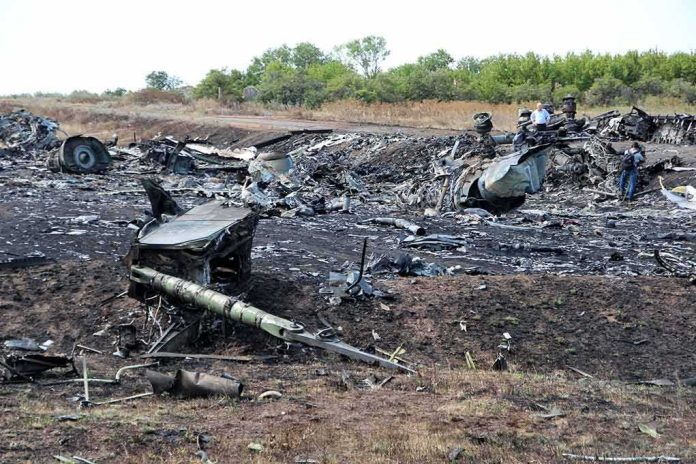
Polish authorities reported that three objects entered Polish airspace amid a large-scale Russian missile-and-drone strike on Ukraine and came down at three locations in the country’s southeast. Defense Minister Władysław Kosiniak-Kamysz publicly attributed the event to the Russian Federation and identified at least one object as a Russian Kh-101 cruise missile; the second object was described as probably a missile, and the third as likely a jet-powered drone. Debris or crash sites were reported near Nowy Lipowiec, Rudnik nad Sanem, and Mołodycz, with no casualties and no critical infrastructure damage described. The timeline matters: the violations unfolded while Russia was conducting one of its larger recent aerial attacks on Ukraine, providing a clear operational context for the presence and trajectory of Russian munitions near Poland’s border.
Poland’s operational command added an important air-defense detail: of 11 threatening aerial objects tracked near the border that night, three crossed into Polish territory. That ratio helps explain both the intensity of Polish air-policing activity and the selective appearance of debris on the Polish side. Prime Minister Donald Tusk convened a security meeting with senior military and intelligence leaders and characterized the events as an intentional provocation, language echoed across Polish officialdom as Warsaw asked NATO for an enhanced presence on the eastern flank.
How this fits the air-defense picture: mechanism and practical realities
Kh-101 is a long-range, subsonic, air-launched cruise missile Russia has used extensively against Ukrainian targets. Its guidance blends inertial navigation and satellite updates with terminal scene-matching; when functioning as designed, it flies low to evade radar and follows preprogrammed waypoints. In a mass strike, dozens of such missiles thread complex routes across western Ukraine, frequently skirting NATO borders. That geometry increases the risk that a malfunction, a navigation update error, or a defensive intercept in Ukrainian airspace could divert a missile’s terminal path. Add loitering munitions and jet-powered drones to the same congested corridor and you have a cluttered tactical environment in which air-defense networks must discriminate, engage, and—when weapons leak through—reconstruct what crossed the line where and when.
Poland’s report that it tracked 11 objects and confirmed three entries shows the system working as intended: detect early, task fighters and ground-based air defense, warn civilians, and then recover and forensically process any debris that lands in-country. The absence of casualties does not diminish the gravity of the violations; from an air-defense perspective, the salient facts are the sovereignty breach, the weapon identification, and the alliance implications.
Intent versus attribution: what officials assert, and what matters for policy
On attribution, Polish officials were unambiguous: at least one object was a Russian Kh-101; the other two were likely a missile and a jet drone, and all three were linked to the Russian strike wave on Ukraine. On intent, officials used more interpretive language—Tusk called it an intentional provocation—reflecting a policy judgment layered atop technical reporting. That distinction is routine in crisis management: militaries often can identify the hardware and reconstruct flight paths quickly, while determining whether crews or planners aimed at Polish territory, accepted a known overshoot risk, or lost control to malfunction is a higher bar. The public record, as summarized by Polish statements, supports strong attribution and a confident description of what crossed into Poland; it also acknowledges that two of the three objects were classified probabilistically pending full forensics, which is standard in early reporting.
The alliance-level implication is clearer than the philosophical debate over intent. NATO exists to deter and, if necessary, defend against attacks on member territory; repeated cross-border appearances of Russian munitions—irrespective of motive—stress-test that deterrent posture and force decisions about air policing, layered defenses, and proportional signaling. Poland’s call for reinforced NATO presence after the incident follows this logic and is consistent with how allies have responded to previous eastern-flank airspace scares.
The pattern since 2022: more traffic near NATO borders, recurring questions about motive
Since Russia expanded its war on Ukraine in 2022, alliance airspace along the eastern flank has seen more frequent proximity events—aircraft, cruise missiles, and drones approaching or, on several occasions, entering NATO airspace. Analyses that track these incidents describe a persistent interpretive challenge: distinguishing deliberate probing from navigational error or technical failure is often difficult in real time, and sometimes even after debris recovery. Media and policy reporting have counted multiple suspected or confirmed violations involving Poland and other frontline allies, reinforcing that the November incursion did not occur in a vacuum. This is the operating environment in which Warsaw, Vilnius, Bucharest, and others are calibrating readiness, rules of engagement, and public messaging.
This context helps explain why Poland framed the event as a provocation. Repeated episodes harden threat perception, and the timing—concurrent with a heavy Russian strike package—supports Warsaw’s argument that Moscow accepted, or perhaps intended, spillover risks. Whether that rises to “deliberate targeting” is analytically separate from the policy response: NATO will continue to scramble fighters, posture air defenses, and emphasize that state borders, including airspace, are sovereign by law and guarded by capability and will.
Poland is investigating a suspected Russian violation of its airspace after three objects, believed to be two missiles and a drone, entered the NATO member’s territory during a massive Russian attack on Ukraine early Friday. https://t.co/WSJQB7QS7N
— Washington Examiner (@dcexaminer) November 20, 2026
What to watch next: forensic resolution and alliance posture
Expect two tracks from here. First, forensic and operational analysis: Polish military prosecutors and technical teams will catalog debris, correlate radar tracks, and finalize identifications. The key deliverables typically include a consolidated timeline, confirmed object types, crash-site documentation, and, where feasible, recovered guidance components. Even limited public release—photos, serial fragments, or a summarized track—can lock in the factual narrative to the level needed for diplomacy and deterrence. Second, alliance posture: requests for additional NATO forces, air-policing rotations, or ground-based air-defense assets on Poland’s eastern flank are likely to be considered, especially if Warsaw and Brussels judge the incident part of a recurring pattern rather than a one-off.
Sources:
redstate.com, reuters.com, kansas.com, politico.com, independent.co.uk, hromadske.ua, english.nv.ua