
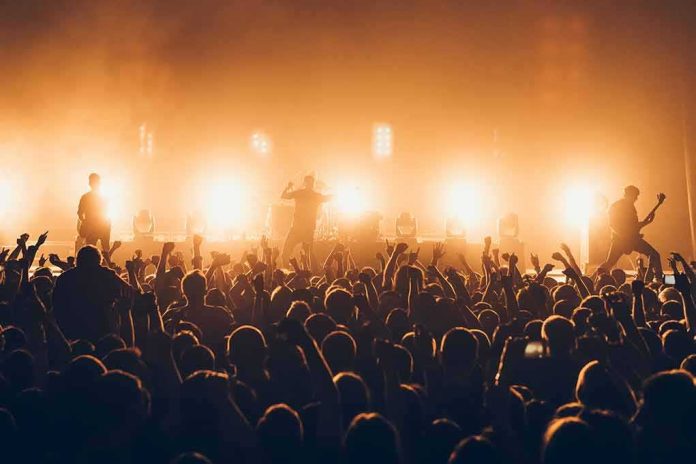
When a concert venue says a show “will not take place” if a specific artist is on the bill, it reveals the real gatekeepers of American live music: building operators and their corporate owners. The Macklemore–Ed Sheeran dispute made that power visible, then extended it into a second act when nine major U.S. arenas declined a proposed “Free Palestine” benefit tour.
At a Glance
- Messina Touring Group said multiple venues told the Sheeran camp they would not allow a concert if Macklemore remained on the lineup.
- Robert Kraft publicly tied the Gillette Stadium decision to Macklemore’s recent conduct and onstage material, invoking a hate-speech rationale.
- Macklemore says nine arenas rejected his Palestine-benefit tour; MSG responded that he is “not an arena-level act” with limited availability.
- The controversy sits in a wider pattern where venues frame decisions as business or conduct-based, while artists call it political suppression.
What happened and why it mattered to the tour business
The hinge event is not ambiguous: the U.S. promoter for Ed Sheeran’s tour, Messina Touring Group, said several venues notified them they would not permit a concert if Macklemore, the slated opener, remained on the bill. That language—“will not allow a concert to take place”—is the blunt instrument of the arena era; the building decides who gets a stage, full stop. The immediate trigger was Macklemore’s “Free Palestine” messaging and associated visuals during New Jersey performances; the consequence was his removal from Sheeran’s U.S. dates, a sequence that several fellow openers protested by stepping off the tour themselves.
Gillette Stadium owner Robert Kraft did not hide behind a neutral schedule excuse. He connected the stadium’s decision to Macklemore’s “recent actions” and “material shared from the stage,” framing the exclusion as guarding against antisemitic rhetoric and hate speech. Whether one accepts that characterization or not, it provided a conduct-policy justification that venue operators frequently rely upon when political speech intersects with alleged bigotry or safety risk.
The second act: nine arenas and a benefit tour
After the Sheeran episode, Macklemore announced a “Macklemore and Friends” benefit tour with proceeds pledged to organizations supporting Palestinians. He then said nine major U.S. arenas—including Madison Square Garden, UBS Arena, Barclays Center, Prudential Center, Climate Pledge Arena, Chase Center, Intuit Dome, Kia Forum, and Crypto.com Arena—declined to host the shows. That list matters because it spans different owners and markets; if accurate in substance, it suggests either parallel business judgments or a fast-spreading political allergy.
MSG Entertainment publicly pushed back—just not on the politics. It called its buildings among the busiest in the world and described Macklemore as “not an arena-level act.” Availability and draw are classic, defensible booking filters, and they offer a commercially legible alternative to political motive. The draw debate is hard to adjudicate from the outside: recent European benefit dates reportedly sold out, but success in 10,000–20,000-capacity U.S. rooms turns on guarantees, marketing windows, historical grosses, and market-by-market demand curves that the public never sees.
How venue power works in practice
In the modern touring ecosystem, the artist, agent, promoter, and venue each control a valve. When the building closes its valve—whether citing conduct, security, insurance, reputation, routing conflicts, or simple unavailability—the promoter’s hands are often tied. Morals clauses and content standards, embedded directly or by reference in venue use agreements, give operators levers to decline shows they deem too risky for brand, partners, or public safety. The Messina statement is a case study: once multiple stadiums said no to a bill that included Macklemore, the Sheeran camp had to reroute or change the lineup to salvage dates already under hold or on sale.
Crucially, this power is structurally opaque. Internal risk memos, security assessments, insurance conditions, and owner directives rarely reach daylight; the public sees only the outcome, then reverse-engineers motive. That opacity encourages dueling narratives—censorship versus business prudence—without the documentary record that would settle motive conclusively in each building.
Competing frames: political speech, hate-speech claims, and commercial discretion
Three frames converged here. First, an artist-rights frame: Macklemore positioned the benefit tour as an explicitly political, humanitarian endeavor and cast the refusals as a handful of billionaires narrowing the bounds of permissible speech in mainstream arenas. Fellow performers who stepped away from Sheeran’s tour after his removal underscored that many inside the industry recognized the moment as political rather than merely procedural.
Second, a conduct-policy frame: Kraft articulated a red line grounded in what he described as antisemitic rhetoric and imagery, placing the stadium’s decision in the domain of platform responsibility—no stage for hate speech, as he defined it. That argument sidesteps the abstract right to speak and focuses on specific content standards within private venues, which face public-relations and safety consequences if a show inflames tensions.
Third, a commercial-capacity frame: MSG’s response placed the dispute in the ledger book—limited dates, scarce inventory, and a claim that Macklemore is not presently an arena-level headliner. For readers outside the business, that can sound like corporate boilerplate. Inside it, the metric is unforgiving: recent hard-ticket history, price elasticity, and production scale determine whether a benefit concept can shoulder arena costs even if buzz is high. The two frames—political concern and commercial caution—can coexist, and in practice they often do.
The wider pattern: culture spaces as proxy battlegrounds
This controversy lands in a long-running pattern: cultural institutions becoming proxy battlegrounds for geopolitical conflict. In the United States and the United Kingdom, artists who voice solidarity with Palestinians have encountered withdrawals or disinvitations; Jewish, Israeli, or pro‑Israel performers have likewise faced cancellations or heightened security burdens. Venue operators, for their part, routinely assert that such choices are commercial, reputational, or safety decisions rather than ideological gatekeeping. That push‑and‑pull is now a standing feature of the live business, not a one‑off anomaly.
Why this matters beyond one artist: arenas and stadiums control the highest-capacity platforms for contemporary music. When those gatekeepers adopt broad risk filters or allow owner-level objections to cascade across markets, they effectively define the practical perimeter of mainstream cultural speech. The Macklemore episode shows how quickly a single owner’s stance—publicly articulated and echoed by venue notifications—can reorder a national tour’s lineup and limit where a benefit concept can land.
#Macklemore says nine U.S. arenas allegedly turned away his Palestine benefit tour after learning the shows would raise money for Palestinian relief, prompting the rapper to vow to build his own stages.
MSG Entertainment disputed the claims, citing limited venue availability and… pic.twitter.com/0X4DoKnO4l
— TheWrap (@TheWrap) November 6, 2026
What to watch next: levers, alternatives, and consequences
Three trajectories bear watching. First, the normalization of content-based refusals at scale. If more operators publicly anchor decisions in alleged hate speech, expect intensified scrutiny of how those determinations are made and whether comparable standards are applied across causes. Second, the emergence of parallel circuits. Artists who anticipate friction with legacy arenas can pivot to independent buildings, outdoor sites, pop-up stages, or multi-night theater residencies—trading maximum reach for curatorial control. Macklemore’s vow to “build our own stages,” if pursued, would test the logistical and financial viability of that workaround in major markets.
Third, the reputational economy around tours. Sponsors, insurers, and public officials increasingly influence bookings upstream. When a promoter receives credible signals that a headliner-plus-message combination will draw protests, insurance exclusions, or political backlash, the default will be to de-risk—long before a public cancellation. For politically explicit benefit tours, that means pairing message with undeniable demand signals, tight production costs, and venues whose governance structure can absorb controversy without blinking.
Sources:
nypost.com, edition.cnn.com, rmb.reuters.com, seattletimes.com, people.com, nbcphiladelphia.com, uk.news.yahoo.com