
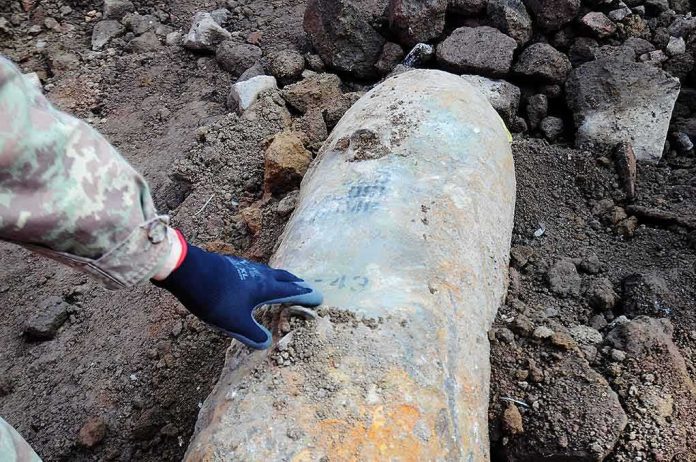
When energetic material deteriorates, time stops being an ally; the governing question is not whether disposal is ideal, but which available method credibly minimizes total risk—to people on the day of action and to communities for years after.
At a Glance
- The Army says in-place controlled detonation of degraded lead azide at the Iowa Army Ammunition Plant is the lowest-risk way to eliminate an acute hazard before colder weather further destabilizes it.
- Environmental groups and residents dispute the necessity and the safeguards, arguing alternatives like chemical neutralization were not adequately pursued and that lead fallout risks are under-addressed.
- EPA policy presumes enclosed alternatives over open detonation, but retains an exception for explosives that cannot be safely treated otherwise; facilities must document why OB/OD is necessary for the specific waste condition.
- The core conflict is perennial: trading near-term explosives safety against longer-term environmental exposure, and proving—not asserting—that detonation is truly the last resort for this particular stock.
What the Army is doing and why it says this is the safest path
According to Army statements, deteriorating lead azide—an extremely sensitive primary explosive—was discovered at the Iowa Army Ammunition Plant (IAAAP). The material was stored in bunkers and had degraded sufficiently that officials characterized it as an acute hazard, sensitive to handling and environmental swings. The Army framed its plan as an in-place, controlled detonation timed ahead of a forecast temperature drop that, in its view, would further destabilize the stock and raise the odds of an uncontrolled event. On that basis, leaders postponed once to the latest feasible window, emphasizing that public safety drove both the delay and the need to act.
Lead azide is not TNT. As a primary explosive, it is used to initiate other energetic compounds; by design it is more sensitive to shock, friction, and thermal change. When it ages badly—moisture ingress, crystallization on container threads, chemical byproducts—it can become treacherous to move. The Army’s operational logic follows a familiar explosives-safety doctrine: when degradation has advanced and container integrity or predictability is suspect, minimize handling, contain the work, and neutralize the energy as directly as possible. Controlled detonation, under that lens, trades a managed, short-duration plume for the elimination of a potentially catastrophic storage risk.
The counter-case: alternatives, fallout, and proof of “necessity”
Environmental organizations, local officials, and residents have not challenged the general hazards of degraded lead azide; they have challenged the Army’s claim that detonation—especially open-air or semi-open—in this instance is the only practicable way to make the site safe. They argue that chemical neutralization pathways and other enclosed treatments were insufficiently examined or disclosed. They also warn that a lead-bearing plume and subsequent deposition could expose people, livestock, and wildlife, especially downwind and in vulnerable groups such as pregnant women and children. Several declarants—including two scientists and a city manager—said they had not seen evidence of an emergency compelling immediate detonation, underscoring a demand for documentation rather than rhetoric.
On alternatives, press accounts indicate EPA documents acknowledged that chemical decomposition and neutralization options were considered; environmental groups maintain that “considered” fell short of the rigorous, comparative analysis the regulations expect. That critique is not abstract: EPA’s own guidance requires OB/OD operators to evaluate—and re-evaluate—whether safer alternative technologies are available, and to use those alternatives where available instead of open burning or detonation. Put simply, the dispute centers on whether the Army’s record shows that alternatives were unsafe, unavailable, or impracticable for the specific, degraded condition of these drums—and whether the monitoring and cleanup plan for any detonation sufficiently mitigates residual risk.
The regulatory lens that decides disputes like this
Federal hazardous-waste rules have long treated open burning and open detonation (OB/OD) as disfavored technologies, permitted only under a narrow exception: explosives that cannot safely be treated by other methods. The Environmental Protection Agency codified this structure in 1980 and has since tightened expectations around the search for alternatives, publishing a compendium of potential enclosed and contained technologies and reiterating that facilities must choose them when feasible. The current EPA posture, including recent rulemakings and webinars, pushes operators to justify OB/OD with waste-specific evidence—condition, configuration, stability—not with generic statements about difficulty.
That framework matters here. If a batch of lead azide is homogeneous, accessible, and stable enough to be moved into an enclosed reactor for wet chemical destruction, the exception weakens. If, by contrast, the material’s degradation has produced crystalline growth on closures, questionable drum integrity, or sensitivity that makes even minimal handling a trigger risk, the calculus changes. The law asks for demonstration: alternative-by-alternative feasibility, risk to workers and the public, and the comparative emissions and deposition profiles of each option, paired with concrete monitoring and contingencies if detonation proceeds.
Mechanics and risk: how controlled detonation compares to alternatives
In-place detonation reduces handling—the major initiator of accidents with primary explosives—by allowing engineers to place donor charges and shielding in situ. Done well, it can minimize sympathetic reactions and direct the blast upward, but it cannot zero out particulate emission. Lead azide contains lead; any energetic destruction route must account for where that lead goes—into slag, filters, soil, or air. Enclosed chemical neutralization routes can, in principle, trap solids and scrub vapors, but they require transfer into vessels, reagent handling near an unstable energetic, and often multi-hour processing under tight pH and temperature controls. With degraded primaries, the transfer step is often the largest single risk.
This is why disputed cases hinge on the specific condition data: sensitivity testing, container condition, ambient temperature trends, moisture content, and any evidence of crystallization or exudation. Those details, more than abstract pros and cons, determine whether detonation is truly the lowest-risk total pathway. EPA’s own summary documents reflect that nuance: OB/OD is permissible when other modes “cannot safely” be applied; that is an operational determination documented in the permit record, not a blanket preference.
What credible assurance looks like if detonation proceeds
If the Army’s judgment prevails that controlled detonation is necessary for this stock, the community’s reasonable demand is rigorous, verifiable mitigation. That means a transparent modeling-and-monitoring plan aligned to prevailing wind bands and stability classes on the operation day; upwind and downwind air sampling with time resolution sufficient to capture the plume; soil and surface-wipe sampling at tiered distances for post-event deposition mapping; and public release of methods, detection limits, and results. It also means clearly defined cleanup triggers—numerical thresholds that, if exceeded at specific receptors, commit the operator to remediation actions and retesting. These are standard tools, not exotic asks, and they align with the regulatory drive toward measurable protection.
How to judge the Iowa case—and cases like it—on the merits
The right question is not whether detonation can ever be done safely, nor whether lead is toxic (it is); it is whether, given the actual material condition at IAAAP, detonation was the only available method that kept total risk—acute plus chronic—lowest. The Army’s public rationale invokes degradation and an approaching temperature shift to justify urgency. The counter-case challenges the sufficiency of the alternatives analysis and the robustness of monitoring and cleanup commitments. Federal policy sets the tiebreaker: operators must prove that alternatives are unsafe or impracticable for this waste and must pair any OB/OD with technical controls and transparent verification.
That is the evergreen lesson beyond Iowa. Communities do not object to safety; they object to being asked for trust where documentation should suffice. When the record shows waste-specific instability that makes handling untenable, controlled detonation—properly monitored—can be the least-bad option. When the record is thin, skepticism is warranted. The path to legitimacy is not louder assurances; it is a defensible alternatives analysis, clear emission controls, and data the public can read without translation.
Sources:
dvidshub.net, freep.com, edition.cnn.com, apnews.com, wvik.org, us.cnn.com, shawlocal.com, politifact.com, epa.gov, rcrapublic.epa.gov