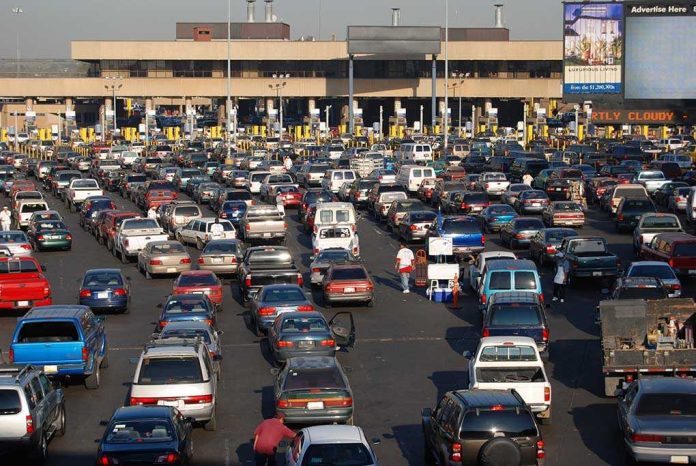
A sharp drop in Canadian visitors is quietly draining hundreds of millions of dollars from American border communities — and the businesses feeling it most had no vote in the trade war that started it.
Story Snapshot
- Passenger vehicle crossings at the U.S.-Canada border fell nearly 20% from January through October 2025 compared to the same period in 2024, with some states seeing declines exceeding 27%.
- Canadian tourism generated $20.5 billion for the U.S. economy and supported 140,000 American jobs in 2024 — all of that is now at risk.
- Border businesses from Washington state vineyards to ferry operators are reporting layoffs and revenue losses directly tied to fewer Canadian visitors.
- Canada has responded with its own economic countermeasures, including a “Buy Canadian” policy redirecting $70 billion in government purchasing away from U.S. suppliers.
The Numbers Behind the Drop
A December 2025 report from the Joint Economic Committee — Minority found that passenger vehicle crossings at the U.S.-Canada border fell nearly 20% between January and October 2025 compared to the same stretch of 2024. Washington state recorded a decline exceeding 24%, while Seattle saw almost 27% fewer international overnight stays. Spokane reported 33% fewer Canadian visitors in March 2025 alone compared to March 2024. These are not rounding errors — they represent a sustained, measurable collapse in cross-border activity.
The financial stakes are significant. Canadian tourists contributed $20.5 billion to the U.S. economy and supported 140,000 American jobs in 2024. Cities and states along the northern border — from Vermont to Montana to Washington — built local economies around that steady flow of Canadian shoppers, diners, and travelers. A 20-to-33% decline in that traffic does not stay contained to tourism statistics; it ripples into payroll decisions, restaurant receipts, and retail revenues across dozens of communities.
Real Businesses, Real Consequences
The numbers have human faces. Scott Osborn of Fox Run Vineyards reported that Canadians once represented roughly 10% of his business through tastings, tours, and wine sales — and that traffic has dried up noticeably. Clipper Navigation, which operates ferry service between Seattle and Victoria, British Columbia, reported a 30% drop in ridership and responded by laying off 25% of its workforce. Duty-free operators along the border have reported revenue declines of 40 to 50%. These businesses did not choose sides in a trade dispute; they are absorbing the costs of one.
Broader city-level data reinforces the pattern. Canadian visits to U.S. cities fell 42% year over year in affected regions, according to financial data tracking cross-border movement. Hotels, restaurants, and shops along the northern border have all reported declining revenues tied directly to the reduction in Canadian foot traffic. The Joint Economic Committee report found the pattern consistent across every state sharing a border with Canada, suggesting this is not a localized anomaly but a systemic shift.
Canada’s Countermoves Add Complexity
The full picture requires acknowledging that Canada has not been a passive actor. The Canadian government implemented a “Buy Canadian” policy in late 2025 redirecting approximately $70 billion in government purchasing toward domestic suppliers. Several Canadian provinces imposed restrictions on American alcohol products, with reports of a 91% collapse in U.S. wine sales to Canada in affected markets. Canada also announced tariffs on $30 billion worth of U.S. goods, targeting consumer food and beverage products. These retaliatory measures created independent reasons for Canadians to reconsider cross-border spending and travel.
The honest accounting here is that both sides bear responsibility for the economic friction ordinary Americans and Canadians are now absorbing. U.S. tariffs on Canadian goods — imposed in multiple rounds beginning in early 2025 — triggered Canadian retaliation that compounded the damage. Whether the original tariffs served legitimate national security or trade-balance goals, the downstream effect on border-dependent American businesses has been measurable and painful. The workers laid off by Clipper Navigation and the vintners watching Canadian tour buses stay home are not trade policy abstractions — they are the real cost of a dispute their government entered on their behalf, without asking whether they could afford it.
Sources:
[1] Web – REPORT: Amid Trump’s Tariffs, Declining Canadian Tourism Is …
[2] YouTube – Trump Underestimated Canada—And It Cost Him Billions
[3] YouTube – TRUMP ERUPTS as CANADA BOYCOTT COSTS US $21B …
[4] Web – Trump’s Tariffs Cause Decline in Canadian Tourism and Commerce …
[5] Web – Trade Tariffs: Impact & Response
[6] Web – Senator Murray Responds to New Congressional Report Showing …
[7] YouTube – Is the U.S. starving for Canadian travellers? | About That
[8] YouTube – How Canadians’ travel habits have changed since Trump took office
[9] YouTube – Congressional report finds drop in Canadian tourists hurting US …
[10] Web – US cities face broad drop in Canadian visits as Trump trade policies …
[11] Web – Canadian visitor slump hits Washington hard – Axios Seattle