
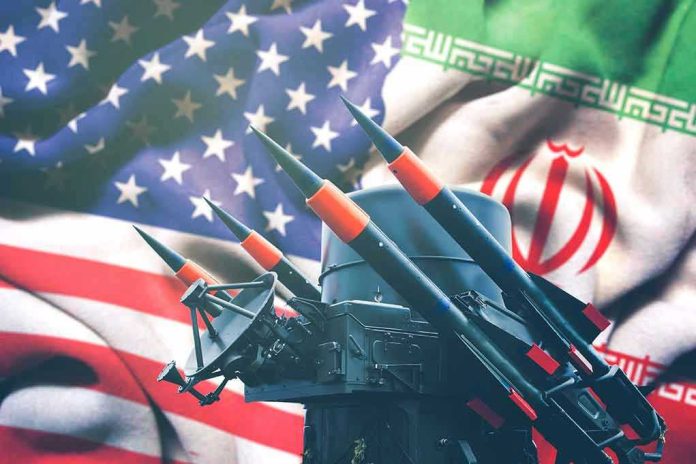
Iran says it slammed the backchannel shut over Lebanon, and Donald Trump all but shrugged—so what game is really being played here?
Story Snapshot
- Iranian state media claims Tehran halted indirect talks with Washington over Israeli strikes in Lebanon [4].
- Coverage ties the suspension to a ceasefire dispute that may or may not have included Lebanon [11].
- U.S. messaging signals negotiations are not dead and pressure will continue regardless [12].
- Both sides appear to be leveraging public theatrics while private channels likely persist [1].
Iran links a diplomatic freeze to battlefield heat
Iran’s semi-official Tasnim outlet, amplified by multiple broadcasters, reported that Tehran stopped “dialogue and exchange of texts through mediation” with the United States, citing Israeli military action in Lebanon and a broader protest over Gaza [4]. The move fits Iran’s familiar rhythm: fuse battlefield incidents to diplomatic preconditions, then test Washington’s tolerance for ambiguity. The linkage matters because it tries to define the negotiating agenda around regional ceasefire terms rather than nuclear files or sanctions relief alone [1].
Messaging from Tehran leans on a claim that a ceasefire framework should have restrained Israel in Lebanon; Washington and Jerusalem dispute that scope [11]. That gap is not a technicality. It is the fulcrum for leverage over oil lanes, militia tempo, and escalation ladders that can raise the price of miscalculation in days. By suspending talks, Iran signals cost for any reading of a ceasefire that excludes Hezbollah’s theater, while preserving plausible deniability about command links to cross-border attacks [6].
Washington projects indifference—and keeps the door ajar
U.S. commentary portrayed the Iranian announcement as neither definitive nor determinative. Reports summarized the American stance as continuing to wait Iran out while avoiding an immediate rush back into major combat, implying channels remain usable when Tehran wants them [12]. That posture reflects a classic conservative instinct: do not reward tantrums. Keep deterrence credible, hold allies close, and refuse to let Tehran’s calendar dictate American power deployment or diplomatic tempo [12].
Public indifference also bleeds oxygen from Iran’s spectacle. If Washington treats the suspension as theatrics, market panic softens and allied messaging stays synchronized. That matters because risk premiums in oil and shipping spike when Washington looks reactive. A steady tone pressures Tehran to show it can extract real concessions from walkouts, not just headlines. If no concessions arrive, the cost-benefit of future “suspensions” falls, and private pragmatists in Tehran gain an argument to re-engage quietly [12].
The ceasefire argument is the leverage battlefield
Reports pointed to dueling narratives over whether a United States–Iran understanding encompassed Lebanon, alongside expectations about maritime transit through the Strait of Hormuz [11]. That ambiguity is leverage by design. Tehran treats any Israeli strike in Lebanon as breach-adjacent, a reason to pause talks; Washington treats Lebanese operations as outside scope, a reason to keep talking while backing Israel’s latitude. Each side uses the same fog to discipline the other’s proxies without owning the escalation ladder outright [11].
This is the Middle East playbook: declare a pause, deny the pause matters, then trade messages through mediators anyway. Coverage showcasing Iran’s walkout claim sits beside pieces implying contacts will resume when incentives align—fuel prices, militia losses, or leader-to-leader optics shift the calculus [1]. None of that absolves anyone. It simply recognizes the recurring pattern: backchannels rarely die; they go dark until both capitals think they can reopen them without looking weak at home [1].
Common-sense read for American interests
Evidence supports that Iran tethered its halt to Israeli strikes, but the same evidence shows a stage-managed attempt to reset terms, not a principled exit from diplomacy [4]. A conservative, common-sense policy answer is clear: maintain pressure, deny Tehran the right to define ceasefire borders retroactively, and keep military options ready while nudging allies to calibrate strikes that avoid gifting Iran easy pretexts. That triad protects deterrence, limits misreads, and preserves space for quiet talks when Tehran’s cost curve turns unfavorable [11].
https://twitter.com/ifeoluwa3589/status/2061503082664514039
Expect more announcements of “suspensions” as bargaining chips. Expect Washington to discount them publicly while stress-testing Iran’s red lines privately. The measure that matters will not be the next press release. It will be whether rockets quiet down across the Lebanese frontier, tankers move through Hormuz without harassment, and both sides find a formulation that lets them declare victory to domestic audiences without lighting a larger fuse. The pattern says they will—until the next flare-up resets the board [12].
Sources:
[1] Web – Iran Claims It Stopped Talking With The United States. Trump Isn’t …
[4] YouTube – Iran talks STALL after US intercepts strikes, Israel …
[6] YouTube – Iran Halts All US Talks as Israel Launches Beirut Blitz
[11] Web – Iran’s foreign minister travels to Pakistan and Russia after …
[12] Web – Trump cautions Iran against charging tolls to go through Strait of …