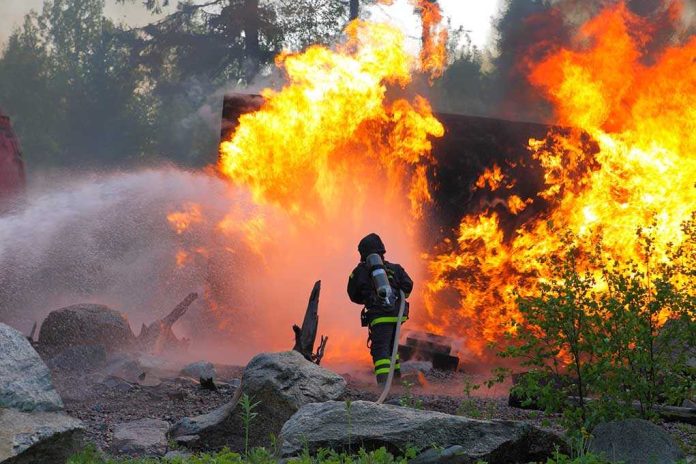
Two fires in Los Angeles County produced more insured losses than any wildfire event in recorded history, and the bill is still being counted.
Story Snapshot
- The January 2025 Palisades and Eaton fires generated roughly $40 billion in insured losses, the largest single wildfire insured-loss event on record.
- Global insured natural catastrophe losses reached approximately $107 to $108 billion in 2025, according to Swiss Re and Munich Re respectively.
- 2025 marked the sixth consecutive year that global insured catastrophe losses exceeded $100 billion.
- The headline numbers are still model-based estimates, not final settled claims, meaning the figures could shift as insurers close their books.
Two Neighborhoods Rewrote the Record Books
The Palisades and Eaton fires burned through some of the most densely valued residential corridors in the United States. Munich Re estimated total losses from the Los Angeles wildfires at approximately $53 billion, with insured losses landing near $40 billion. [1] Gallagher Re placed the insured figure slightly higher at $41 billion. [3] Moody’s offered a more conservative range of $20 to $30 billion as a likely settled total. [5] The spread between those estimates is not a sign of chaos — it reflects the normal lag between catastrophe models and finalized claims, a distinction worth keeping in mind before treating any single number as gospel.
What makes the Los Angeles fires historically significant is not just the dollar amount but the acreage-to-dollar ratio. Relatively contained burns in high-value urban-wildland interface zones can produce insured losses that dwarf much larger fires burning through lower-exposure terrain. Swiss Re’s 2025 reporting confirms this dynamic, noting that secondary perils — wildfires, severe convective storms, floods — drove a record 92% of global insured losses for the year. [6] The concentration of expensive housing, replacement-cost inflation, and smoke-damage claims in densely populated areas is what transforms a regional disaster into a global insurance milestone.
The Broader Catastrophe Picture Behind the Wildfire Headline
Isolating wildfire losses from the full 2025 catastrophe landscape risks missing the larger financial story. Weather-related disasters accounted for 97% of total insured losses in 2025, according to Munich Re. [1] Severe convective storms in the United States posted losses exceeding $45 billion for the third consecutive year. [5] The wildfire record did not emerge from a quiet year — it emerged from a year when nearly every major peril was active and expensive. 2025 was the sixth straight year that global insured catastrophe losses cleared the $100 billion threshold. [6]
Total economic losses from natural hazards in 2025 reached approximately $224 billion globally, of which only $108 billion was insured. [7] That gap between economic and insured loss is the number that rarely makes headlines but carries the most consequence for households, municipalities, and governments that lack coverage. The record wildfire insured-loss figure, as striking as it is, captures only a portion of what communities actually lost.
Climate Attribution Is Real but the Causal Chain Is Incomplete
Munich Re stated directly that climate change played a role in the record-breaking wildfire costs. [1] That assertion from one of the world’s largest reinsurers carries weight and should not be dismissed. However, the reports driving the 2025 wildfire narrative are insurance-market summaries, not fire-behavior studies or peer-reviewed attribution analyses. No document in the current evidence base quantifies precisely how much wind, drought, heat, or fuel-load conditions each contributed to the final insured-loss total. Acknowledging climate’s role is reasonable; treating a reinsurer’s annual loss summary as a forensic reconstruction of fire causation is not.
There is also a structural incentive worth naming plainly. Munich Re, Swiss Re, Gallagher Re, and Moody’s all operate in markets where catastrophe-loss narratives directly influence pricing, capital allocation, and underwriting strategy. [5] That does not make their data wrong — their loss-tracking methodologies are the industry standard — but it does mean consumers and policymakers should read catastrophe-trend framing with the same critical eye they would apply to any analysis produced by a party with a financial stake in the conclusion. The record is real. The precision and the causal story attached to it deserve continued scrutiny as claims settle and independent science catches up to the headlines.
Sources:
[1] Web – Study finds 2025 was costliest year on record for wildfires
[3] Web – Global Natural Catastrophe Insured Losses Hit $107 Billion in 2025 …
[5] Web – How wildfires and storms drove insurance losses in 2025
[6] Web – 2025 Catastrophe Review: Wildfires and severe convective storms …
[7] Web – 2025 marks sixth year insured natural catastrophe losses … – Swiss …