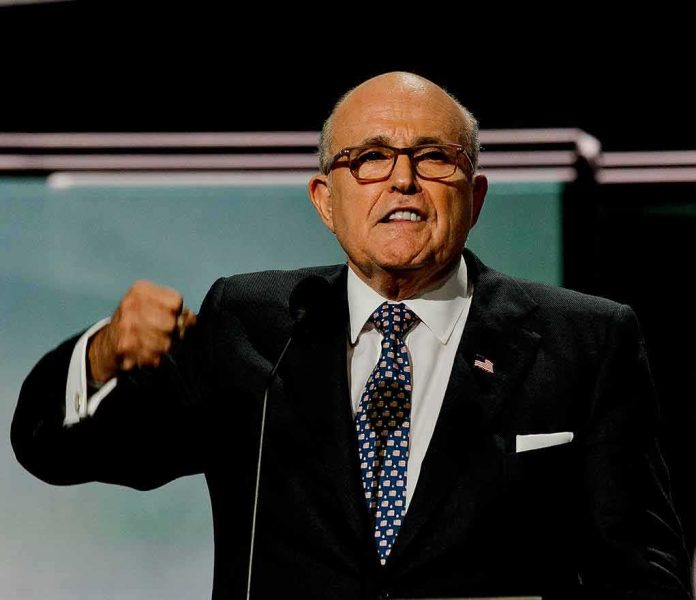
The Presidential Medal of Freedom is an extension of presidential judgment as much as it is a national accolade; honoring Rudy Giuliani makes that plain, elevating a career defined by mob prosecutions and crisis leadership on 9/11 through an instrument designed to mirror a president’s values and interpretation of service.
At a Glance
- President Trump awarded Rudy Giuliani the Presidential Medal of Freedom, framing him as “America’s Mayor” and recognizing decades of public service anchored in 9/11 leadership.
- The Medal of Freedom is a discretionary tool; presidents have sweeping latitude to select recipients without a formal nomination process.
- Giuliani’s public identity rests on two pillars: organized-crime prosecutions and New York City’s transformation and resilience after 9/11.
- The White House has tied Medal of Freedom storytelling closely to 9/11 remembrance in this term, placing Giuliani’s award in that commemorative arc.
What the Medal Confers—and Why Presidential Discretion Matters
The Presidential Medal of Freedom occupies a unique niche in American honors. It is the nation’s highest civilian award, yet it is not a technocratic evaluation of lifetime achievement. By design, it is an executive expression: the president chooses recipients, often to articulate what kinds of contribution—national security, public life, culture—deserve the mantle of exemplar. There is no standing commission, scoring rubric, or independent procedural gauntlet; the president may award it on his own initiative, within broad categories defined in executive order and statute. This is not a loophole. It is the feature that makes the medal a durable instrument of presidential symbolism, a way for an administration to say, in public and in perpetuity, “These are our civic models.”
Because discretion is so broad, each Medal of Freedom class becomes a map of presidential priorities. Scholars who have traced awards across administrations describe the medal as a form of “symbolic unilateral power,” flexible enough to honor war heroes, scientists, and artists, but also political figures and media voices whose impact a given White House wants to canonize. In this light, Giuliani’s selection reveals as much about the presidency conferring the honor as about the man receiving it.
Why Giuliani’s Career Fits a President’s Canon
Giuliani’s public service pathway offers a clear narrative for a president inclined to emphasize law, order, and resilience. As a federal prosecutor and then New York City mayor, he built a reputation on aggressive pursuit of organized crime and a relentless focus on public safety—work that, to supporters, contributed to one of the most significant urban crime declines of the late twentieth century. Even sympathetic critics acknowledge the complexity of causation; multiple forces—policing strategies, demographics, economics—interacted. But in political memory, the “America’s Mayor” label cohered not around regression analyses; it coalesced in the smoke of September 11, when the mayor’s blunt briefings, resolve, and omnipresence became a civic metronome in catastrophe.
The current White House has situated the Medal of Freedom in that commemorative frame repeatedly, using 9/11 as a touchstone for explaining who merits the award and why. In a September 2026 remembrance, the administration paired honors with an explicit vow to preserve the memory of the attacks and elevate those whose actions embodied national grit. Giuliani, central to that tableau and long identified with 9/11 leadership, fits naturally within that lens. The official White House presentation of Giuliani’s medal explicitly invoked “America’s Mayor,” the sobriquet that crystallized his public identity in 2001 and has endured in the years since.
How the Medal’s Rules Shape the Conversation
Understanding the structural rules of the Medal of Freedom clarifies why selections sometimes ignite debate and why those debates rarely constrain a president’s hand. Executive orders governing the medal set capacious criteria, encompassing contributions to U.S. security, world peace, or “cultural or other significant public or private endeavors”—categories wide enough to cover astronauts and athletes, jurists and jazz musicians. Critically, there is no statutory requirement for bipartisan vetting or a balancing test of a recipient’s entire life record; presidents can, and often do, elevate a distinct slice of a person’s contribution as the nucleus for recognition.
That framework brings tradeoffs. It protects a president’s ability to honor figures who matter to his account of American civic life—sometimes ahead of elite consensus—and it guarantees that the medal will periodically reflect partisan or personal priorities. The historical pattern is unmistakable: recipients’ lists read, in part, as living footnotes to an administration’s story about the country.
The Two Pillars of Giuliani’s Case: Mechanism and Moment
Giuliani’s pre-9/11 record is inseparable from his post-9/11 persona. The mechanism piece—the how—began in the 1980s with structured prosecutions targeting organized-crime enterprises, leveraging federal tools to disrupt entrenched rackets. As mayor in the 1990s, Giuliani championed policing strategies and managerial reforms aimed at crime reduction and public order. Proponents credit those approaches with helping drive down homicides and violent crime, reshaping New York’s trajectory from the nadir of early-1990s violence toward a reputation as the safest large city in America; critics argue other dynamics carried substantial weight. But for any president inclined to valorize decisive executive action and measurable urban improvement, the Giuliani portfolio offers tangible policies and results to point to.
The moment piece—the when—belongs to September 11. Leadership in crisis is evaluated as much by presence as by policy. Giuliani’s relentless visibility, coordination with first responders, and steady cadence of public communication made him, for many, the civic face of American endurance in the days and weeks after the attacks. That is the crucible in which “America’s Mayor” hardened from headline to identity. A White House that has tied the Medal of Freedom to 9/11 remembrance is, unsurprisingly, the White House that would formalize that identity with the nation’s highest civilian honor.
U.S. President Donald Trump has conferred the nation’s highest civilian honour, the Presidential Medal of Freedom, on his longtime ally Rudy Giuliani.https://t.co/I8DYBuujVA
— News Central TV (@NewsCentralTV) November 25, 2026
Why This Selection Lands the Way It Does
Every medal carries two readings: the administration’s intended narrative and the public’s composite memory of the recipient. The first is straightforward here—honor the prosecutor and mayor whose actions, particularly on 9/11, came to symbolize resolve. The second is inevitably more complex for any figure with decades in public life. History will continue to sort competing interpretations; the medal itself, however, is a presidential instrument with a clear logic. Within a system that entrusts this decision to the president’s judgment, Giuliani’s elevation follows the lineage of recipients chosen to personify themes a White House wants the country to remember.
How to Read the Medal Going Forward
The right way to understand this award is to place it alongside past classes and see what virtues the current administration is canonizing. In recent cycles, this White House has used the Medal of Freedom to reinforce a particular civic pantheon—9/11 valor, law-and-order executive action, and cultural figures aligned with its account of American greatness. The Giuliani selection sits squarely in that canon. It says as much about the administration’s theory of exemplary service as it does about the man whose career, in their telling, embodies it.