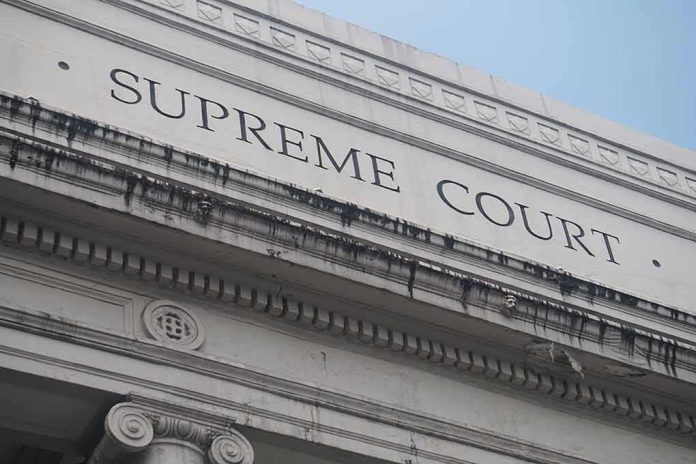
When a Supreme Court justice says Congress can “turn off the lights” at the Court, he is not speaking figuratively about politics; he is describing a real appropriations lever that could impair the Court’s operations even while judges’ pay remains protected.
At a Glance
- Justice Samuel Alito warned that Congress could effectively halt Supreme Court operations by withholding funds.
- He tied funding power to judicial independence, arguing that coercive budget tactics would alter the constitutional balance.
- Congress’s control of the purse is explicit in the Constitution; judicial salaries are protected, but most operations are not.
- Historically, Congress funds the judiciary through annual appropriations; modern friction centers on constraints and delays, not abolition.
What Justice Alito said, and why it matters
Justice Samuel Alito told an audience at the Federalist Society’s Antonin Scalia Memorial Dinner that Congress can “turn off the lights at the Supreme Court and stop everything from happening if they want to defund their activities.” He also warned that using the purse as leverage against the judiciary threatens its independence and, by extension, the constitutional settlement itself. The remarks came shortly after Democrats won control of both chambers of Congress, giving his warning an unmistakable institutional focus: appropriations are the hinge on which the Court’s day-to-day functioning turns, from clerks and staff to building operations and security.
The Court’s adjudicative power flows from Article III; its budget does not. That is the fulcrum of Alito’s point. While the Constitution prohibits reducing judges’ salaries during continuance in office, nearly everything else the Court needs to operate is subject to annual appropriations. As a practical matter, that creates a vulnerability: if Congress cuts or withholds funds, the Court’s capacity to manage dockets, draft opinions at pace, and maintain secure facilities shrinks—even if the Justices continue to draw their pay.
The constitutional mechanics: the purse and the bench
The Appropriations Clause could not be plainer: “No Money shall be drawn from the Treasury, but in Consequence of Appropriations made by Law.” That provision vests Congress with comprehensive control over federal expenditures, including those that fund the judicial branch. The Constitution Annotated and Congressional Research Service describe this as a structural check: the courts exercise judgment; Congress authorizes the money that allows the judiciary to function. Nothing in Article III exempts the Court’s operating budget from this rule of the purse.
Two guardrails complicate any blunt-instrument reading. First, the Compensation Clause protects judges’ salaries, a targeted firewall against political retaliation through pay cuts. Second, separation-of-powers principles limit the use of ordinary tools—appropriations included—when they are deployed to coerce adjudication or dictate outcomes. Alito’s warning lives in that seam: Congress unquestionably funds the Court, but budgetary power can morph from legitimate governance to unconstitutional interference if used to penalize or control decisions rather than to set priorities in good faith.
Operations versus compensation: what “turning off the lights” entails
In appropriations practice, the Supreme Court’s needs are granular: personnel (law clerks, administrative staff, librarians, security), facilities (utilities, maintenance), technology, and case-processing infrastructure. These are funded annually through the Financial Services and General Government bill alongside other judicial accounts. By contrast, judges’ salaries and certain retirement obligations are mandatory or otherwise insulated from year-to-year cuts. The distinction is decisive: preserving compensation does not keep the lights on, the building secure, or the chambers staffed; appropriations do.
Recent CRS work puts the scale in perspective: the judiciary typically requests on the order of $9 billion in discretionary funds—about two-tenths of one percent of federal outlays—plus separate mandatory funding for judicial compensation and retirement. Even modest reductions ripple into court operations; a wholesale cutoff would be more than symbolic—it would degrade the institution’s capacity to function, from scheduling arguments to issuing opinions on time-sensitive matters.
How we got here: a long history of funding the courts
Congress has financed the federal judiciary since the early Republic. Historical snapshots from the Federal Judicial Center show that appropriations generally rose over time as the system’s caseload and administrative complexity grew. The normal pattern has been negotiation over levels and priorities, not attempts to extinguish the courts. In the modern era, controversies more often concern delayed appropriations, partial shutdowns, or policy riders that constrain how funds may be used, rather than explicit efforts to abolish judicial functions outright.
That history matters because it clarifies the baseline. Congress’s purse power is not hypothetical; it is the longstanding operating model for the courts. What is newly salient is the rhetorical move—inside a period of intense interbranch conflict—to link that power to the potential for acute institutional pressure. Alito’s comments take a routine constitutional fact and highlight its sharpest edge.
Where the real line is: legitimate budgeting versus coercion
Budgetary authority encompasses priorities, efficiency, and stewardship; it does not include dictating adjudicative outcomes. The difficult cases arise when Congress uses funding conditions to shape judicial administration in ways that plausibly influence case disposition—starving clerk support, restricting courthouse operations, or attaching riders aimed at the Court’s internal processes. The Constitution does not supply a bright-line formula, but the logic of separated powers does: when a fiscal measure is reasonably calibrated to administration, it is governance; when its design and effect are to punish or pressure the Court for its decisions, it veers toward unconstitutional encroachment. Alito’s formulation—warning that aggressive defunding would change the Constitution as lived—invokes that boundary.
The Supreme Court is often called the “least dangerous” branch because it has neither sword nor purse, relying on judgment and public acceptance to give rulings force. That maxim cuts both ways: a judiciary without adequate resources loses the practical capacity to render timely, credible judgments, and the public’s willingness to accept them erodes when the institution appears hobbled by political design.
Justice Alito warns Congress can ‘turn off the lights’ at Supreme Court
"So, it is important to preserve the independence of the judiciary," he added. "If that is eliminated, then the Constitution as adopted in 1789 will no longer be the same."
— Steamer Rolling (@SteamerRolling2) November 14, 2026
Practical implications if funding pressure escalates
Should an appropriations fight target the Court directly, the immediate effects would be managerial—hiring freezes, curtailed operations, deferred maintenance—before they are doctrinal. But the knock-on effects reach substance: thinner staffing slows opinions and increases error risk; constrained security and technology jeopardize the integrity of proceedings; diminished administrative bandwidth delays justice in urgent disputes. The Compensation Clause would keep Justices paid, yet the Court’s ability to do the work the Constitution assigns would still be impaired—precisely the scenario Alito flagged.
Sources:
pjmedia.com, cbsaustin.com, politicalwire.com, huffpost.com, constitution.congress.gov, congress.gov, yahoo.com, washingtonexaminer.com, uscourts.gov, fjc.gov