
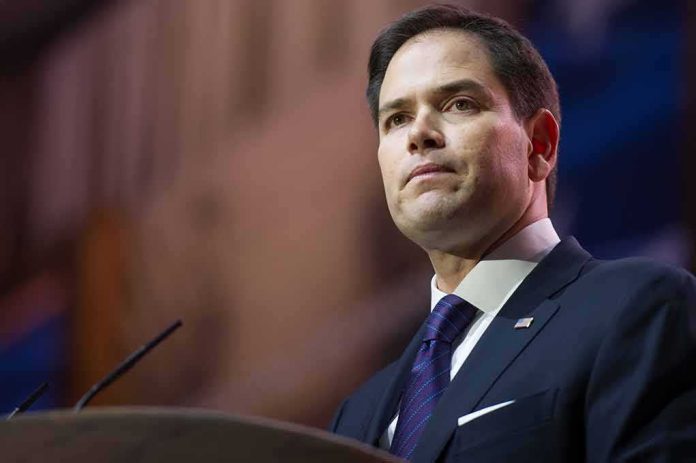
Chris Van Hollen’s bid to unseat Chuck Schumer as Senate Democratic leader is, at bottom, a wager that a party fresh off midterm gains wants confrontation over continuity — and the wager carries a cost Van Hollen did not choose: a year-old confrontation with Secretary of State Marco Rubio that keeps resurfacing to undercut the very image of toughness he is now selling.
Key Points
- Van Hollen announced his challenge to Schumer on November 12-13, 2026, arguing Democrats need a leader focused on “delivering for the American people” even if it means “shaking things up”
- He claims backing from at least 10 senators, including Bernie Sanders and incoming Michigan Senator Abdul El-Sayed
- Senate leadership is chosen by secret ballot inside the caucus, not a public vote — a process with deep institutional precedent that limits outside visibility into senators’ actual reasoning
- A 2025 hearing clash in which Rubio mocked Van Hollen over his meeting with deported Salvadoran man Kilmar Abrego Garcia has resurfaced as a viral talking point against Van Hollen’s leadership pitch
- The leadership contest is unfolding as an intra-party power struggle, with Schumer allies crediting his tenure even as critics argue the moment calls for a different posture toward President Trump
What Van Hollen Is Actually Running On
At a Denver policy conference in mid-November 2026, Van Hollen laid out the rationale for his campaign in blunt terms: institutions, he argued, deserve no special deference if they stop delivering results for ordinary people. “We should not be preserving our institutions if they are not delivering for the American people,” he told the crowd, framing his candidacy as a referendum on whether the Senate Democratic caucus should keep rewarding seniority or reward a willingness to disrupt. That is a notable break from how caucus leadership fights usually get sold — less an appeal to loyalty or tenure than a direct challenge to the incumbent’s theory of the job itself.
The Associated Press reported that Van Hollen wants Democrats to “go toe to toe” with President Trump rather than negotiate quietly, a posture that resonates with a base energized by recent midterm victories but increasingly impatient with institutional caution. He has paired that message with a specific biographical pitch: two terms in the Senate, prior service in the House and the Maryland legislature, and stints chairing both major party campaign committees — a résumé built, by design, around the mechanics of winning elections and running caucuses, not just policy credentials.
The Math and the Mechanism Behind a Leadership Challenge
Unseating a sitting Senate leader is rare, and the process by which it happens is deliberately opaque. Leadership elections are conducted by secret ballot within the party caucus — a practice with roots stretching back decades in Senate history, designed explicitly to let members vote their private judgment free of public pressure or retaliation. That means public endorsement counts, while real, only go so far as predictive evidence. A senator can tell a reporter one thing and vote another way behind closed doors, and the institution’s own practice protects that gap. Van Hollen’s reported support from Sanders, El-Sayed, and roughly ten colleagues establishes that his challenge is not a lone protest — but it does not guarantee the votes that matter, which are cast where no one is watching.
Where Genuine Disagreement Lies Inside the Party
Coverage of the contest has consistently framed it as a clash between two theories of Democratic power rather than a clean ideological split. Schumer’s defenders point to his track record stewarding the caucus through difficult years and argue that destabilizing leadership so soon after a strong midterm performance sends the wrong signal to voters who just rewarded the party. Van Hollen’s camp counters that the midterm wins are themselves the mandate for change — proof that aggression, not caution, is what moved voters. Both readings of the same election results are plausible, and neither is independently verified by polling data specifying that leadership change, as opposed to other issues, drove ballots. That gap between campaign narrative and electoral evidence is worth sitting with rather than resolving by fiat.
The Rubio Exchange That Keeps Resurfacing
The viral video attached to Van Hollen’s leadership push did not originate from this campaign at all — it dates to a May 2025 Senate hearing in which Rubio and Van Hollen sparred over the deportation of Kilmar Abrego Garcia, a Salvadoran man Van Hollen had traveled to meet. Rubio told Van Hollen directly that the man he “had a margarita with” was “a human trafficker” and “a gang banger,” repeating the characterization multiple times despite Van Hollen’s objection that the allegations were unsubstantiated. The Washington Examiner’s contemporaneous transcript captured Rubio’s exact phrasing, and multiple outlets corroborated the exchange’s tone as testy and personal rather than strictly procedural.
That clip has re-entered circulation now precisely because it compresses a complicated immigration and accountability dispute into a single, visually memorable moment of one senator appearing to get the better of another — the kind of clip that travels faster than any policy platform. Nothing in the available record updates or contradicts what was said in that hearing; it is simply being redeployed, eighteen months later, against a different argument Van Hollen is now making about his fitness to lead.
What Remains Undocumented — and Why It Matters
Van Hollen’s campaign rhetoric leans heavily on two pillars beyond leadership style: a case against economic inequality and a case for rooting out political corruption. Neither pillar, as reported, comes attached to a specific legislative record, a named oversight finding, or a quantified outcome — the public record so far documents the argument, not the receipts. That is not unusual for an opening campaign speech, but it is the detail a careful observer should track as the contest progresses: whether “shaking things up” eventually cashes out into bill numbers, committee votes, and audited results, or remains a framing device for an internal power contest.
What the Outcome Will Signal
However the secret ballot falls, the contest itself marks something durable about this moment in Senate politics: a caucus freshly emboldened by electoral success is nonetheless willing to litigate, in public, whether its own leadership model fits the moment. That tension — between the discipline institutions reward and the disruption voters sometimes demand — recurs across both parties and across decades of Senate history, and it rarely resolves cleanly. What is new here is the speed at which an old hearing clip can be weaponized against a new argument, collapsing eighteen months of context into fifteen seconds of video. Readers judging Van Hollen’s case should weigh the platform he is articulating now against the documentary record he has yet to produce — not against a viral moment that predates the campaign entirely.
Since Chris Van Hollen Thinks He Should Be Senate Leader, Video of Rubio DOG-WALKING HIM Goes Viral https://t.co/R64oGXyPpa. Check for bullet holes in the feet of @ChrisVanHollen, self inflicted of course!
— Bigmoe (@Bigmoe16574013) November 13, 2026
Sources:
twitchy.com, upi.com, wsbt.com, cbsnews.com, washingtonpost.com, abcnews.com, fox17.com, eastbaytimes.com, wreg.com, washingtonexaminer.com