
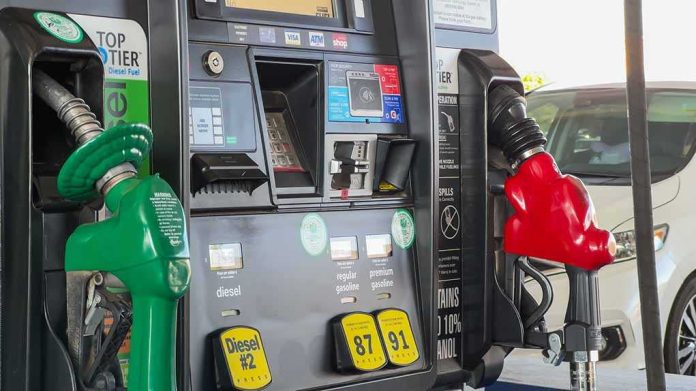
A twenty-four-cent federal excise tax does not sound like the stuff of a political turnaround, but when diesel is pushing past six dollars a gallon and feeding into everything from grocery freight to farm equipment, even a temporary reprieve becomes a headline. President Trump’s October 2026 executive order deferring the federal dyed-diesel tax, and Interior Secretary Doug Burgum’s full-throated defense of it on Newsmax, is best understood not as a permanent fix to fuel costs but as an emergency bridge — one whose real-world payoff depends on mechanics most viewers never see.
Key Points
- President Trump signed an executive order on October 5, 2026, temporarily allowing tax-free “dyed” diesel — normally restricted to off-road use — onto highways, and deferring the 24.4-cents-per-gallon federal excise tax through December 31, 2026.
- Interior Secretary Doug Burgum told Newsmax the move would save truckers and farmers roughly $100 per fill-up and help ease food and freight costs nationwide.
- The White House says the order could eventually lead to forgiving the deferred tax entirely, but that outcome requires further action and is not yet settled.
- Independent fuel analysts note the relief is uneven: most states still restrict dyed diesel on public roads, and the measure defers a tax rather than adding supply.
- The order followed weeks of internal administration debate over harsher options, including a diesel export ban, which Energy Secretary Chris Wright and Burgum both argued would backfire.
What the Executive Order Actually Does
The mechanism is narrower than the political rhetoric around it suggests. Diesel sold for off-road use — farm equipment, construction machinery, generators — is dyed red and exempted from the federal highway excise tax, which currently runs 24.4 cents per gallon. The October 5 order temporarily lifts the on-road restriction, allowing that tax-exempt fuel to be legally burned in trucks and other vehicles operating on public highways, while directing the Treasury Department, in consultation with the Secretary of War, to defer collection of the federal tax on that use through the end of 2026 without interest or penalty. It is a timing and eligibility fix, not a change to how much diesel the country produces or imports.
Crucially, the fact sheet accompanying the order frames permanent relief as aspirational rather than guaranteed: Treasury is directed only to “explore pathways” toward eventually eliminating the deferred tax obligation altogether. That distinction matters. A deferral buys truckers and farmers breathing room on when they must pay; it does not, by itself, promise they will never pay. Several governors — in Arkansas, Louisiana, Missouri, and Texas — had already taken similar action at the state level before Washington followed suit, underscoring that this was as much a catch-up measure as a bold new policy.
Burgum’s Case for the Order
Appearing on Newsmax the morning after the signing, Burgum made the administration’s pitch directly: the order lets farmers and truckers buy tax-free red-dye diesel immediately, saving roughly $0.24 per gallon and translating to about $100 per fill-up, with downstream effects on food prices through lower transportation costs. He was careful to note the limits of executive power — permanent tax cuts require Congress, he said, while the order itself is a temporary waiver with future forgiveness still under consideration. Pressed on why gasoline taxes weren’t addressed the same way, Burgum pointed out that federal fuel taxes are uniform nationwide, while states like California and New York layer on additional levies the White House cannot unilaterally waive.
Burgum also tied high diesel prices to refinery capacity, arguing that California’s reduction from roughly thirty refineries to eight under Governor Gavin Newsom’s energy policy has pushed up costs not just in-state but in neighboring Nevada and Arizona, while Texas — with more than thirty refineries and new capacity under construction — illustrates the alternative path. That argument is consistent with broader reporting on the diesel squeeze: PBS NewsHour and other outlets have traced this year’s price spike to a combination of tight distillate inventories, reduced shipping through the Strait of Hormuz amid regional conflict, and refinery output decisions that affect diesel, gasoline, and jet fuel simultaneously, since all three come from the same barrel of crude.
Why the Administration Rejected the Harder Option
The diesel order did not emerge in isolation. Through September 2026, President Trump had publicly floated a ban on U.S. diesel exports — the country ships roughly 1.5 million barrels a day abroad, about a fifth of global seaborne diesel trade — as a blunter way to force more fuel to stay home and lower domestic prices. Energy Secretary Chris Wright publicly broke with that idea, warning that storage tanks, particularly on the Gulf Coast, would fill within weeks, forcing refiners to cut crude runs and reduce gasoline and jet fuel output in the process, likely raising prices at the pump for everyday drivers even as diesel eased. Burgum and Treasury Secretary Scott Bessent voiced similar reservations, citing retaliation risk and the uneven regional impact an export ban would create, since Gulf Coast markets might see relief while New England and West Coast consumers — more dependent on pipeline-constrained supply — could see prices rise. The diesel-tax deferral emerged as the administration’s narrower, lower-risk alternative to that fight.
Secretary Doug Burgum touts Trump’s diesel tax relief: "This saves money for truckers. It saves money for farmers. It's going to save money for every American." pic.twitter.com/8cSIIvVhGZ
— NEWSMAX (@NEWSMAX) October 7, 2026
What Independent Analysts Say About the Real-World Payoff
The gap between the policy’s legal text and its retail impact is where close observers have focused. GasBuddy’s Patrick De Haan has noted that the order will do little for most drivers because many states still prohibit dyed diesel on public roads regardless of federal rules, and because the federal tax is deferred rather than erased — meaning the bill may eventually come due. Reporting from Spectrum News similarly found the relief likely to be felt unevenly across equipment operators, since the underlying 24.4-cents-per-gallon obligation remains on the books even as collection is paused. None of this contradicts the administration’s description of what the order does; it simply clarifies that “relief” here means deferred and partial, not eliminated and universal — a distinction any fair reading of the White House’s own fact sheet supports.
What It Means Going Forward
The diesel order should be read as a stopgap measure deployed during a genuine price shock, not as the administration’s final word on fuel taxation. Its staying power depends on three things: whether Treasury follows through on exploring permanent forgiveness, whether states loosen their own road-use restrictions on dyed diesel to make the federal waiver actually usable, and whether underlying diesel supply — shaped by refinery capacity, global shipping routes, and geopolitical flashpoints — eases enough that the tax deferral’s modest savings are even noticeable against the broader price trend. For truckers and farmers watching their fuel bills, the relief is real but bounded; for the political fight over who gets credit when prices eventually fall, the deferral has already done its job.
Sources:
newsmax.com, conspiracydailyupdate.com, whitehouse.gov, yahoo.com, energymarketersofamerica.org