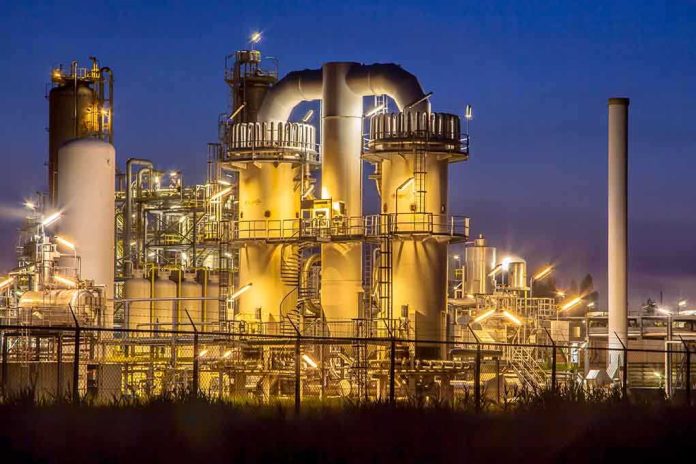
When a refinery the size of Cardón goes dark, the story is bigger than a localized blaze: it exposes how a single failure point inside an aging system can ripple through a nation’s fuel supply and the regional energy balance.
At a Glance
- Venezuela’s 310,000-barrel-per-day Cardón refinery was halted after a fire linked to a gas line serving its diesel hydrotreater.
- Operators evacuated personnel and shut supporting utilities, including boilers, to contain risk and isolate the unit.
- Cardón is the country’s second-largest refinery; outages there can translate quickly into domestic fuel tightness.
- Fires and unplanned shutdowns are recurrent in Venezuela’s refining system, which operates with chronic fragility.
What happened inside the plant
According to detailed wire reporting, a fire ignited on a gas line connected to Cardón’s diesel hydrotreater, triggering a full-plant halt and evacuation procedures as operators cut steam and auxiliary systems to put the facility in a safe state. A diesel hydrotreater removes sulfur and other contaminants by reacting fuel with hydrogen over a catalyst; the associated gas lines carry combustible streams under pressure, so standard practice in a fire is to isolate, depressurize, and shut dependent utilities to prevent escalation. That sequence appears to have unfolded here, with sources describing a halt that encompassed boilers and other sitewide services to ensure the fire could be controlled safely.
Early accounts from regional outlets that echoed the wire service noted that workers were moved out preventively and that the blaze was brought under control. The geography is clear and uncontested: the incident occurred at Cardón, in Falcón state, the second-largest refinery in Venezuela by nameplate capacity at roughly 310,000 barrels per day. Reports did not enumerate injuries or provide a damage tally; what is clear is the operational outcome—production stopped while responders contained and assessed the affected area.
How a hydrotreater fire cascades into a sitewide shutdown
Modern refineries run as tightly coupled ecosystems. Process units exchange heat, hydrogen, steam, power, and intermediate streams continuously; when a safety incident compromises a hydrogen-rich system like a diesel hydrotreater, engineers rapidly drive the entire complex toward a stable idle. Boilers that generate steam for stripping, heating, and instrument air often must be tripped or ramped down to prevent feeding utilities into an unstable situation. Hydrogen plants and reformers may be decoupled. Storage operations pivot to receive off-spec materials or hold intermediates in place. In short, the safe choice is to stop first and sort later—especially in a facility where redundancy is limited by age or past de-bottlenecking choices. The reporting aligns with that playbook: an ignition on a gas line, evacuation, and a full stop across Cardón’s systems while the fire was contained.
This is not unique to Venezuela; any large refinery presented with a credible escalation path—hydrogen, light ends, or sour service—will favor a conservative shutdown. What differs country to country is the speed and reliability of restart, which depends on maintenance discipline, spares availability, and the condition of utilities and instrumentation.
Why Cardón matters more than a single unit
Cardón sits within the Paraguaná Refining Complex, long the backbone of Venezuela’s domestic fuels production. When Cardón halts, the consequences are immediate: diesel and gasoline blending pools tighten, and logistics—already strained by intermittent output—must bridge gaps with inventory drawdowns or imports. Reuters’ prior coverage of PDVSA operations has been blunt on the base rate: fires, power interruptions, and outages are common across the state company’s sites and can impair gasoline and diesel supply for the home market. That background gives this fire more weight than an isolated industrial mishap would carry elsewhere; it lands in a supply system without much slack.
Scale is the other reason. At 310,000 barrels per day of nameplate capacity, Cardón represents a large fraction of what the national system can theoretically process. Even if the hydrotreater itself sustained limited damage, the interdependency of units means crude runs and conversion capacity fall together until utilities are verified, flaring normalizes, and process safety confirms stable conditions. Outages of this size can also influence neighboring markets if Venezuela turns to imports to stabilize domestic supply, as has occurred during past refinery upsets.
The pattern: recurrent incidents in an aging system
The Cardón fire fits a documented pattern rather than standing as an outlier. Over years of reporting and industry analysis, Venezuela’s refining network has been characterized as aging, under-maintained, and frequently operating below capacity. In April of the same year, wire reports detailed another Cardón fire, emphasizing that frequent power failures and fires plague PDVSA’s refineries, which typically run at a fraction of their designed throughput. The operational lesson is straightforward: when the base rate of unplanned events is high, even a localized ignition can force a whole-site response, and recovery timelines lengthen because multiple latent defects surface when systems are stressed.
From a process-safety standpoint, recurring utility instability—voltage sags, steam loss, instrument air fluctuations—can convert routine upsets into fires. Hydrogen service exacerbates this risk because leaks ignite easily and burn with high heat release. Plants with robust preventive maintenance, proactive inspection of hydrogen circuits, and reliable emergency isolation valves can confine such fires to equipment-level events; plants without those advantages tend to see unit- or site-level consequences. The record cited above places PDVSA’s facilities closer to the latter profile.
Separating the fire from sensational “explosion” framing
Some aggregation headlines around the episode favored the word “explosion.” The core, consistent backbone across the strongest reporting, however, is a fire on a gas line connected to the diesel hydrotreater and a full-facility shutdown with evacuations—serious in its own right, but not substantiated as a multi-explosion catastrophe. When evaluating industrial incidents, mechanism matters: a gas-line ignition in hydrogen-rich service can produce a sharp pressure wave and visible flare activity, yet the operational response remains the same—evacuate, isolate, and halt. The wire reports and regional summaries are aligned on those specifics; that is the reliable picture to carry forward.
What to watch next: restart mechanics and supply consequences
Two clocks start when a refinery halts for a fire. The first is process safety: verifying metallurgy and piping, testing relief and isolation valves, confirming that instrumentation is reading truth after heat exposure, and inspecting electrical runs for insulation damage. The second is operations: reheating furnaces, re-establishing hydrogen and steam balances, drying and pressure testing, and bringing units back on stream in the right order. In systems with constrained spares and inspection capacity, that can stretch from days into weeks. Analysts track three signals to gauge duration: visible flaring declines (suggesting stabilization), hydrogen plant restarts (a prerequisite for hydrotreaters), and crude unit reheat rates. Past comparable fires at large refineries elsewhere have required multi-week paths to full rates, even when equipment damage was limited.
For Venezuela’s domestic market, the immediate question is whether inventories and any import options can cover diesel and gasoline demand while Cardón restarts. History suggests that when PDVSA faces concurrent utility issues or staffing constraints, restarts are staged and partial, prioritizing units that most directly feed on-road fuels. That pragmatic triage, while sensible, can still leave the market tight until hydrotreaters and reformers are reliably back in service.
Sources:
zerohedge.com, reuters.com, elnacional.com, albertonews.com, arabnews.com, baike.baidu.com