A single, fast decision by a 20-year-old in a drive-thru line turned a volatile confrontation inside a crowded restaurant into a non-injury outcome—an object lesson in how bystander action, when grounded in clear threat recognition and swift control of the hazard, can stop workplace violence before it becomes a casualty count.
At a Glance
- A 20-year-old customer, identified in reports as Lucas Opperman, entered a Lake Elsinore In-N-Out through the drive-thru window to confront a woman wielding a stick-like weapon inside the lobby.
- Opperman used a metal spatula to maintain distance, executed a quick disarm, and ended the incident without reported injuries.
- Witnesses and video describe the woman striking objects and threatening workers; sheriff’s deputies later took her into custody.
- The episode fits a broader pattern of violence directed at fast-food workers, where threats and assaults are far from rare.
What Happened Inside the Lake Elsinore In-N-Out
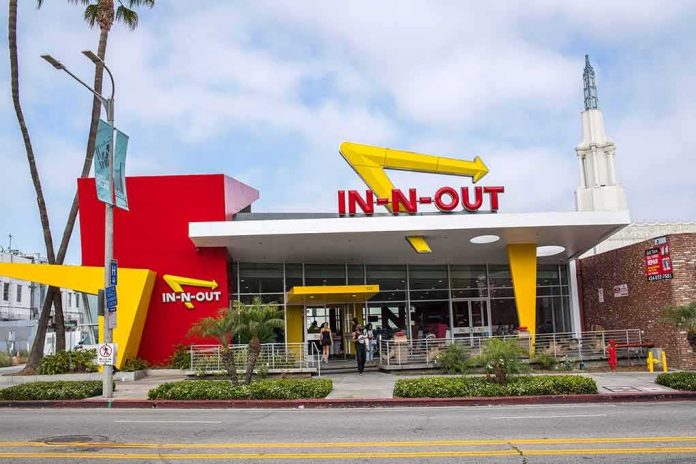
Multiple local outlets recount the same sequence with consistent detail: as cars queued in the drive-thru at the In-N-Out Burger on Dexter Avenue in Lake Elsinore, a woman inside the lobby brandished a long, stick-like implement, described across reports as a sharpened wooden stick, mop handle, or bat-length piece of wood. Opperman—20 years old, a college student and former gymnast and freestyle trampoline athlete—saw the commotion, vaulted feet-first through the drive-thru window, and grabbed a metal spatula from the counter to create separation and leverage for a disarm. He then seized the stick and neutralized the immediate danger before deputies arrived and took the woman into custody.
Opperman later explained his decision with clarity that tracks trained threat assessment: loud, repeated banging, a weapon-like object, and employees directly in its path. “If I didn’t step in right there and then, I knew that somebody would have gotten hurt,” he said in an on-camera interview. He described the object as bat-length with a sharp end and recounted a shoulder-driven snatch of the stick during the brief struggle. No injuries were reported, and video recorded by another customer corroborates the basic physical sequence of the intervention, including his ingress through the window and the confrontation that followed.
Why This Incident Resonates Beyond One Restaurant
This was not an outlier in the sense that matters most to workers: fast-food restaurants are high-friction environments where public access, time pressure, and occasional intoxication or agitation converge. Academic and labor research has documented the prevalence of violent or threatening encounters in quick-service settings for years. A UCLA Labor Center study reported that 37% of fast-food workers had experienced violence—including threats, assaults, and robberies—underscoring that confrontations like the one in Lake Elsinore exist on a broader continuum of risk, not as freak events. Another analysis summarized tens of thousands of violent or threatening incidents across major fast-food chains over a multi-year span, highlighting both the volume and regularity of these events.
Understanding that baseline reframes the In-N-Out episode. The most unusual element here was not the threat itself but the speed and form of the response: a bystander who moved decisively to interpose, controlled the weapon, and ended the hazard window before injury. That sequence—recognize, approach with a tool to keep distance, disarm with a directed movement—mirrors principles taught in bystander intervention and de-escalation frameworks, though to be clear, he acted on instinct and athleticism, not as a trained security officer. The point is not to prescribe emulation but to understand the mechanics of why it worked and where the risks lay.
Mechanics of a Successful Disarm: Distance, Leverage, and Intent
In volatile, confined spaces, three variables govern outcomes: proximity to the weapon, control of the wielder’s dominant arm, and the duration of the hazard window. Opperman’s first move—arming himself with a spatula—seems trivial until you consider function: any rigid object extends reach, directs attention, and can parry strikes without committing one’s hands to a grapple. His second move—the fast, shoulder-led capture of the stick—shifted leverage at the moment of contact, turning a swinging implement into a contested object and robbing it of arc. The third step—separating the weapon from the wielder—compresses the hazard window to near zero. Combine those with the psychological shock of an unexpected entry through a non-door aperture and you have a sequence that favors the intervener, briefly, if executed with speed and conviction.
That same sequence, mishandled, could easily end in laceration or head trauma. This is why, in most workplaces, the orthodox guidance remains: prioritize escape, isolation, and calling law enforcement. Yet incidents do not unfold on whiteboards. The practicality of flight depends on layout, the number of employees and customers present, and the aggressor’s movements. Witness accounts suggest the woman’s stick was already in motion and employees were exposed; within that context, the quick disarm was the shortest path to a no-injury outcome, and that is the outcome the reports describe.
The Role of Video and the Shape of Public Memory
A customer’s video, shot from the drive-thru line, underwrites confidence in the reported sequence. It shows the ingress, the confrontation, and the resolution. Video does not answer every question—motive and antecedent exchanges remain outside the frame—but it anchors the physical story: there was a weapon-like object, it was wielded inside the lobby, and a bystander neutralized it. For the public, that is usually enough to slot the episode into a hero narrative. For workers, it is a reminder of daily exposure to low-probability but high-consequence events that most customers never see. Those realities coexist.
Law enforcement’s arrival and custody of the woman, reported by multiple outlets, provides a second stabilizing fact: this was a real call, not a staged skit or misinterpreted scuffle. While published accounts vary on the precise description of the stick and do not all use the same verbs for the aggressor’s movements, their convergence on location, sequence, and outcome supports a coherent reconstruction: a threatened workplace, an immediate intervention, no injuries, and a subsequent arrest at the scene.
What This Means for Fast-Food Safety and Bystander Action
Two pragmatic lessons emerge. First, employers should design for containment. That means clearer lines of retreat for front-of-house staff, quick-lock partitions that can isolate a lobby from a production line, and training that conditions employees to move rather than argue when a weapon appears. Second, communities benefit from informed bystanderism, not bravado: intervening to create distance, draw attention, or disrupt a weapon’s arc can be lifesaving, but only when a person realistically assesses their ability to act without escalating risk to others. Research on bystander interventions supports the value of practiced responses—training that models options beyond direct confrontation increases prosocial action in the real world.
Opperman’s athleticism and confidence made a difficult maneuver look simple. It is not simple. Most people, most days, should prioritize evacuation and calling for help. But this incident does clarify a narrower truth: when a weapon is already in play and potential victims have no easy exit, seizing the initiative decisively can collapse the danger interval. In Lake Elsinore, it did.
Sources:
thegatewaypundit.com, patch.com, pjmedia.com, nypost.com, www3.huntingtonbeachca.gov, ktla.com, abc7.com