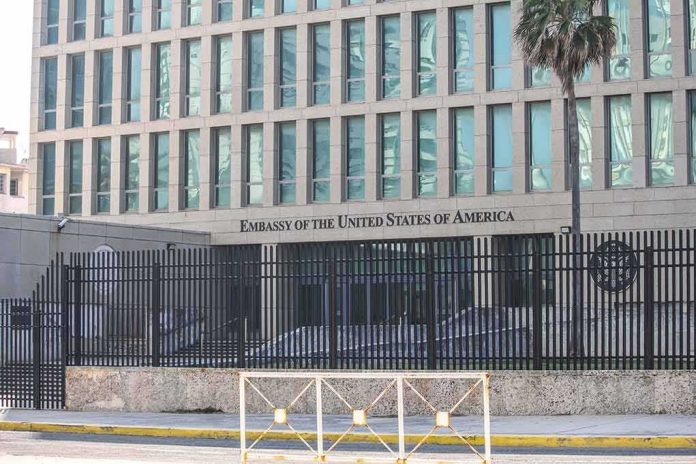
When Washington puts an embassy on “ordered departure,” it isn’t theater; it is the State Department’s risk calculus turning into personnel action—an explicit decision to thin a diplomatic footprint to protect people while keeping the mission’s core functions alive.
At a Glance
- On March 8, 2026, the United States ordered non‑emergency government personnel and eligible family members to leave Saudi Arabia, elevating a prior authorization to a mandatory departure.
- The embassy’s public notice cited recent Houthi attacks on Red Sea shipping as part of the deteriorating security environment.
- A State Department spokesperson confirmed the order’s scope—Saudi Arabia only, and limited to non‑emergency staff and families—after broader media characterizations circulated.
- This is a technical status change, not a shuttering of the mission; essential operations continue while the risk to non‑critical personnel is reduced.
What Washington Ordered—and What It Means
On March 8, 2026, the U.S. Embassy in Saudi Arabia announced that the Department of State had moved from an earlier “authorized departure” to an “ordered departure” for non‑emergency U.S. government employees and U.S. government employee family members, citing safety risks. The embassy’s advisory explicitly referenced recent Houthi attacks targeting vessels in the Red Sea as part of the security picture shaping the decision. In parallel, the State Department spokesperson underscored that the order applied to Saudi Arabia only and covered non‑emergency staff and families—important boundaries that distinguish a focused risk‑management step from a wholesale evacuation.
Within State Department practice, the difference matters. “Authorized departure” permits employees and eligible dependents to leave at government expense; “ordered departure” requires them to do so. Neither label implies the embassy is closing, and both are designed to balance duty of care with the need to maintain diplomatic capability. In this case, the ordered departure draws down the at‑risk cohort while retaining the essential core to conduct daily diplomacy with Riyadh and coordinate security and consular functions.
Why “Ordered Departure” Is Not “Evacuation”
Public shorthand often collapses any reduction in embassy staffing into “evacuation,” but the State Department’s personnel statuses are more precise. Ordered departure is a temporary, risk‑responsive posture that can be scaled up or down. History clarifies the distinction: in Kabul, ordered departure preceded a complex, phased drawdown; it did not instantly empty the compound of all U.S. personnel because specialized teams were still required to execute the wind‑down and security tasks. In Ukraine’s crisis, Washington initially authorized departure for families and non‑essential staff before mandating it later, again keeping a lean operational nucleus in place. The Saudi move follows this lineage—reduce exposure where it yields the greatest safety gain, preserve the minimum cadre to keep the mission functioning.
That context also helps decode headline variance. Some contemporaneous reports gestured at sweeping withdrawals across Gulf posts, or “all staff” leaving Riyadh. The on‑record correction from the State Department narrowed the aperture: non‑emergency staff and families, in Saudi Arabia, only. The embassy’s own advisory—publicly dated and archived—aligns with that narrower scope.
The Security Driver: Houthi Threats and the Red Sea Theater
The immediate catalyst for Washington’s decision was a pattern of Houthi activity that expanded risk for U.S. personnel and dependents. The embassy’s advisory named recent attacks against Red Sea shipping—an operational lane that runs close to Saudi ports and coastal infrastructure—among the factors shaping the threat environment. The maritime picture in mid‑to‑late 2026 featured periodic missile and drone strikes emanating from Houthi‑controlled areas toward commercial vessels, with U.S. maritime security bulletins warning of persistent threat conditions across the Red Sea approaches and Gulf of Aden. It is the convergence of those attacks with the Houthis’ demonstrated reach against Saudi infrastructure—not a single incident—that typically tips the balance in favor of a drawdown of non‑critical presence.
Diplomatic security planning treats such patterns, not headlines, as the unit of analysis: capability, intent, and opportunity. The Houthis have fielded anti‑ship and land‑attack systems with enough range to harass shipping and periodically strike Saudi territory; when that harassment intensifies, travel routes, schools, soft facilities, and family residences are the softest targets. The State Department spokesperson linked the decision directly to such conduct, citing attacks on civilian airports and other critical infrastructure that produced casualties and disruptions, the kind of civilian‑facing risk that drives a two‑step move from authorization to order.
How the Process Works: From Risk Assessment to Movement
Ordered departure is the end of a chain, not the beginning. Posts maintain standing Emergency Action Plans (EAPs) that identify triggers for graduated responses—curfews, movement restrictions, hardening measures, and, ultimately, personnel reductions. When intelligence reporting, incident logs, or host‑nation posture indicate elevated risk to non‑essential personnel and dependents, the Chief of Mission, in consultation with Diplomatic Security and the regional bureau, requests a status change. Washington adjudicates the request, issues a cable that defines categories affected and timelines, and the embassy executes: manifests, travel entitlements, safe‑haven arrangements, and minimal‑staff rosters for essential functions. The public travel advisory—what readers see—is the visible tip of that apparatus, paired with security alerts that guide private U.S. citizens’ decisions.
This mechanics‑first lens explains why an ordered departure can be both urgent and bounded. Family departures remove the highest‑risk cohort quickly; non‑emergency staff reductions reduce the soft target surface area; the remaining essential staff operate under tighter security protocols. If the threat abates, the Department can rescind the order and return to authorized status or normal operations; if it worsens, the mission can further contract without starting from zero.
U.S. Gulf Embassy Evacuations: Iran War and Airline Disruption: U.S. Gulf embassy evacuation plans raise Iran escalation fears as Saudi airport attacks threaten airlines, tourism and… dlvr.it/TW10D4 #AirspaceRestrictions #Gulfairlines #Iran #Qatar | breaking news | pic.twitter.com/nJNJqVnzi2
— eTurboNews | Trends | Travel News (@eTurboNews) October 21, 2026
What to Watch Next: Indicators of Stability or Further Contraction
The most telling indicators are operational, not rhetorical. First, maritime threat trends in the Red Sea and Bab el‑Mandeb—frequency, sophistication, and success rates of Houthi missile and drone strikes—will signal whether the risk calculus is easing or hardening. U.S. maritime security advisories and allied reporting on vessel harassment are reliable barometers of that arc. Second, the tempo of attacks against Saudi civilian infrastructure—especially airports and energy or logistics nodes—maps directly to consular and family‑safety risk. Third, the embassy’s public posture itself is an indicator: additional security alerts, movement restrictions, or a shift to emergency operations would imply sustained pressure; conversely, a downgrade back to authorized or routine status would suggest confidence that the threat has receded to manageable levels.
Sources:
nampa.org, sa.usembassy.gov, trtworld.com, worldisraelnews.com