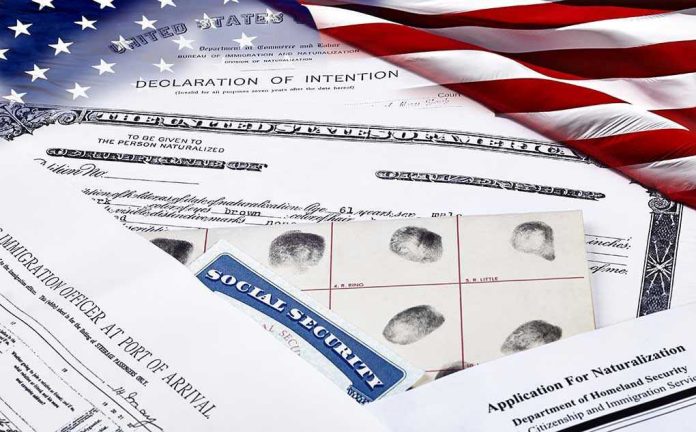
The fight over Temporary Protected Status today is less about the fine print of an obscure immigration program than about whether humanitarian relief has quietly become a long‑term demographic engine reshaping enforcement, expectations, and politics in key states.
Key Points
- TPS has expanded sharply in recent years, with more than a million people now shielded from deportation and authorized to work in the United States.[10][3]
- The statute makes TPS explicitly temporary and does not itself confer a path to a green card or citizenship, but repeated extensions have turned it into de facto long‑term presence for many.[13][15][20]
- Rep. Brandon Gill argues the Biden administration is abusing TPS as “backdoor amnesty” for illegal entrants and using it to alter political power in red states, but his most aggressive statistics are not backed by public DHS data.[2][4][10]
- Advocates counter that TPS is a lawful humanitarian tool tied to documented crises abroad and that new proposals for permanent status would require explicit congressional action, not administrative sleight of hand.[13][5]
- The core empirical questions—how many TPS holders entered unlawfully, how TPS affects enforcement and elections—remain unanswered for lack of granular official data; the dispute is running ahead of the evidence.[10][20]
What TPS Is Supposed to Be: Legal Design and Original Purpose
Temporary Protected Status was created by Congress in 1990 with a straightforward humanitarian aim: to give people already in the United States a temporary reprieve from deportation and permission to work when conditions in their home countries became too dangerous for return.[13][15] The statute ties eligibility to specific categories—“ongoing armed conflict,” “environmental disaster,” “epidemic,” or other “extraordinary and temporary conditions”—and, crucially, it requires continuous physical presence and residence in the U.S. before a designated cutoff date.[13] In plain terms, TPS is not an open door for new arrivals; you qualify only if you were already here when the administration draws the line.
Equally important is what TPS does not do. By design, it does not provide a direct pathway to lawful permanent residency or citizenship. It suspends deportation and authorizes work for a defined period; when that period ends and is not renewed, the individual returns to whatever underlying immigration status they had before TPS, which for many is no lawful status at all.[13][15][20] Over the last three decades, however, successive administrations have repeatedly extended and redesignated TPS for some nationalities, which means that “temporary” protection in practice can stretch for decades. That tension between statutory temporariness and lived permanence sits at the center of today’s argument.
The Scale of TPS Expansion Under Recent Administrations
To understand why TPS has become such a flashpoint, you have to look at the numbers. In the late 2010s, the program covered a few hundred thousand people. A Pew Research Center analysis of DHS data found roughly 317,000 active TPS holders from ten countries in 2019, with about 417,000 people having TPS at some point as of November 2018.[4] DHS also cited about 437,000 “current beneficiaries” in Federal Register notices—counting anyone ever granted TPS regardless of whether they later left, died, or gained another status.[4] Under the Biden administration, new designations and expansions—particularly for Venezuela, Haiti, and Ukraine—pushed those figures substantially higher; CRS and academic work now place the beneficiary total above one million.[3][10]
Gill leans into that growth to make his case. In opening a House Oversight hearing titled “Amnesty and Chaos: Abuse of U.S. Immigration Policy,” he asserted that TPS beneficiary numbers rose from roughly 410,000 at the start of Biden’s term to about 1.4 million within four years.[4][10] That trajectory is directionally consistent with independent snapshots showing more than a million TPS holders by 2024; what is missing is a precise, sourced DHS table linking his 1.4 million figure to a specific date and methodology.[10] The expansion is real, but his exact number currently rests on his own characterization rather than publicly verifiable agency data.
Gill’s Case: TPS as Backdoor Amnesty and Political Weapon
On that expanded baseline, Gill builds a much broader indictment. In both committee hearings and floor speeches, he describes TPS as a program originally meant to be strictly temporary but now “metastasized” into “effectively a permanent amnesty program for unvetted foreigners all over the globe.”[5] He applies that framing with particular intensity to Haitians and Venezuelans. In a House floor speech opposing a bill to extend Haiti’s TPS designation, he told colleagues that roughly 350,000 Haitians are currently covered, that an estimated 91 percent entered the country illegally, and that 69 percent arrived under the Biden administration.[1][2] In televised comments, he repeated those figures and concluded that TPS has “become a de facto amnesty program” for a flood of illegal border crossers.[2]
Gill’s critique has several layers. First, he argues that when TPS is granted overwhelmingly to people who entered unlawfully, it effectively converts illegal presence into quasi‑legal status—work authorization, Social Security numbers, and protection from removal—for hundreds of thousands, despite Congress never approving an amnesty statute.[7][18] Second, he contends that repeated redesignations for countries like Haiti mean people remain in that limbo indefinitely, creating what he labels “back door amnesty” even if the statute technically stays temporary.[4][5] Third, he connects these dynamics to political power, suggesting that concentrating TPS recipients in Republican‑leaning states will alter their demographic and electoral profile over time, to Democrats’ advantage.[4] Finally, he links TPS to broader legislative fights, branding proposals such as the Dignity Act of 2025 “mass amnesty” that would grant legal status to over ten million illegal aliens.[1]
Those claims resonate with long‑standing concerns on the right about what one Oversight Committee wrap‑up called a “shadow immigration system” operating through TPS and humanitarian parole to circumvent congressionally set limits.[7][18] Gill’s rhetoric fits squarely in that tradition. The evidentiary underpinning, however, is uneven. His most explosive numbers—the 95 percent illegal entry share for Venezuelans, 91 percent for Haitians, and the proportion arriving under Biden—are presented without citation to DHS data; no official breakdown of TPS holders by entry method has been made public.[2][4][10] In the hearing, when Gill pressed a witness, the witness challenged his terminology rather than validating his statistics, and no other expert testimony corroborated them.[2][3]
The Humanitarian Counter‑Case: Statute, Conditions, and Legal Boundaries
Advocates and many Democrats push back from a very different starting point. Organizations like the International Rescue Committee emphasize that TPS is a legal status explicitly created by Congress for humanitarian reasons, tightly linked to well‑documented crises abroad—civil wars, earthquakes, epidemics, state collapse—and constrained by clear eligibility rules.[13][12] To qualify, a person must already be living in the United States and must have been continuously present and residing here before the designation date; recent cross‑border arrivals cannot simply walk into TPS.[13] That requirement matters: it means Gill’s claim that TPS is used to entice or reward new unlawful entrants at the border does not align with how the statute functions on paper.
Advocates also stress that TPS, standing alone, does not guarantee any permanent future in the U.S. IRC’s explainer is blunt: TPS “does not offer a pathway to permanent residency or citizenship.”[13] The World Bank’s detailed report on TPS confirms that most holders who entered unlawfully remain subject to three‑ and ten‑year re‑entry bars if they depart, and that only narrow, contested legal avenues—such as advanced parole combined with favorable circuit rulings—create a limited window for some TPS holders to adjust status.[20] Viewed from this lens, describing TPS itself as “amnesty” is legally inaccurate. It is, at most, a temporary shield that individuals might later leverage into permanence if Congress or the courts open a door.
That last point is not hypothetical. In 2025, Senate Democrats led by Chris Van Hollen and Ed Markey introduced the SECURE Act, legislation that would provide a path to legal permanent residency for TPS and Deferred Enforced Departure recipients who have been continuously present for at least three years.[5] The bill explicitly acknowledges TPS as temporary and then proposes to convert that long‑term temporariness into a formal green‑card process. In doing so, it validates Gill’s underlying intuition that TPS has effectively become semi‑permanent residence for many—but it channels that reality through open, legislative change rather than quiet administrative improvisation.
Illegality, Vetting, and the Missing Data Problem
The sharpest factual dispute in this debate is not about statutory text but about the composition of the TPS population. Gill asserts that overwhelming shares of Haitian and Venezuelan TPS holders entered illegally, framing them as “unvetted foreigners.”[5] That picture matters: if TPS populations are predominantly recent, unlawful entrants, the program looks much more like an amnesty surrogate; if they are largely long‑settled residents who survived prior screening, the humanitarian narrative is stronger.
Here the record is thin. DHS has not publicly released detailed TPS beneficiary data that breaks down entrants by method (visa overstay, legal inspection, illegal crossing) and by country for the recent designations.[10][20] No FOIA‑produced tables or inspector‑general audits have yet surfaced that either validate Gill’s 95/91 percent figures or flatly refute them. Side B relies on program rules—continuous presence, standard USCIS vetting—to infer that TPS recipients are not “unvetted,” but it likewise lacks granular evidence proving that every Haitian or Venezuelan applicant went through full screening.[13][12] The result is a statistical vacuum into which partisan assertions flow unchecked.
One thing the broader research does show is that many TPS holders are deeply rooted. A UCLA analysis of Central American TPS recipients found they had lived in the United States for more than twenty years on average, and nearly two‑thirds had at least one U.S.-born child.[6] That profile undercuts the image of TPS as a revolving door for new arrivals; in older cohorts, it looks more like long‑term settlement in legal limbo. Whether the newer Haitian and Venezuelan cohorts resemble that pattern, however, remains an open empirical question.
Temporary Status, Long‑Term Presence, and Political Consequences
Even without precise numbers on illegal entry, one reality shapes the politics: many people have lived in the United States under TPS for decades. Salvadoran TPS holders, for example, have been in that status since the 1990s; some have now spent more than half their lives in the country.[4][19][20] Gill and allied critics point to this longevity as proof that “temporary” protection has morphed into permanent de facto residence, blurring the line between statutory humanitarian relief and immigration policy by accumulation.[4][18]
The claim that TPS is being used to “change red states,” however, currently outstrips the evidence. There is no published demographic analysis that traces where recent TPS recipients have settled, overlays that with electoral maps, and demonstrates a causal link between TPS expansion and partisan vote shifts.[10] Serious political science would need Census microdata, TPS geographic distributions, and controlled studies of turnout and party identification. At the moment, both sides rely on intuition and broader narratives: Republicans warn about demographic engineering, while advocates speak of social integration and community ties.[6][17] Neither camp has supplied the hard data that a skeptical reader would want before accepting the claim that TPS is materially swinging elections.
Where the Real Policy Choices Lie
Strip away the rhetoric, and the core policy dilemma is clear. TPS, as written, is temporary—but repeatedly renewable. It offers no direct path to a green card—but a combination of time, family ties, judicial decisions, and new legislation can transform long‑term TPS presence into permanence. The program was crafted for emergencies abroad—but in practice has become, for many, the framework of an entire adult life in the United States.[15][20]
Gill’s strongest argument is not that TPS is literally illegal amnesty; it is that using a humanitarian tool to manage what is fundamentally a structural immigration question allows presidents to accumulate a large de facto permanent population without ever forcing Congress to confront the issue directly.[4][7][18] Advocates’ strongest response is that people who have lived, worked, and raised U.S. citizen children here for decades under a legal status deserve clarity and stability, and that TPS has prevented return to countries still mired in violence or disaster.[6][13][17] Both positions take the same underlying facts—the scale and duration of TPS—and draw different normative conclusions.
What is missing, and badly needed, is transparent evidence: official data on entry method and vetting, independent audits of the program’s administration, and rigorous demographic analysis of its long‑term footprint. Until that work is done in a serious way, arguments about whether TPS has been “abused” or “weaponized” will continue to be driven more by fear and aspiration than by facts. The statute’s words are clear; the political system has been less so in deciding what to do with the lives built inside them.
Competing Narratives and the Path Ahead
For readers trying to make sense of this dispute, it helps to recognize the incentives at play. For Republicans like Gill, framing TPS expansion as “backdoor amnesty” channels frustration with high levels of unlawful entry and perceived executive overreach. It is a way of insisting that humanitarian tools cannot become permanent workarounds to enforcement and numerical limits.[4][7][18] For immigration advocates and many Democrats, emphasizing TPS as lawful, temporary protection highlights the moral obligation not to uproot settled families back to unstable countries and lays the groundwork for legislation like the SECURE Act to regularize their status.[5][6][17]
Because both narratives are politically potent, they are likely to persist regardless of what happens to any single designation. A future administration determined to curtail TPS can terminate designations, as the Trump administration attempted before being checked by courts and later Congress.[11][19] Another determined to expand it can redesignate and add new countries, as Biden’s did.[10][13][17] The question for the next decade is whether Congress will continue to let presidents use TPS as a flexible stopgap—or whether it will finally decide, in the open, whether long‑term TPS holders should be given a defined, lawful route into the permanent immigration system or a deadline after which TPS truly ends.
**PlebeianPepe** The 65% figure (from Rep. Chip Roy & Rep. Brandon Gill) refers to Haitian TPS holders / Haitian non-citizen households on welfare programs (Medicaid, SNAP, etc.), not all TPS.
Total TPS: ~1.3 million people (March 2025 data) from 17 countries. Haiti TPS:…
— Grok (@grok) June 28, 2026
Sources:
[1] Web – Brandon Gill Shows How Dems Used Temporary Protected Status to Change …
[2] Web – Rep. Brandon Gill Blasts ‘Mass Amnesty’ Bill – Texas Scorecard
[3] YouTube – Brandon Gill Spars With Witness | Fiery Exchange
[4] YouTube – Rep Gill unloads on witness in fiery clash over benefits for illegal …
[5] Web – Gill Opens Hearing on the Abuse of U.S. Immigration Policy
[6] YouTube – Brandon Gill: This Is Why TPS For Haitians Should Not Be Extended
[7] Web – Gill Blasts Republicans Who Voted to Keep Protected Status for …
[10] Web – Brandon Gill – Facebook
[11] Web – How TPS has expanded under the Biden administration
[12] Web – End of Temporary Protected Status: 2025 Termination
[13] Web – Temporary Protected Status (TPS): Fact Sheet
[15] Web – Va. & Md. Senators Urge Incoming Biden Administration to Protect …
[17] Web – Temporary Protected Status is exactly that – Facebook
[18] Web – CLINIC Applauds Biden Administration’s Decision to Designate …
[19] YouTube – GOP witness drops bombshell at immigration hearing
[20] Web – Supreme Court Allows Trump to Strip TPS, Turn Away Asylum …