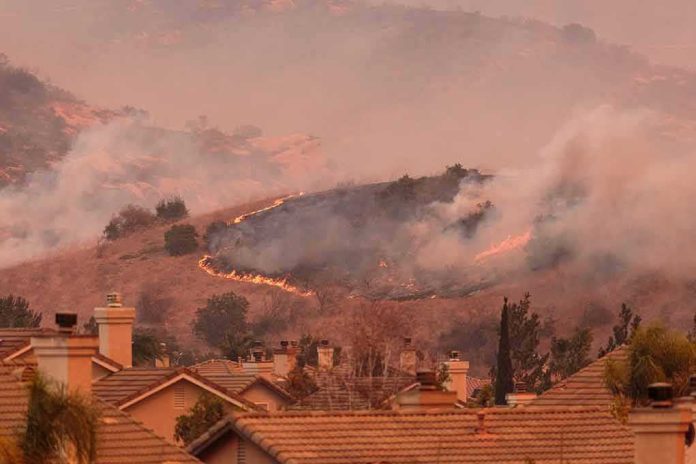
The Cottonwood Fire matters because it is not just large; it exposes how quickly a fire can move from a suppression problem to a property-loss catastrophe when wind, drought, steep terrain, and human ignition intersect.
Key Points
- The fire has been officially classified as human-caused, but investigators are still determining the exact ignition source.
- It has become the largest active wildfire in the United States and has already inflicted historic property loss in Utah.
- Fire behavior has been unusually aggressive, with officials saying it did not act like other fires and was extremely difficult to protect against.
- Even with no reported fatalities, the fire has forced evacuations, closures, and emergency measures, including fireworks restrictions.
Why the Cottonwood Fire Became a Statewide Test of Capacity
Wildfires are often measured in acres, but the more revealing metric is what a fire does to the decision-making window. The Cottonwood Fire compressed that window almost immediately. It moved fast enough, and in conditions severe enough, that officials described protection of homes and resort structures as nearly impossible; that is the language of an incident that has outrun ordinary containment logic rather than merely exceeded a numeric threshold.[13] The fire’s size has also been reported at different moments as more than 70,000 acres, more than 92,000 acres, and nearly 100,000 acres, a spread that reflects the speed of the event and the lag between reporting updates.[1][3][15]
That variability should not obscure the central fact: this is the dominant active fire in the country, and in Utah it has become the state’s most destructive wildfire by property loss.[1][15] The distinction matters because acreage alone can mislead. A fire can burn enormous tracts with relatively little structural loss, or it can hit a compact but developed corridor and produce outsize damage. Cottonwood has done the latter. It has already severely damaged Eagle Point ski resort and burned through cabins, homes, and condos that sat in the path of an exceptionally fast-moving front.[1][13]
Human-Caused Does Not Mean Fully Explained
Authorities have classified the fire as human-caused, but they have not publicly closed the case on the exact ignition source.[1] That distinction is important and often lost in public discussion. “Human-caused” is a broad attribution category: it means the fire began because of human activity, not that investigators have yet pinned down whether the trigger was equipment, a spark, target shooting, debris, or some other act. The ongoing investigation leaves a genuine evidentiary gap in the chain from classification to mechanism.[1]
That gap has fueled speculation, including social media references to target shooting, but speculation is not the same thing as corroborated cause.[6] The strongest reading of the record is straightforward: the fire’s human origin has been officially confirmed, while the exact ignition circumstances remain under investigation.[1] In wildfire reporting, that is not an unusual contradiction. It is the normal sequence of events. A fire is quickly categorized for operational and policy purposes; the forensic work that narrows the actual ignition source comes later, once investigators can trace burn patterns, interview witnesses, and reconstruct the first minutes of the event.
Why the Fire Ran So Hard and So Fast
The immediate drivers of Cottonwood’s behavior were meteorological and topographic. Reports from the field described strong winds, very low humidity, and dry fuels that allowed flames to race with little resistance.[8][13] Wind is the blunt-force multiplier of wildfire behavior: it tilts flames into unburned fuel, accelerates spotting, and can turn a manageable edge into a broad head fire in minutes. In steep country, that effect compounds, because fire moving uphill preheats the slope ahead of it. The result is not just faster spread but a more erratic, less governable fireline.
That is why officials emphasized that the blaze “did not act like other fires” and why aerial resources were at times constrained by conditions.[13] The weather picture surrounding the incident also fits a broader western pattern: red flag warnings, dry thunderstorms, and dangerous fire weather have been widespread across the region.[4][15] This is the modern western fire dilemma in compressed form. Human ignition starts the event, but weather and landscape determine whether it becomes a local burn or a regional emergency.
Historic Loss Without a Death Toll
The most striking feature of the Cottonwood Fire is the coexistence of severe destruction and no reported fatalities.[13] That is not a contradiction; it is a measure of what effective evacuation can still accomplish even when structural defense fails. Emergency crews were credited with getting people out during the initial critical hours, and that early movement likely prevented a tragedy from becoming a mass-casualty event.[13] In wildfire terms, evacuation success can coexist with property failure. The two are related, but they are not the same outcome.
At the same time, the absence of fatalities should not be mistaken for a soft landing. The governor’s description of the fire as the most destructive in Utah history for property loss captures the real damage category here.[15] Homes, cabins, and resort infrastructure carry economic value, but they also anchor communities, seasonal economies, and generational memory. When a resident says a family cabin was “leveled” and that there was “nothing but cinder block foundations left,” the physical scale of loss becomes legible in a way acreage figures never can.[13] That is the human dimension behind the headline number.
Why Utah Responded With Fireworks Restrictions and Emergency Measures
Governor Spencer Cox paired the emergency declaration with fireworks restrictions for the July 4 period, a move meant to reduce the chance that a bad week would become a catastrophic one.[4] That decision fits the logic of wildfire prevention in a dry western state: when fuels are primed and the atmosphere is unstable, small ignition sources become policy problems. Fireworks bans are not symbolic in that setting; they are a practical attempt to reduce the number of human ignition points during the highest-risk stretch of the calendar.
The governor’s action also reflects the reality that Utah was already contending with multiple fires and a dangerous weather pattern. AP reported a rare “Particularly Dangerous Situation” warning and widespread red flag conditions, while other outlets noted at least a dozen new fires in the state over a short period.[4][15] That broader context matters. A single blaze can usually be managed with enough resources and a cooperative wind field. Multiple simultaneous starts, under sustained red flag conditions, are what stress the system and expose the thin edge of incident capacity.
The largest active wildfire in the U.S. has now exploded to more than 92,000 acres in Utah… and it's still 0% contained according to authorities as of Saturday night.
New video shows thick smoke billowing over the Cottonwood Fire as flames continue tearing through Piute pic.twitter.com/bawJAs1ppQ
— Robert C. Byrd (@QPatroit) June 28, 2026
The Larger Lesson in Western Fire Management
Cottonwood is part of a familiar Western wildfire pattern that has become increasingly hard to ignore: the majority of ignitions are human-caused, but the severity of any individual fire is governed by weather, fuels, and exposure. Utah’s own fire officials have repeatedly emphasized how large a share of the state’s fires are human-caused, and the broader wildfire literature shows that human ignition has long dominated fire starts in populated landscapes.[18][15] At the same time, climate change has increased fire weather in the American West, making the atmosphere more conducive to rapid spread.[19]
That is the strategic problem Cottonwood lays bare. Prevention begins with human behavior, but suppression depends on the alignment of crews, aircraft, roads, weather, and terrain. Once a fire is moving under wind and low humidity through steep country, the goal often shifts from full control to triage: protect life, preserve the most defensible assets, and keep the fire from gaining even more momentum. Cottonwood has already shown how expensive that triage can be. It is a case study in why the West’s fire future is increasingly determined not by one factor but by the collision of all of them at once.
Sources:
[1] Web – The largest active wildfire in the U.S. has now exploded to more than …
[3] Web – Cottonwood and Morrill Fires Update – March 22, 2026
[4] Web – CottonwoodFire MIDDAY UPDATE, June 24,2026 The fire is …
[6] Web – Investigations | Cottonwood, AZ
[8] Web – The Cottonwood Fire burned through structures as it exploded in …
[13] Web – ‘It’s End-of-Days-Type Stuff’: Wildfires Rage in Utah’s Mountains
[15] Web – July-August human-caused wildfire comparisons: 159 in 2021 471 …
[18] Web – [PDF] All About Wildfires – Natural History Museum of Utah
[19] Web – More than 75% of Utah’s wildfires are human-caused, which means …