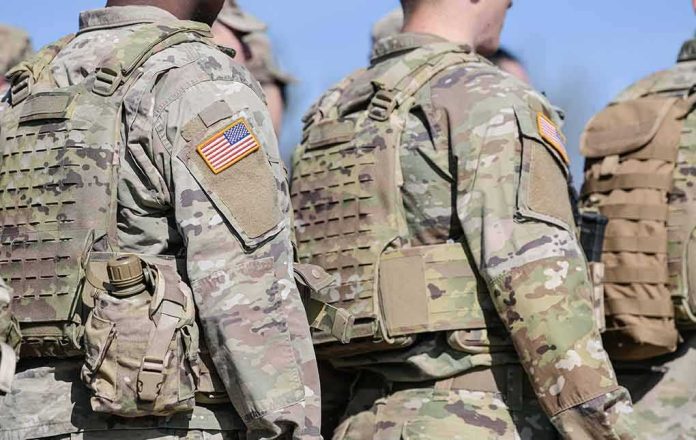
When a suspected terror plot brushes up against an allied bomber base, the line between routine policing and national security hardens fast; that is exactly what happened outside RAF Fairford, where a midnight call, three vans, and five arrests moved a local response into a full counterterrorism operation.
The Short Version
- Police acting on a pre-dawn call intercepted three suspicious vehicles near RAF Fairford and arrested five men.
- Initial Explosives Act arrests were escalated to suspicion of preparing a terrorist act under section 5 of the Terrorism Act.
- Counter Terrorism Policing took charge; a major incident was declared, with evacuations and bomb-disposal teams deployed.
- RAF Fairford’s role supporting US operations against Iran raised the stakes and shaped the security posture at the scene.
What Happened: From a 12:45 a.m. call to terrorism arrests
Gloucestershire Police received a call shortly before 1 a.m. reporting three suspicious vehicles apparently heading toward RAF Fairford. Armed officers intercepted in the Whelford area and arrested five men for suspected offences under the Explosives Act; those men were subsequently further arrested on suspicion of preparing a terrorist act, a serious inchoate offence under section 5 of the Terrorism Act that targets planning and preparatory conduct rather than completed attacks. The escalation was not merely rhetorical. Counter Terrorism Policing assumed primacy, a major incident was declared, cordons were erected, and residents were evacuated as Army explosive ordnance disposal (EOD) teams examined the vehicles and nearby locations.
The picture across outlets is unusually consistent: five men, three vehicles, arrests near the base, explosives suspicion growing into a terrorism probe, and national-counterterror command leading. This convergence matters because it marks the incident as a live terrorism investigation rather than an ambiguous public-order or isolated hazardous-materials stop.
Why RAF Fairford concentrates risk
RAF Fairford is not a typical British airfield. It is a forward base used by the United States Air Force, repeatedly surged for long-range bomber deployments and, as contemporaneous reporting noted, connected to US operations against Iran. The base’s mission profile—hosting strategic bombers, supporting allied strike packages, and enabling transatlantic power projection—makes it a high-payoff target for state actors and violent extremists alike, even if attribution in any single case remains unassigned at the time of arrest. In plain terms, Fairford’s importance compresses reaction time: suspicious movement toward its perimeter compels a muscular response, not a wait-and-see posture.
That posture is exactly what unfolded. Roadblocks and layered cordons created standoff distance while EOD teams applied a measured, method-driven search regime. Evacuations—disruptive for residents but standard in potential explosives scenarios—reflect a calculus rooted in blast physics, vehicle-borne improvised explosive device (VBIED) risk, and the uncertainty band that defines early hours of any explosives-linked callout.
How UK counterterror law and policing architecture engage
The UK’s modern counterterror apparatus is built for speed at the front end and evidentiary rigor across the arc of an investigation. Section 5 of the Terrorism Act 2006 criminalizes the preparation of terrorist acts, a tool designed to let police and prosecutors intervene before the attack phase—when reconnaissance, material acquisition, or operational movement coalesce into imminent threat. It is often paired with Explosives Act powers early on, then refined as forensic and digital evidence are processed.
Operationally, the handoff from a territorial force to Counter Terrorism Policing (CTP) moves the case into a networked command that integrates intelligence exploitation, specialist interview teams, digital forensics, and liaison with MI5. That shift, explicitly reported in this case, is a strong signal: investigators treated the arrests as part of a terrorism problem set, not a standalone criminal explosives offence. Declaring a major incident unlocks multi-agency coordination, logistics, and public safety actions—evacuations, controlled detonations if required, and structured scene management to preserve evidential integrity.
What we know firmly, and what the early stage does not change
Several core facts are firm. Five men were arrested after a specific report of three vehicles heading toward RAF Fairford; explosives-related suspicion drove the initial detentions; terrorism-preparation suspicion followed; counterterrorism command and EOD teams led a large, precautionary operation with evacuations and cordons. The base’s relevance to US operations against Iran is well established in open sources and framed why security around Fairford has been elevated during periods of regional tension.
As is normal in the opening phase, officials did not publish the identities of those detained or itemize any materials recovered from the vehicles; neither did they outline motive or alleged target selection in detail. Those omissions are procedural, not exculpatory: they protect lines of inquiry, control for contamination of witness memory, and, in explosives cases, allow scientific analysis of residues, components, and communications to run its course before public disclosure. A single caveat belongs here and no farther: investigators described the case as early-stage, which simply explains why some specifics were not yet public.
Why a civilian phone call can trigger a national-security surge
One feature of the Fairford incident stands out to seasoned practitioners: the initial cue came from a member of the public reporting suspicious vehicles heading toward a sensitive site. That is neither unusual nor a sign of systemic failure. Much of counterterrorism’s front end is built on precisely this community-to-command pipeline—quickly triaged, cross-checked against local threat context, and actioned by armed response units when the risk profile demands it. When the location is a base that enables allied bomber sorties, the threshold for intervention drops further; the cost of under-reacting dwarfs the cost of temporary disruption.
Once a stop is made, doctrine dictates securing people, vehicles, and surroundings; sweeping for secondary threats; and pushing out a layered cordon. EOD teams then work from the outside in, using remote means first to interrogate potential devices. In parallel, detectives begin the evidential chain—documenting, preserving, and transmitting every item for forensic analysis, from possible explosive precursors to digital devices that can map out coordination and intent. These mechanics rarely make headlines, but they are why early arrests can harden into prosecutable cases.
Implications for allied basing and public security
The Fairford arrests underscore three enduring realities. First, allied assets on British soil will continue to invite attention from both ideologically motivated actors and those animated by geopolitical grievance; basing confers deterrent value, but it also concentrates symbolic targets. Second, community vigilance remains a critical sensor in the wider security architecture; the fastest-growing detection edge is often a citizen who knows what does not fit. Third, the legal scaffold built after the 2000s—especially section 5—was expressly designed for this phase of interdiction: when movement, materials, and proximity to a target converge into reasonable suspicion of a planned act.
In practical terms, expect security rhythms around Fairford—and similar sites such as RAF Lakenheath and Mildenhall when hosting US operations—to flex with the geopolitical temperature. That adaptation looks like more visible patrols, tighter vehicle screening, and quicker thresholds for cordons and evacuations when anomalies appear. It is not theater; it is risk arithmetic informed by base mission, recent threat intelligence, and lessons harvested from incidents where early disruption prevented catastrophe.
Update These arrests will no doubt have caused some shock and anxiety." Temporary Chief Constable Maggie Blyth says residents from around 85 households near RAF Fairford, Gloucestershire, remain unable to return to their homes after five terror arrests were made earlier today. https://t.co/UCcNQFlRq4
— 🇬🇧🇺🇸🇪🇺🇺🇦🇮🇱 Miss Jessica Martina Winfield (@Jessica72351918) September 27, 2026
Bottom line
Five men under arrest, three vehicles intercepted, a base of strategic consequence, and a counterterror machine that moved exactly as designed: the RAF Fairford incident is a case study in how Britain manages potential attacks on allied military infrastructure. The details that remain nonpublic are part of the evidentiary cadence, not a contradiction of the core narrative. The through-line is straightforward and sound: credible suspicion arose, the right authorities took charge, and the community around a sensitive target was protected while specialists did their work.
Sources:
humanevents.com, bbc.com, abcnews.com, standard.co.uk, mirror.co.uk, reuters.com, oxfordmail.co.uk, independent.co.uk