
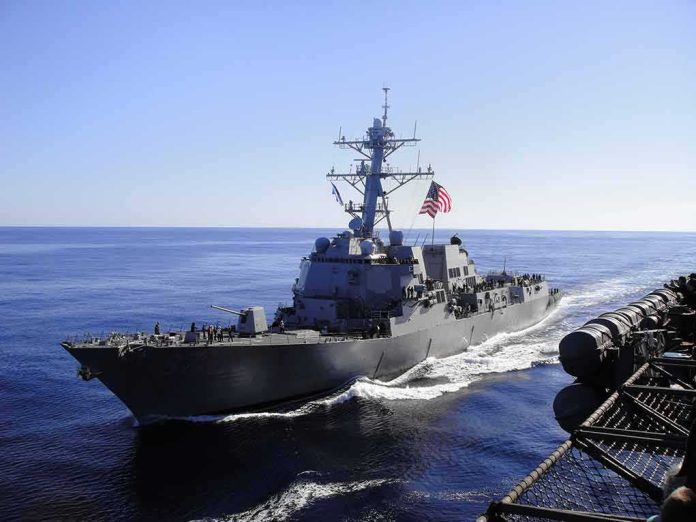
The United States has shifted from boarding drug boats to destroying them at sea—an escalation that rests on classified intelligence, tests unsettled legal theories, and is remaking maritime counterdrug practice faster than public oversight has caught up.
The Short Version
- SOUTHCOM says Joint Task Force Western Hemisphere destroyed a “go-fast” vessel on a known trafficking route in the Caribbean, killing those on board, based on confirmed intelligence.
- This strike is one in a continuing series since 2025 that substitutes lethal force for interdiction and seizure—a historic departure from the Coast Guard-led playbook.
- Mainstream outlets have reported the military disclosed no publicly testable evidence that the struck boat was carrying drugs; rights groups call the campaign extrajudicial killing.
- The core debate is not whether trafficking exists, but whether lethal maritime strikes—without boarding or capture—are lawful, effective, and strategically sound.
What happened and why it matters
U.S. Southern Command announced a lethal kinetic strike on a fast craft operating along established trafficking routes in the Caribbean, attributing the action to Joint Task Force Western Hemisphere and stating that classified intelligence confirmed the vessel’s trafficking role. Independent reporting corroborated the strike’s occurrence and the military’s characterization, while also relaying rights groups’ criticism that such attacks constitute extrajudicial killings. That factual core is uncontested: a U.S. military strike destroyed a suspected drug boat. The consequential question is the template, not the single incident. Beginning in late 2025, the United States has repeatedly opted for stand-off destruction rather than the traditional detect-pursue-board-seize sequence. That is the transformation readers should track.
The stakes are considerable. Lethal maritime strikes compress detection, adjudication, and punishment into a single military action, conducted far from courts and often without publicly shareable evidence beyond a blast video. Proponents argue that cartels adapted to outrun and outmaneuver boardings, and that go-fast boats are disposable links in a billion-dollar supply chain; therefore, disabling or destroying them at distance protects U.S. and partner forces and denies traffickers their logistics node. Critics counter that jumping to lethal force surrenders due process, increases risk to noncombatants at sea, and may rest on legal justifications that have not been publicly vetted.
How this approach departs from the historic maritime model
For decades, the Caribbean “transit zone” mission was built around a layered Coast Guard-led system: long-range surveillance, pursuit by cutters and aircraft, warning shots and disabling fire when necessary, boarding teams, arrests, and seizures. Congressional testimony, Coast Guard doctrine, and GAO reviews documented this choreography in detail—lethal force was tightly cabined to immediate threats, with Airborne Use of Force helicopters and pursuit boats designed to stop, not sink, suspect craft. The dominant idea was presence plus interdiction: build cases, collect intelligence from detainees and cargo, and dismantle networks through law enforcement channels.
The current strike pattern flips the sequence. Instead of compelling compliance and boarding, U.S. forces increasingly neutralize the vessel outright. Analysts across the political spectrum have described this as unprecedented in the modern counterdrug era, precisely because it sidesteps the evidence-gathering that enabled prosecutions and partner-nation cooperation. It is a doctrine of denial and deterrence by firepower, not seizure and prosecution.
The evidence standard and public verification gap
SOUTHCOM’s release asserts “confirmed intelligence” on the vessel’s trafficking role; that is the stated predicate for the strike. However, major outlets have noted that the military has not publicly released corroborating evidence—cargo photos, interdicted contraband, or chain-of-custody material—that would allow independent verification after the fact. The result is a verification gap: the government’s claims are primary and specific, but they are not testable in public, and they terminate the possibility of later proof because the target is destroyed at sea. Skeptical readers are therefore being asked to accept that the intelligence threshold was met without the downstream artifacts law enforcement interdictions typically generate.
That opacity fuels two distinct critiques. The first is legal: if strikes are justified under a framework akin to armed conflict, who are the belligerents, where are the boundaries of the battlespace, and what law governs captured or shipwrecked survivors? Legal scholars at Just Security and elsewhere argue the administration’s claimed authorities remain untested in court and may be incompatible with human rights obligations at sea. The second is empirical: if the campaign’s aim is to reduce drug flow into the United States, publicly available indicators—seizure volumes, street prices, purity trends—have not been publicly tied to demonstrable impact from these kinetic actions; some lawmakers point to DEA assessments that question strategic effect.
The law and the line between interdiction and attack
Maritime law enforcement authorities are robust: the Coast Guard can stop, board, and search vessels subject to U.S. jurisdiction and those of consenting flag states; when suspects flee, warning shots and disabling fire are authorized under strict rules to compel compliance. Lethal force is traditionally limited to defense against imminent threats to life. The current strikes assert a different legal basis. External analyses describe an asserted armed-conflict or self-defense framework that treats trafficker boats as militarized logistics nodes of “narco-terrorists”—a label intended to pull them into the ambit of lethal targeting rules, not policing rules. That theory is vigorously contested by human rights organizations and international law commentators, who argue narcotrafficking, by itself, does not convert civilian vessels into lawful military objectives, and that sinking them absent immediate threat violates both human rights law and the law of the sea. Parallel litigation seeks disclosure of the Justice Department’s internal legal opinion said to justify the campaign, underscoring how unsettled the legal basis remains in public view.
One downstream issue is treatment of survivors. If a strike renders a crew “shipwrecked,” law-of-war and maritime rescue duties may attach regardless of the target’s alleged criminality. Expert analysis has emphasized that even under an armed-conflict theory, shipwrecked persons are protected and must be rescued and treated humanely; lethal force cannot extend to those hors de combat. These are not academic niceties—they are the line between a harsh but lawful operation and a war crime. Clear, consistent post-strike rescue protocols and transparent reporting would go far toward reducing legal risk and moral hazard.
Strategic effectiveness: what success would have to look like
Even if one credits classified intelligence as sufficient predicate, strategy demands measurable outcomes. The classic interdiction model offered concrete metrics: number of boardings, arrests, prosecutions, intelligence leads, interdicted tonnage. A strike-led model must answer a different test: do destroyed hulls translate into sustained supply-chain disruption borne out in price, purity, or mortality trends in North American markets? Public briefings to date have emphasized counts of vessels destroyed and people killed, but counts-of-losses are at best proximate measures; cartels can replenish boats and crews quickly. A compelling demonstration of effectiveness would map kinetic actions to interdiction intelligence, follow-on network seizures ashore, and persistent reductions in throughput along specific maritime corridors. Absent that, the campaign risks becoming performative violence—spectacular video with limited strategic yield.
Governing a lethal tool that is not going away
Given the operational attractions—stand-off safety, speed, and deniability—this tool will likely persist. The question for policymakers is governance. Three reforms would make the practice more defensible. First, publish a summary legal framework, redacted as necessary, that states the authorities, targeting criteria, and geographic scope; ongoing litigation to surface an OLC opinion suggests demand for precisely this clarity. Second, institute a rigorous after-action transparency regime: for each strike, release declassified, non-operational details sufficient to enable congressional and allied oversight—flag state status, tracking synopsis, corroborating intelligence categories, and rescue outcomes. Third, pair strikes with law enforcement exploitation—task Coast Guard and partner services to surge along disrupted nodes, convert tactical effects into arrests and seizures, and report compound impact through shared indicators with DEA and allies.
None of this denies the reality that traffickers exploit the sea’s vastness and that go-fast boats are built to outrun conventional interdiction. It does insist that in a democracy, lethal maritime force cannot live indefinitely on trust-me intelligence and dramatic footage. If the United States is going to normalize sinking civilian craft on suspicion of narcotrafficking, it owes the public and its partners a clear legal theory, disciplined safeguards, and persuasive evidence that the strategy does more than make waves.
#Trump flexing his military might. He can't control Iran's military; he turns his might on rowboats in the #Caribbean. The latest U.S. strike killed four people the military said were involved in drug trafficking. The military has not publicly provided evidence. pic.twitter.com/DfOM9VnZDp
— Trump Watch & Dem Voices 🏛️ (@TrumpTrackerHQ) September 20, 2026
Bottom line
The military’s core factual claim stands: a U.S. joint task force destroyed a suspected trafficking vessel in the Caribbean based on intelligence it deems confirmed. The strategic and legal case remains contested, and for good reason. The burden now is to align this new practice with law, oversight, and outcomes—or to reconsider whether a counterdrug mission built on sinking boats is the right instrument for a problem that has always been more network than vessel.
Sources:
facebook.com, southcom.mil, reuters.com, upi.com, foxnews.com, breitbart.com, islamtimes.com, washingtonexaminer.com, theepochtimes.com, defconlevel.com